


The first dark line disappeared when Samrawit changed the light.
She held the polished section beneath the microscope and turned the illumination through a shallow angle. The line returned, too straight, crossing features it should have followed. A preparation scratch. She rejected the image, released the specimen clamp, and entered the reason beside it.
One useful-looking photograph could consume the rest of their investigation if she let it.
Beyond the lab’s closed door, Article Four remained captured in Slip Two. Three mixed transitions held shallow cracks beneath whole-looking surfaces. No new load would go through the flight barrel. The retained coupon archive had to answer what it could without borrowing more damage from the structure they needed to save.
Samrawit secured her boots at the preparation station. Ventilation drew against the enclosed work chamber. She checked its seals before starting the captive polishing head.
Two parent plates. One mixed joint. The same preparation, or no comparison worth carrying to Wanjiku.
The archive tray locked beneath the station rail. Each cut retained its local identity and orientation through a linked section sketch. She checked both upstream certificate hashes against the specimen record. Their contents were unavailable; the links were not.
She took a section from each retained plate population and another across the mixed coupon’s weld and adjoining material. The remaining portions returned to their separate captive cells. Today’s cuts could not erase tomorrow’s opportunity to ask a different question.
The preparation head hummed through the reduced-power allocation. Abrasive, rinse, polish. She kept the sequence and examination conditions matched, preserving the original surface orientation in the record. The scratch cost her another pass.
Her assay comparison waited beside the microscope.
Both populations still belonged within the same stated chemistry band. The repeated results supplied no contamination pattern that followed the damaged side. She checked the retained assay references before moving the chemistry window aside, not closing it.
The answer she wanted would have been a wrong element in a convenient column. Something she could name, isolate, and stop admitting.
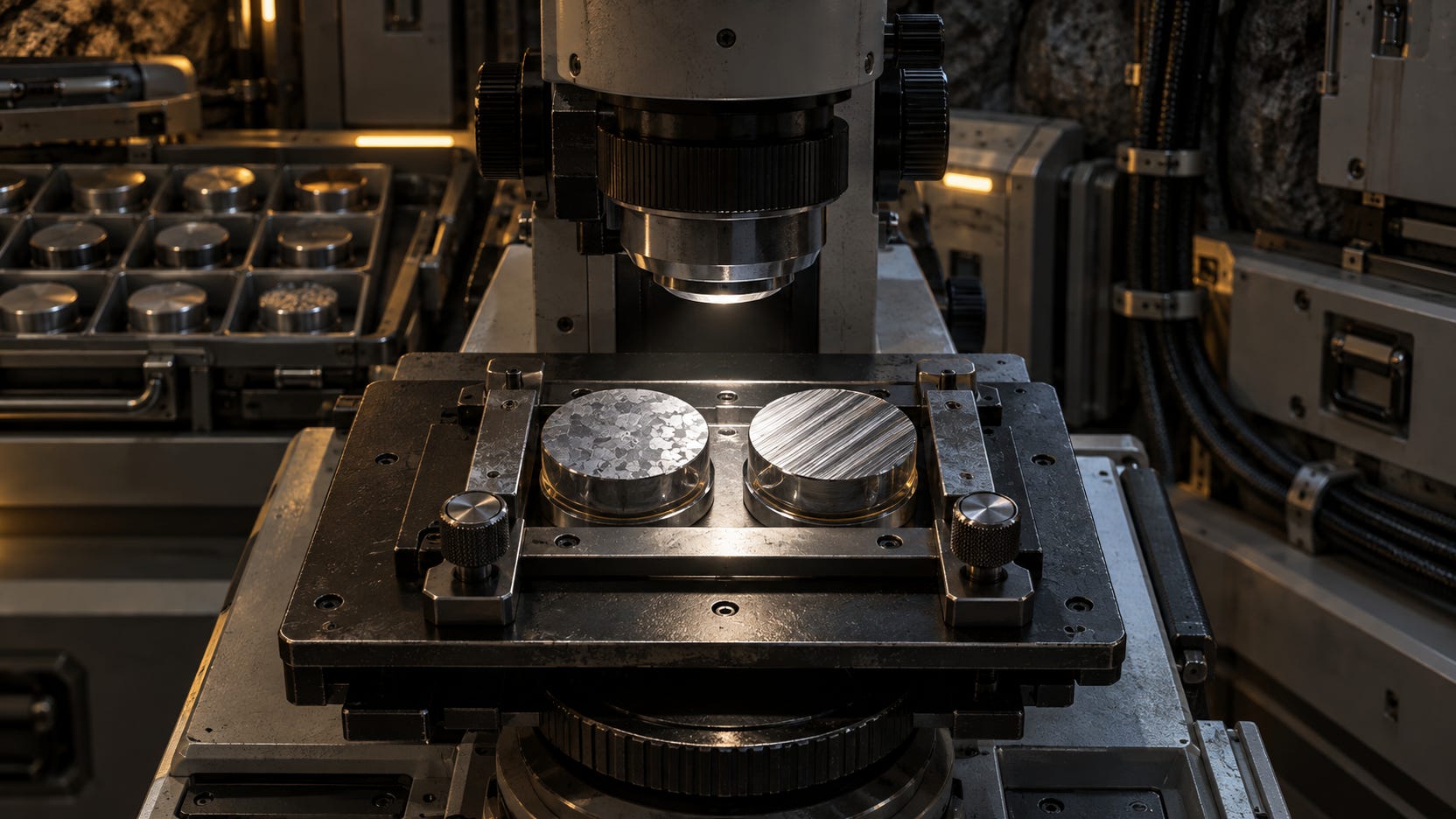
Instead, the two clean faces returned the lamp as similar silver circles.
She etched them under the same controlled conditions. Their exposed structures ceased to look alike.
One field held a more uniform arrangement. The other carried a preferred direction through the plate, an elongated grain pattern that survived beyond the small patch beneath the lens.
She moved to a neighboring field, then another. The direction remained. Rotating the specimen changed its place on the screen without changing its relationship to the section sketch.
Not the scratch.
Samrawit saved the images with their preparation records and checked the first population again. A structure consistent with normalized plate. Beside it, a structure consistent with directional working and a controlled cooling history.
Consistent with. The phrase stayed in the caption.
Wanjiku arrived carrying the defect overlays in a closed packet. She clipped it beside the microscope station before fitting her boots into the adjoining restraint.
“Can I put a material name on the test definition?”
Samrawit brought up both fields at the same scale.
“Two different histories. I can’t give you the exact cycles.”
Wanjiku studied the elongated pattern.
“Worked?”
“Strongly directional. Accelerated cooling is consistent with the combination. Several processing routes can leave similar evidence. The certificate needs to distinguish them.”
“It didn’t.”
“The local summary didn’t. We still need the upstream answer.”
She replaced the parent-plate fields with the mixed coupon section. The weld occupied its middle; the surrounding bands recorded heat that had changed material without melting it.
Across the more uniform side, the change was comparatively gradual. On the directional side, the altered band pressed sharply against the parent structure.
Wanjiku opened the retained orientation map. The directional population occupied the side where Article Four’s indications clustered.
Samrawit did not let the agreement finish the argument. She shifted the specimen to repeat the image away from the first field. The same contrast returned.
“I need the hardness traverse,” she said.
Wanjiku secured the overlay packet again and waited.
The indenter made a measured row of small impressions across parent plate, altered zone, weld, and the opposite side. Samrawit checked the reference response, spacing, and surface before accepting the readings. A repeat row lay beside the first rather than through its marks.
The directional side showed the sharper change. Local softening occupied the band altered by the shared treatment. The other side did not answer it with a matching depression.
Samrawit tightened her fingers around the station handhold. The pattern had shape now. She could follow it from the receiving rows to a coupon, then to three mapped transitions in the barrel.
It still did not contain a furnace record.
“That tells us toughness?” Wanjiku asked.
“Not directly. Hardness isn’t a fracture test. It supports a changed local condition. The damage map and treatment record make reduced toughness a likely explanation.”
She placed that limitation beside the traverse before Wanjiku could carry the image away without it.
Cho joined them at the rail with the mock-up allowance open on his slate. The curved test definition occupied most of its view.
“Do I need different stock?”
“You need to preserve these two identities,” Samrawit said. “Not replace them with another piece under the same category.”
He held the slate between them. “I need a disposition that isn’t only what we don’t know.”
The demand was fair. His allowance would spend material and power the yard could not retrieve by revising a caption.
She brought the chemistry comparison back beside the micrographs.
“This isn’t counterfeit stock or a gross chemistry error. There’s no contamination pattern explaining the damaged side. Nothing here requires Vethrak material. These are human structural steels with different processing histories.”
“Bad plate?”
“Not established. A plate can be usable under its own qualified procedure and wrong under the treatment applied to its neighbor.”
She opened the shared thermal record. The cycle had been performed. Its completion did not prove it was suitable for both populations.
In the finding field she entered reduced local heat-affected-zone toughness after shared high-heat treatment as the likely issue. Beneath it she retained exact upstream process and qualification status unverified.
Cho read both lines.
“The second one stays on the first page?”
“Beside the first one.”
He acknowledged the finding without changing the stock to rejected. Wanjiku kept structural release withheld.
Samrawit returned to the test definition. A useful uncertainty had to risk being wrong somewhere they could examine it.
“With the retained pair, matched direction, restraint, sequence, and treatment, I expect the mock-up to reproduce emissions during unloading. The before-and-after ultrasound should show measurable growth on the worked-plate side.”
Wanjiku checked the specified examination positions.
“If it doesn’t?”
“We retain that result and revisit this explanation. We don’t change the specimen afterward and call the changed test confirmation.”
The prediction went into the record before any test could supply its answer. No actuator authorization accompanied it. The flight barrel stayed untouched.
Cho secured his slate and pushed away along the rail. Wanjiku took the linked finding back to the inspection station, leaving the microscope’s narrow pool of light to Samrawit.
She reopened the rejected scratch image and checked that its rejection remained visible. Then she saved the accepted fields beside it, with both material links, the hardness traverses, and the question the missing certificates still had to answer.
At receiving, the plates had offered the same gray face to the same lamp. Beneath the microscope, light traveled through the optics and returned from their polished cross-sections. One held a quiet, even pattern. The other carried a direction no blind category had managed to erase.
Author’s note: This story continues the Site Anvil arc in late Year 3, within the same bounded dark-state investigation. Samrawit Assefa examines retained specimens while Article Four remains on structural hold.
New to The Vethrak Requiem? Start with The Exodus Rush, Book 1, where humanity fights for survival after an alien invasion using technology it barely understands. These short stories explore the wider universe; the novel begins the main story.