


The phrase reached its fourth repetition before it stopped being information.
Union-linked terminal. The station feed ran it beneath a still image of Scrubber Bank C, gray on the environmental schematic, above a scroll line that named no person and implicated everyone. Mateusz Zieliński hooked a boot under the corridor strip and read the scroll to its end. Association had a grammar. First the terminal was union-linked. Then the command was union-linked. By the fourth pass the outage itself belonged to the union, carried there by repetition, moved from a circuit to a people while nobody added a single fact.
He had entered strategic threat in his own report six days earlier. The feed offered to promote the words. A crew that would foul the station’s own air matched the assessment he had carried down the approach shuttle, and every reflex he brought to Ceres leaned toward accepting the match.
He held the offer at arm’s length. The reflex was old. The distrust was new, and it traced back to a welded plate and a clear sleeve of recovery tags he had straightened in front of a woman who asked him for nothing.
The joint incident briefing convened in a bolted alcove off operations control. No spin floor. Both delegations clipped to opposing rails.
The operations security manager presented from a wall slate, and the summary on it was the one already running on the feed.
“Isolation command at 0413,” he said. “Credentials belonging to a Spacers Union pressure crew. Terminal seven, west habitat spur. The valves sequenced in order. A trained hand, not a fault.”
“A trained hand on a union badge,” Mateusz said.
“The credentials are union. I am precise about that.”
Precise. The summary had been precise yesterday in the same flat grammar, on the director’s desk before it reached the feed. It proved which credentials opened the valves. It stopped there and let the listener travel the remaining distance alone.
Mateusz requested the checkpoint log.
Kavita Nair sent it before the manager answered. She sent the unedited checkpoint video with it, both channels, to every slate in the alcove.
“The feed named the technician an hour ago,” she said. “Not the credential. The man. His partner has taken three calls already, and no charge exists to answer.” Her voice stayed level. “Set the command time against the line record. I am not asking you to trust me. I am asking you to check the clock.”
He opened the two records the way he opened a fabrication clock beside a transport clock.
The command carried a time. 0413:22. The credentials belonged to a pressure-crew technician on the west habitat emergency roster. He pulled the access-spine video and ran it to the same minute.
The technician stood on the line.
Boots locked to the floor grid at checkpoint four. One hand on the rail. A carbon-dioxide trap clipped at the hip. The video timestamp ran continuous through 0411, 0413, 0415. The technician shifted once to let a stabilization crew pass and settled back onto the same anchor. Terminal seven sat four hundred meters and two pressure doors away, on a spur the line did not reach.
A badge had opened the valves at 0413:22. The person that badge belonged to had both boots on a floor grid on the far side of the station, on camera, the entire time.
Mateusz went to walk the distance himself.
The west habitat spur ran narrow and low-lit past the environmental galleries. He kept one hand ahead of him on the rail and let the pulls carry him, his case tight to his hip. Two pressure doors cycled him through on slow pneumatic seals. Fine dust hung across the work lights and drifted only where his passage stirred it.
Terminal seven sat dark under a supervisor lock. A union pressure crew waited at the gallery mouth beside it, three technicians clipped to the rail with intake filters racked and ready, held there for an escort that had not arrived. The scrubber faces behind the mesh carried a gray load he could measure from the rail.
Four hundred meters. Two doors. He had covered it at a careful pace in something over four minutes. The command had taken one line in a log.
Back in the alcove, Mateusz laid the two timestamps on the wall slate so the room shared one frame.
“The credential holder was anchored on the line during the command window. Four hundred meters and two doors from the terminal.”
The security manager did not move. “Credentials can be shared. A badge lends. A crew that plans an incident does not trigger it standing in front of a camera. The absence places the holder, not the credential.”
The reframe was clean. It turned an alibi into tradecraft and kept the union inside the frame from either side. Present at the terminal, guilty. Absent from it, guilty of lending. The story had learned to survive its own contradiction.
“Then show me the controller history,” Mateusz said. “Not the credential trace. The system log. Which account held privileged access to the environmental controller at 0413, and what authority let the isolation route without a supervisor concurrence.”
“The controller history is operational security. Restricted while the inquiry is open.”
“A scrubber bank is operational security,” Mateusz said. “That inquiry reached the station feed inside a day.”
“I cannot release a system log to a Fleet Construction liaison.”
Mateusz recorded the refusal with its time and the authority it cited. He had spent five days pulling hard stops apart from reporting milestones. A refusal that rested on nothing but its own classification belonged in a column of its own.
Dr. Ayanda Molefe came in from the medical spur, hand over hand along the ceiling rail.
“While the inquiry runs, the restriction runs,” she said. “Terminal seven is locked. The crew that cleans the scrubber intakes needs a supervisor escort to reach them, and supervisors are thin during a strike this office is treating as a crime scene. A routine filter inspection on Bank D missed its window last shift. One shift, so far.”
“Bank D carried the station for eleven minutes two nights ago,” Mateusz said.
“Bank D is carrying the station now.” She left the figure in the air the way she left a value in a chart. “Redundancy that cannot be inspected is a drawing. I am saying it in the room before it becomes a document.”
The restriction had been signed to contain a sabotage the log could not prove. The containment was spending the reserve the station would need if the outage ever came back. Mateusz set the refusal beside the missed inspection and found them facing the same direction.
The alcove emptied to its two delegations and then to none.
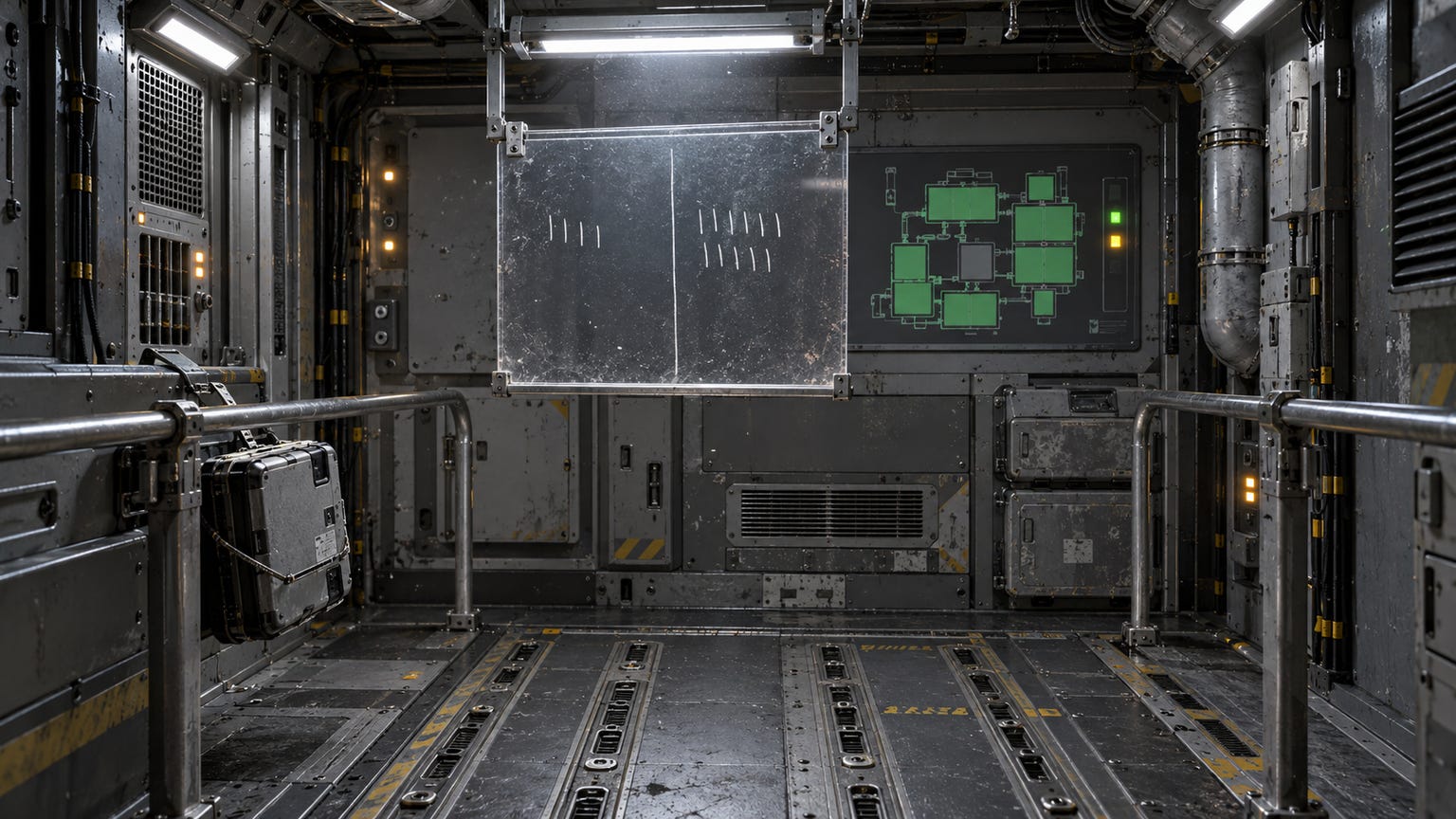
Mateusz stayed clipped to the rail and drew a clear maintenance panel down from its bracket, the kind used to sketch a rig plan in grease pencil. He ruled a line down its center.
On the left he entered what the log proved. A command isolated Bank C at 0413:22. The command carried a union pressure crew’s credentials. The holder of those credentials stood anchored on the access spine at that minute, four hundred meters and two doors from the terminal. Bank D absorbed full flow above its inspected margin. A filter window had passed unworked.
On the right he entered what he had been told it proved. Sabotage. A union that would foul its own air. A crime that justified locking out the crews who kept that air clean.
The left column was shorter. It was also the only one with a timestamp fixed to every line.
He photographed the panel, filed it under the incident reference, and entered his second written request for the controller history. The refusal would return. He dated a space for it in the right column and left the space open, the way he left a red block honestly red, until a log with real authority arrived to fill the gap the credential trace had been cut to cover.
If you enjoyed this story, you can follow the main story arc in The Exodus Rush, the first book in The Vethrak Requiem series.