


The laundry recycler had been running for fourteen hours. Tevita Tuipulotu had been standing in front of it for ten.
The machine occupied most of the small processing room off Corridor Three, a cylinder of salvaged stainless steel and re-welded pipe humming at a frequency a human ear could not quite hear. His shift was twelve hours. He had done the same shift every third day for four years. The recycler took in the colony’s soiled fabric, twelve hundred kilos every cycle, and gave back eleven hundred kilos of clean. The missing hundred kilos was water and protein and the fine particulate dust of eighteen thousand people living inside an asteroid. The numbers did not change. Tevita had written them down every shift for four years. The numbers were the one thing in the colony that had not gotten smaller.
A red light flickered on the control panel. He tapped the intake sensor with the flat of his hand. The light steadied. The recycler resumed its inaudible hum.
The shift passed. The clock on the wall passed 1800. Tevita logged the final cycle count, signed his initials on the duty tablet, and walked to the mess.
The mess occupied half of Corridor Five and smelled of protein synthesis and the sharp brine of the supplement solution the colony’s nutritionist added to every meal. The tables were narrow metal slabs bolted to the deck. The chairs were bolted too. Everything in Sanctuary was bolted down because the asteroid’s spin gravity was not quite Earth-stable and things had a tendency to wander during the quarterly resonance events that nobody fully understood.
The serving line moved fast. It had to. The colony ran on twelve-minute meal windows for the day shift and fifteen for the night.
Tevita took his tray. The protein block on the left side of the compartment was smaller than it had been the day before. The difference was there. He had been expecting it. The council had announced the ration cut six weeks ago. It had started this morning. He had known it was coming. Everyone had known. The math was not secret.
He took his tray to the end of the third table. Three other recycler techs sat at the near end, already halfway through their blocks.
“Two weeks,” Pita said, not looking up from his tray. Pita worked the water reclamation shift and talked in sentence fragments. “Two ration weeks. Already feels like one.”
“Feels like the same block to me,” said the woman across from him. Mele. She had been born on Sanctuary the same year as Tevita. She worked the waste processing shift and had never complained about it once. “Ten grams lighter. Same taste.”
“The taste is not the point,” Pita said.
“The point is She is still broadcasting,” Mele said.
The table went quiet. The table always went quiet when someone mentioned the broadcast.
Sarah Vance’s signal had been going out since before any of them were born. Every morning, the same frequency, the same words. Seventeen thousand souls. We are still here. Please. We are still here. Tevita had first listened to it at eight years old, standing in the residential corridor outside his family’s quarters, the colony’s PA system carrying Sarah’s voice through the rock the way it carried everything. The signal had come through every morning since.
“She has been broadcasting since I was eleven,” Pita said.
“Maybe she is right,” Mele said.
“Maybe,” Pita said. “She has to be right. That is her job. That is not the same thing as being right.”
Mele did not answer. Pita did not push. Tevita did not join. The conversation followed the same shape it always followed, the three of them orbiting the broadcast the way the recyclers orbited the water tables, everything connected and nothing resolved.
He finished his block. He drank the cup of supplement fluid that came with the meal. He put his tray on the return rack.
The smaller portion had not crushed him. He had known nothing else. A person born in the colony had never seen a meal that was not precisely measured. The ration cut was smaller than yesterday, and yesterday had been smaller than the year before, and the year before had been smaller than the year before that, and the line on the chart eventually arrived at a number that did not support life. Tevita had done the math. Everyone had done the math. Nobody talked about it except in the shape of conversations about someone else’s broadcast.
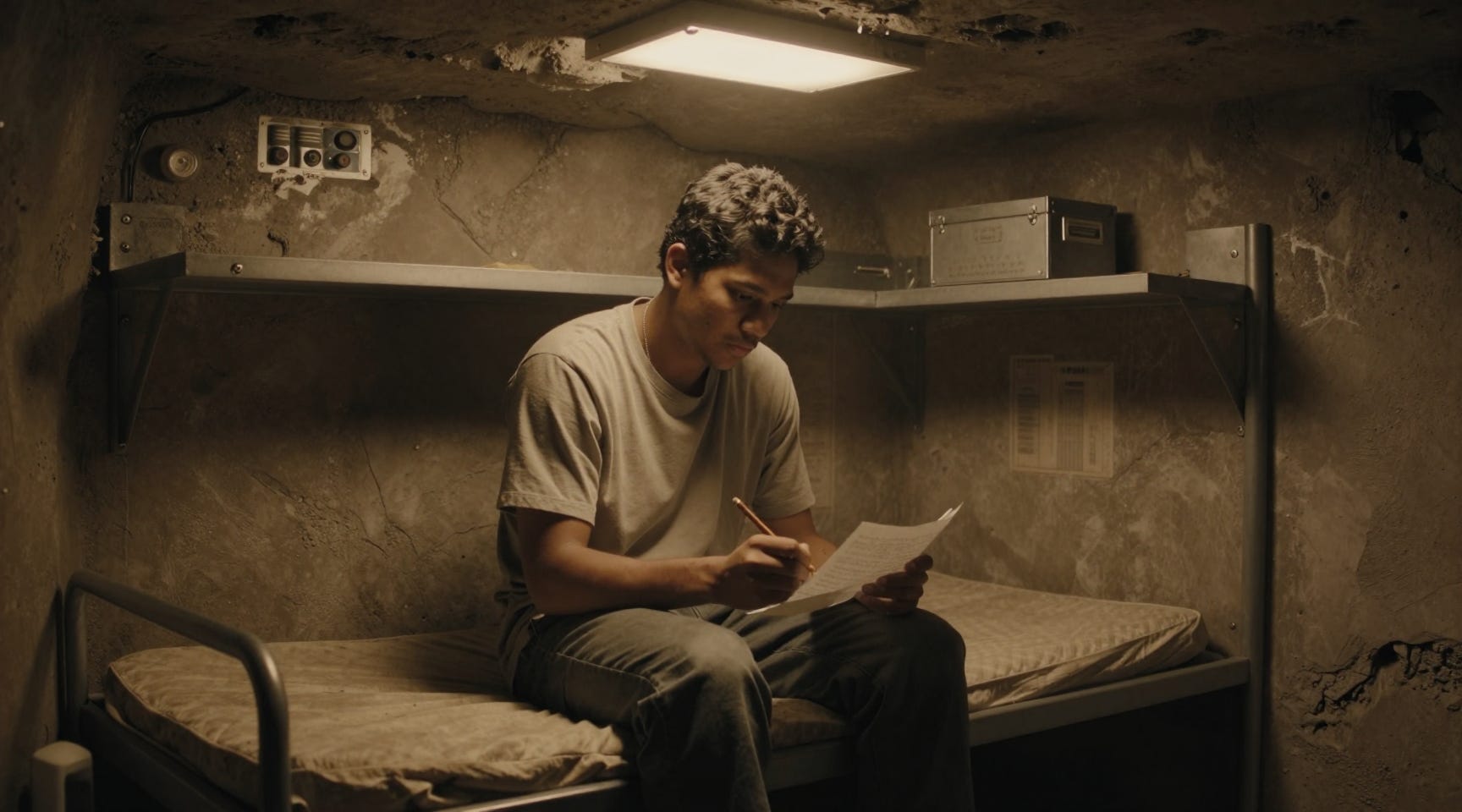
His bunk was in the residential block off Corridor Eight, a space of one hundred forty cubic meters he shared with two other recycler techs who worked the opposite shift. They were not there. The bunk was quiet. The ambient hum of the asteroid’s life support ran through the rock at a frequency slightly lower than the recycler’s.
Tevita sat on the edge of his bunk. The mattress was thin. The pillow was recycled foam that had lost its loft five years ago.
He opened the small box on the shelf above his bunk. The box was an old component casing from a water filtration unit, stamped with a serial number that predated the colony. Inside: four folded pieces of paper. Salvaged paper was precious. The colony’s last paper recycler had failed in Year 9, and the replacement parts had never arrived because no parts ever arrived. Tevita had traded three shifts of overtime for the four sheets, back when overtime was still a thing you could trade.
He took out the fourth sheet. Unfolded it. It was blank. He took the salvaged pencil from the shelf and wrote.
Sela.
I do not know if I will send this. I have not sent the others. You know that. You probably know about the drawer.
He stopped. He looked at the words. He had written the same opening on the other three letters. The words had not gotten easier.
The ration cut came today. It is not bad. It is not enough to make anyone panic. That is the thing about ration cuts. They happen in increments. By the time they matter, you do not notice.
Your mother was in the mess yesterday. She looked tired. Everyone looks tired. Administrator Vance looked the same as she always looks, which is tired in a way that keeps going.
I think about you during the shift. The recycler is loud. It is not loud enough to stop me thinking.
He stopped again. The pencil was a centimeter shorter than it had been when he started. He had been sharpening it with the blade on his duty knife for two years.
If no one comes, I do not know what happens. I think you know. Everyone knows. The broadcast is still going out. I hear it every morning. I do not know if I believe it. I think maybe believing is not the point. The point is that she does it anyway. If she can do it anyway, I can write letters I will not send. That is not the same thing. It is close enough.
I would have wanted you to know this. Not anything dramatic. Just that I thought about you when I was standing at the recycler, and the thought made the shift shorter.
Tevita.
He folded the letter. He did not read it again. He put it in the box with the other three. The box went back on the shelf.
The letters were from three other bad weeks. The first one from Year 9, when the water reclamation had failed for three days and everyone had been on quarter rations and the fear in the corridors had been a thing you could taste. The second from Year 10, after the councilor named Jensen had died of a heart attack and the whole colony had held its breath to see whether the leadership would hold. The third from six months ago, when the supply inventory had crossed a threshold and Sarah had called the council.
The letters were not goodbyes. They were a small private record of the weeks when a young man who had never seen a sky had needed to tell a girl that he was thinking about her.
He lay back on the bunk. The lights dimmed on the colony’s night cycle. The asteroid’s ambient hum settled into his bones. The laundry shift would start again in eight hours. The recycler would take in the soiled fabric and give back clean. The numbers would not change. Sarah Vance would open the comms bay at oh-six-hundred and send the same words into the same silence.
Sixty-two days. That was how long it would take the UENS Hope to cross the distance between the Kuiper Belt patrol route and Sanctuary’s position. Tevita did not know that. The colony did not know. The broadcast was still going out. The silence was still coming back.
He closed his eyes. The asteroid hummed. The shift waited.