


The final ballot field waited on Lena’s cuff while she kept both boots locked to the cargo-bay grid.
Workers filled the bay in layers. Some locked boots to the deck. Others clipped to wall rails or hung from overhead cargo webbing where nickel pallets had ridden before the strike. Empty extraction cars waited beyond the pressure-rated cargo portals, sealed from the access spine by doors built to hold station atmosphere against vacuum. On Strike Day One, those cars had waited in the same place.
Kavita Nair read the terms in order one final time. An independent authority outside the Helios production chain. Immediate protected stop-work power over the operation a documented imminent hazard reached. Maintenance time production could not take without written safety concurrence and a replacement window. Rescue staffing and checked equipment tied to active tunnels on each shift. Fatality and serious-injury records that kept originals, revisions, authorship, timestamps, and dissent. Independent inspectors with unedited access and authority to suspend affected work until the inspector or an independent qualified reviewer verified the written corrective conditions.
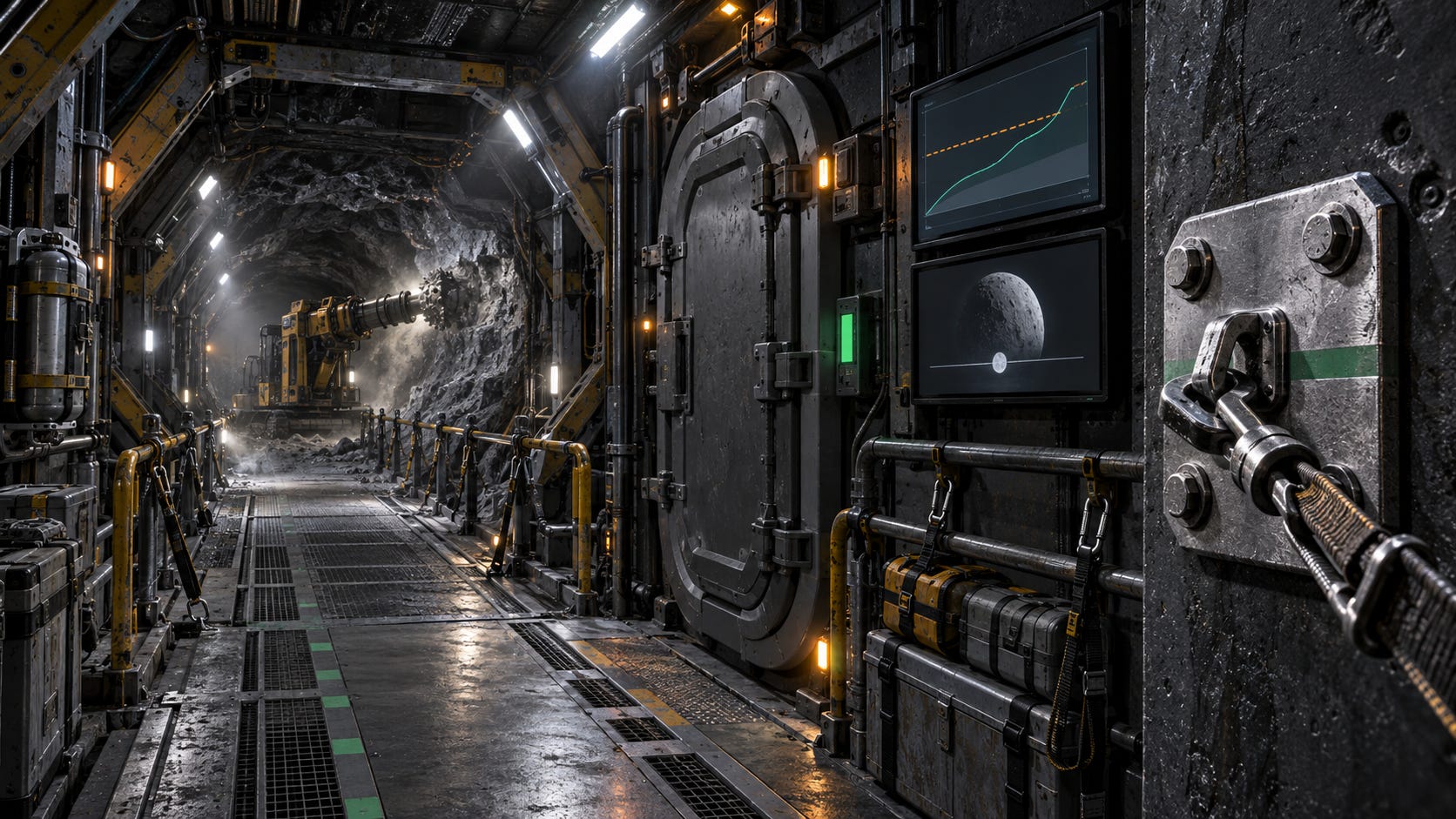
A miner clipped to the rail above Lena tightened his grip on the tether. He had signed the return petition twelve days earlier. His housing grace had run thin. The arithmetic needed no explanation.
“Does this guarantee nobody dies in there?”
Kavita left her slate secured to the lectern. “No honest mine agreement can guarantee that. It can stop the institution from hiding risk. It can give a worker power to act before risk becomes a name on a wall.”
The answer left no victory in the bay. Lena preferred it clean.
“If a brace trace crosses the threshold tomorrow, the face stops first,” Lena said. “The argument follows. The record stays.”
Paper could not brace stone or return the people under 3-Bravo. It could change which hand moved first when a warning crossed the line.
Lena pressed yes.
Kavita checked the duplicate filter, the active membership field, and the certification hash. She gave the recording steward time to repeat each result on the union and station channels.
The approval column carried a clear margin. The dissent column remained large enough to have faces.
Kavita certified the vote without giving either column a cheer.
“The six-part settlement is ratified,” she said. “The dissent remains attached to the record.”
Six demands. Six green entries. None of them put air back into the inner refuge.
Kavita opened the execution pane and entered the chapter authorization. Sigrid Hedlund stood at the opposite rail with the reduced restart model clipped beside her. Counsel’s objections remained visible behind the settlement text.
Sigrid entered Helios Ceres Operations authorization.
The mediator compared both signatures, locked the checksum, and set the effective time at 09:17:44. The strike ended on that timestamp, not on the vote, not on the recommendation from the previous day, and not on a promise to sign later.
Strike Day One and this morning now occupied one closed span in the record: twenty-one days inclusive.
The executed settlement activated predesignated labor, engineering, medical, and external-inspection transition members under the authority’s launch clause. No Helios production officer could chair them. The temporary safety council transferred every open hold, life-safety authorization, inspection image, operative work restriction, clearance status, and unresolved corrective item into the new authority’s custody. Underlying clinical records stayed with medical. The council retained control until the interim launch panel returned a matching checksum.
Only then did the temporary council close its command channel.
Compensation remained on its separate bargaining schedule. Ratification neither settled nor erased it.
Lena shifted one hand to the rail, cycled her boot locks free one at a time, and pushed into the bay-wall passage with the others. They pulled themselves hand over hand toward the memorial alcove. No one rushed the doors.
The 3-Bravo map filled one panel inside the alcove. Its tunnel trace stayed dark. Sealed cases rested beneath it, each fixed to the wall by two restraints. A separate display held the names.
Kavita read them without titles, shift numbers, tonnage, or schedule language.
Lena kept one glove closed around her tether. No drill pitch or brace vibration entered the quiet. Each name landed on its own. After Kavita finished, the names remained on a permanent display separate from the production system.
3-Bravo remained closed pending independent investigation and corrective review.
Lena left without trusting the paper. The first cleared face would be the test.
The interim launch panel opened the restart record from the mine access spine.
Four inspections had finished before the vote under the temporary council’s bounded authority. The panel matched each checksum to the transferred source, reviewed the listed conditions, and adopted the completed findings into the new authority’s record. Adoption widened no clearance. The record kept individual findings for one pressure door, two processing paths, and the selected faces. The damaged return-air branch remained isolated. Temporary scrubbers remained active.
Ayanda Molefe entered the medical clearance on a separate channel. Exposure windows, fit-for-duty limits, relief intervals, and response coverage applied only to the named first-shift assignments. The clearance did not approve normal load.
A qualified technical reviewer independent of the production decision entered the technical finding. Pressure seals, ventilation flow, power isolation, rail continuity, brace traces, and access controls passed for the selected route and faces. 3-Bravo carried no clearance. The finding authorized the written limited-load ramp and nothing above it.
Lena read both timestamps before she released her tether from the spine rail.
The rescue chief called the live readiness check. Names alone did not count. Two trained entry teams answered from separate rack positions. Pressure suits showed current seals. Medical packs carried intact dates. Cutting tools completed load tests. Anchor reels paid out and rewound under resistance. Emergency-air bottles matched their cradles and the planned entries. No responder also counted toward face staffing, environmental watch, or medical response.
The board listed fewer active tunnels than the old plan.
The launch panel marked rescue coverage live.
The selected operations could restart after crew proof checks.
Lena moved down the approved route by handhold, boots catching one strip at a time. The cargo portal sealed behind the crew and equalized with the access passage. Green route lights meant the systems had cleared. They did not mean every piece of hardware had earned a hand.
At the final turn, Lena clipped her travel tether to the anchor beside the face gate. The proof indicator reached its marked load.
The anchor plate shifted.
Three millimeters. Enough to break the witness line and leave a bright crescent under the lower edge.
Her glove stayed off the gate.
“Stop. Access route two, face gate anchor. Documented movement under proof load.”
The new stop control waited on her cuff. Lena entered the affected scope, the observed movement, and the witness-line break. The record took her timestamp before production control could answer.
The face gate locked. The drill remained unauthorized. Nothing wider stopped because the evidence reached no wider.
An independent engineering reviewer pulled himself along the rail from the launch position. He checked Lena’s proof-load reading against the anchor specification, photographed the crescent, and tested the adjacent plate. Production stayed out of the finding.
“Anchor fails entry load,” he said. “Replace plate and fasteners. Inspect the backing channel before release.”
A maintenance technician opened the panel. The backing channel held. A worn seat had let one fastener slip. The fault stayed hidden until the proof load drew the plate across its witness mark. The technician replaced the assembly, entered the old parts into evidence custody, and torqued the new fasteners under the reviewer’s instrument.
The second proof test held.
The reviewer verified the written corrective condition and closed Lena’s bounded stop at 13:06:12. Her original call, photographs, failed reading, replacement record, and release remained together. No supervisor asked what the delay cost. No schedule field opened for an argument.
Lena clipped in again.
Inside the approved face, the old drill waited with its feed limiter set below its pre-strike cycle rate. The limited-load ramp sat on the shift board in writing: one low cycle, inspection hold, brace review, then another decision. Maintenance blocks occupied solid space no ore train could overwrite.
Only a few faces carried green authorization. The lower cycle rate reduced output at each face. The reduced face count kept total output farther below the old quota than the single drill setting suggested.
Lena set one glove on the casing and keyed the motor.
The first turn came through the metal, slow and uneven. She held the feed until the pitch settled. Dust lifted from the cut and stayed suspended in the thin work lights. Behind her, the rescue board remained live. Temporary scrubbers carried the station. The damaged branch stayed isolated. Normal load had no clearance.
The production display rose beneath the old target.
On a separate permanent channel, the memorial names remained where no rising number could cover them.
If you enjoyed this story, you can follow the main story arc in The Exodus Rush, the first book in The Vethrak Requiem series.