


Tuva Hawthorne pulled her signed torch record into the terminal bracket and put the cracked transition map beside it.
Her name occupied the first field. The plate history had no comparable field she could open.
Nobody had accused her. Wanjiku Bett had asked for travel speed, current, torch angle, and filler batch. Those were questions with answers. Tuva clipped both boots into the station restraint and expanded the first run.
Beyond the scaffold, Article Four remained captured in Slip Two’s anchored cradle. The short barrel would join two pressure hulls elsewhere, if inspection ever released it. Three transitions carried shallow cracks beside their welds. Their surfaces still looked clean.
Tuva traced each recorded pass against its location. Current stayed inside the qualified band. Travel speed matched the run log. The angle checks and retained setup images agreed. She checked the filler batch against the captive spool in her torch station, then opened the power-ration history.
Each interruption had a stopping point. Each restart had a temperature check.
Her thumb paused over the longest gap. She remembered the ache between her fingers and Cho asking whether she could carry into the low block. The log mattered more. It showed the arc off before the allocation fell.
“Same spool?” Samrawit Assefa asked from the adjacent rail.
“Enough remains.”
“We keep the batch link.”
Tuva closed the playback pane and left the recorded values open.
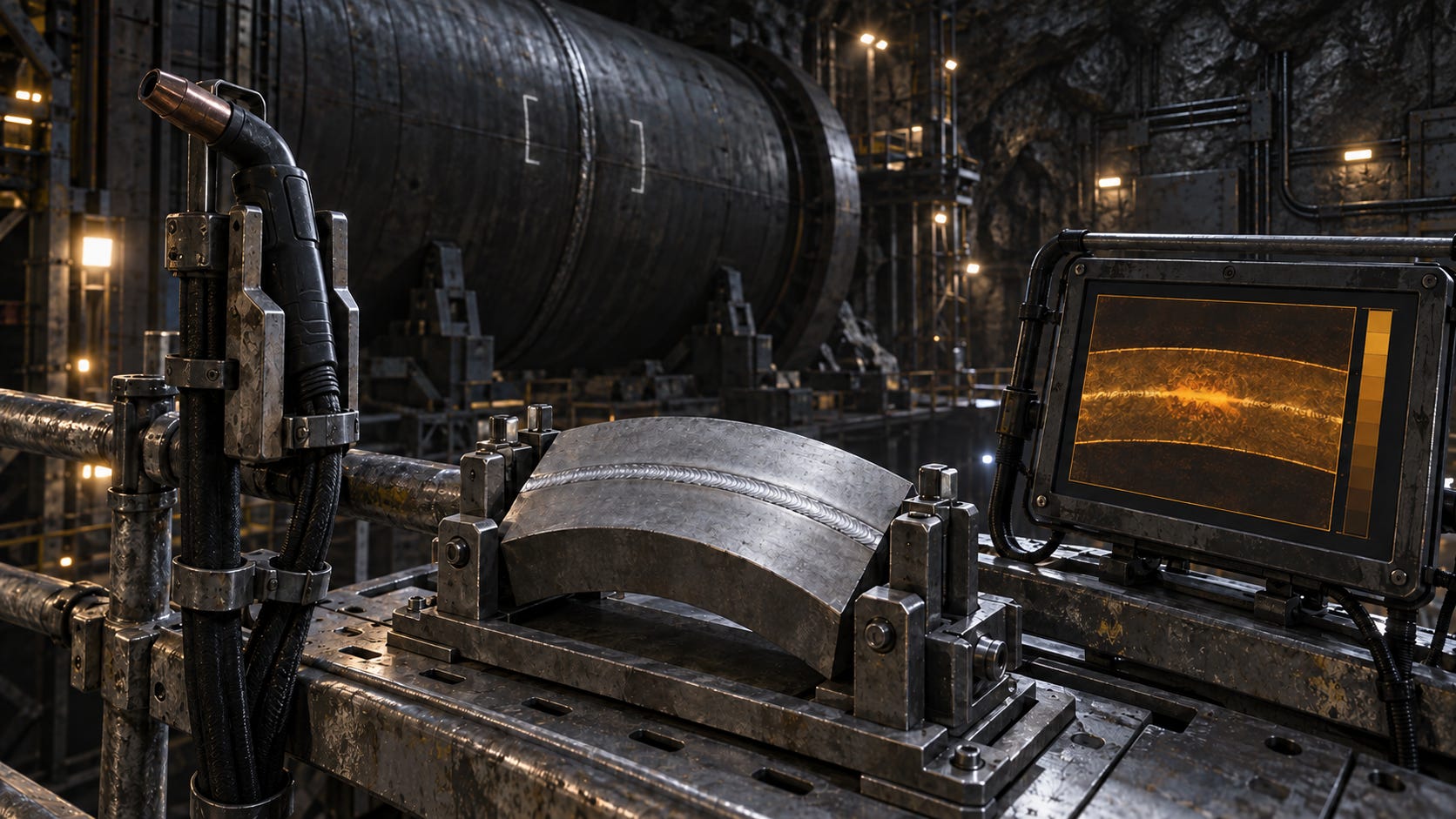
In the coupon bay, two curved pieces sat captive in a joining fixture. Samrawit matched both cut records to one internal plate row. Same thickness, matching edge preparation, the local transition shape reproduced in a smaller segment. No piece had come from the other row.
Tuva checked the fit with a tethered gauge.
The earlier same-row coupons had passed. This one would put her original setup back under witnesses, after the barrel had supplied a reason to doubt it.
Wanjiku compared the curvature and restraint points with the control plan.
“Representative segment,” she said. “This won’t prove the whole barrel.”
Tuva nodded. Article Four would receive no further load. Its hold remained attached to the separate work package.
Onur Tekin fastened his slate to the rail and checked the test assignment. His access record covered the witnesses, the stock withdrawal, and the specimen’s custody. He did not open a worker biography or ask for a source address.
“Your engineering attachments stay with the specimen record,” he said.
He confirmed the limited access and secured the transfer receipt. Samrawit retained both cut links beneath the control identifier. The plate could remain anonymous outside the yard without becoming an untraceable strip inside it.
Tuva moved the torch lead through its captive guide and matched her boot position to the saved setup. Wanjiku checked the torch angle. Samrawit read back the current band and filler batch.
The extraction shroud locked around the joining station. Wanjiku confirmed its flow, then closed the protective screen between the arc and the witnesses. The reserved power block opened.
Light pressed against Tuva’s visor. The arc settled into its ordinary drag through the glove. Heat gathered along the edge; the cooling line trembled against its guide. She advanced at the recorded speed, feeding the same material into a pool whose margin she knew by color and shape.
No strange resistance. Nothing her hand could name as the cause of a hidden crack.
The urge to make this seam better than the first tightened her wrist. Better would change the test.
She eased her grip and held the specified angle.
At the recorded stopping point she killed the arc, parked the torch, and retained the pause. Samrawit confirmed the restart temperature before the next full-output block took the remaining run. Their controlled heaters then carried the segment through the original thermal cycle, with its hold time intact.
Her gloves cooled while the witnesses checked the record. She left them clipped beside the torch rather than rubbing warmth back into her fingers.
The inspection lamp crossed a straight bead.
Visual and dimensional checks passed. The ultrasonic probe passed its reference check before following the required paths beside and through the joint. No reportable indication. Wanjiku saved the baseline with its coverage and settings.
Tuva helped secure the segment in the coupon load frame, then released her boots and pulled herself behind the safe boundary. The grips held the curved specimen between them; the anchored frame would react the force. Nobody’s restraint supplied it.
The technician checked the acoustic pickups with reference taps. Each channel answered. Wanjiku retained the fixture comparison and opened the strain display beside the planned load limits.
Tuva fastened into the observer station. Her empty fingers closed around the restraint bar.
The first stage rose, held, and returned to zero. Ordinary machinery noise stayed in the record. No unexplained cluster crossed the pickups.
At the higher stage, strain settled inside the control plan’s envelope.
“Unload,” Wanjiku said.
Tuva kept her eyes on the descending force. On Article Four, this was when the signals had come, twice in one downramp, with the steel still looking whole.
The channels carried their background to zero.
The dwell finished.
Wanjiku compared the traces before authorizing the planned repeat. The operator loaded the segment again, held it, and brought the force down at the same controlled rate. No matching acoustic group appeared. Strain returned within its permitted residual range.
Tuva loosened one finger from the bar. Then another.
The technician repeated the channel response check after the last dwell. The pickups still answered. Quiet metal had not meant a dead instrument.
Zero load, isolation, and capture followed before anyone crossed the boundary. Post-load dimensions remained within limits. The retained ultrasonic paths stayed clean against their baseline.
Wanjiku signed the control result and left Article Four’s disposition unchanged.
Samrawit secured the passing specimen in a retained rack. Tuva clipped along the connecting rail back to Slip Two, carrying the control record on her cuff.
The barrel’s temporary white marks waited beside its welds. She stopped at the terminal bracket and opened the comparison.
“That clears the torch,” the technician said, fastening the specimen rack beside the display.
Tuva put her hand against the rail.
One clean weld could become a convenient answer. Her fingers wanted it. Her name was still beside three seams that had not survived their proof unchanged.
“It shows this setup can pass on one row,” she said. “It doesn’t replay every movement I made on the barrel.”
“Same procedure,” Samrawit said. “Same recorded power band and treatment. A different material pairing.”
Wanjiku attached the limits of the control to the result. The finding weakened workmanship as the common explanation. It gave nobody permission to clean away the white marks or release the held structure.
Tuva opened her glove. A pale pressure line crossed the base of her thumb. She could account for where the torch had been, how long the arc had run, and why it had stopped. The metal had arrived with a longer life than any of those entries.
“What did it do before it reached me?” she asked Samrawit.
The engineer secured the control’s plate link beside the barrel record.
“We need the history to answer that.”
She did not call it a cause.
Tuva parked her cuff in the bracket and enlarged the saved surface image beside the defect map. A straight ridge, gray steel, no visible opening. The passing specimen carried the same appearance in its rack.
Her hand left the signature field. She pinned both results together.
Beside the mapped cracks, the clean control looked like another piece of the same work. The difference remained where her glove could not reach it.
Author’s note: This story continues the Site Anvil arc in late Year 3, during the investigation of Article Four’s halted proof test. A witnessed control can narrow an explanation without supplying the missing life of the metal.
New to The Vethrak Requiem? Start with The Exodus Rush, Book 1, where humanity fights for survival after an alien invasion using technology it barely understands. These short stories explore the wider universe; the novel begins the main story.