


The restart model had no time for maintenance.
Sigrid Hedlund spread the projection across the arbitration table and enlarged the first seven shifts. Ore trains occupied solid black lanes from face to processor to outbound storage. Inspection holds appeared as narrow gray blocks between them. Every gray block carried the same small control at its edge: movable.
The spin ring gave the room enough weight for the mediator’s pencil to stay where she set it. Sigrid’s hand did not leave the projection.
“Who marked the trains fixed?”
The remote production planner answered from the wall display. “Those are contractual commitments. Maintenance can move inside the operating week without reducing total extraction.”
Ji-woo Han sat at the engineering place with a waist restraint clipped beneath the table. A medical limit on her slate barred tunnel entry and manual work. It did not bar reading.
She opened the clause beneath the schedule. “Page twelve. Conversion authority.”
The settlement draft allowed protected maintenance windows to be temporarily reassigned for strategic necessity. A replacement window would be provided when operational conditions permitted.
Sigrid had approved a sentence built on the same shape before 3-Bravo. One final extraction cycle. Maintenance immediately after the train cleared. Increased sensor watch until then.
The train had become fixed. The time meant to protect the brace line had become gray.
She opened the model’s assumptions. Each face carried a planned extraction rate, equipment availability, transit capacity, and crew hours. Maintenance appeared only as lost production. The model assigned no cost to a late inspection until something failed, then placed the failure in a different ledger.
Sigrid had defended schedules built that way because the missing ore appeared immediately and the missing margin did not. Three-Bravo had supplied the second number in rock, air, and recovery time. Deferred filter work had supplied it again when a green backup carried less reserve than the schedule claimed.
Helios counsel touched the phrase. “Strategic necessity needs an exception path. No schedule survives without one.”
“The exception is the schedule,” Ji-woo said. “Nothing here requires a safety finding. Nothing names who accepts the changed risk.”
Sigrid picked up the mediator’s red pencil and struck the phrase herself.
Counsel stopped with one hand over the objection field. “Operations needs the ability to respond to emergency demand.”
“Operations had that ability,” Sigrid said. “We used it until maintenance became whatever time production left behind.”
She wrote the replacement language while both channels recorded the revision.
Protected maintenance time could become production time only through written concurrence from the independent Ceres safety authority. The concurrence had to identify the affected system, the evidence supporting conversion, the person accountable for the decision, and a named replacement window. The original block, the request, the decision, and the completed replacement work would remain together in the audit record.
Kavita Nair read the text without reaching for the green pencil beside her demand sheet.
“A named window can still be moved again,” she said.
“Then the second move requires a second concurrence and stays beside the first,” Sigrid said. “No rolling deferral. No quiet deletion after the week closes.”
“What happens when the authority refuses?” counsel asked.
Sigrid looked at the black train lanes. “The train moves.”
The planner’s image froze for half a second as the remote link corrected. “You mean the commitment slips.”
“Yes.”
Kavita drew a third green line. The mediator marked the clause provisional and carried its terms into both copies.
The ore trains remained black on Sigrid’s projection. The maintenance blocks remained gray. Nothing on the screen had changed yet.
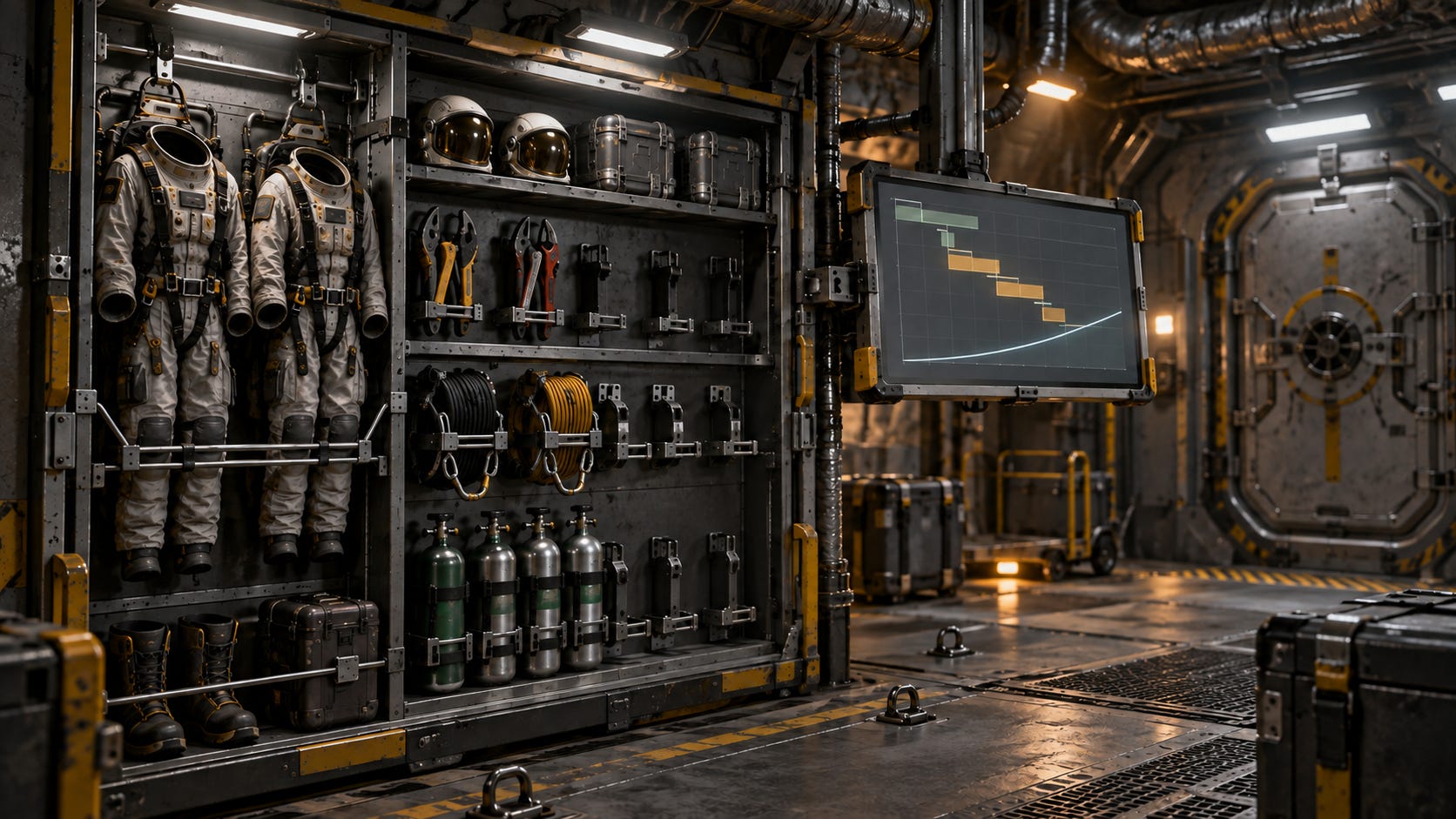
The second rescue-team rack held more empty clamps than equipment. Lena Vasquez clipped the preserved 3-Bravo readiness record beside its current inventory.
She locked her boots to the staging-bay strip and pushed one empty suit hanger along its rail. It stopped beside a pressure hood with its inspection seal broken. Two cutting tools remained in their brackets. One carried a red battery tag. The emergency-air cradle held three bottles and five open sockets.
“Three-Bravo’s recovery board was clipped here,” Lena said.
The bay had no spin. Every pack, reel, tool, and suit needed its own restraint. Sigrid clipped the settlement slate to the rack before opening it.
“One team in?”
“Six names. All active in the throat.” Lena pushed the empty hanger back into place. “The second column had three names, two blank slots, and a surge call nobody answered. The board had a column. Recovery had one team.”
Sigrid had read the delay in the released record. Minutes passed while the first team worked the loaded door and the second team existed only as incomplete names. The inner refuge bottles were at zero when the jam opened. The report stored those facts in separate sections. The rack put them within one reach.
Ayanda Molefe drew a finger down the rack inventory. “A trained person without checked protection is not rescue capacity. Neither is a suit without a wearer, a medical pack without current seals, or a cutting tool whose battery fails under load.”
She opened the readiness list.
Trained personnel present on shift. Pressure suits inspected and assigned. Medical packs sealed. Cutting tools load-tested. Anchor reels measured and restrained. Emergency air charged, dated, and matched to the planned entry. A second team had to remain available while the first team was committed.
“Available means not counted twice,” Molefe said. “No rescue name can also fill a face minimum, an environmental watch, or a medical response slot during the same interval.”
Kavita fixed the fourth demand beside the rack. “The floor scales with active tunnel count on each shift. Not a station average. Not a weekly percentage. The active faces on the night shift carry a night-shift rescue requirement. Day staffing cannot cover an empty rack after midnight.”
Sigrid read the management draft. It measured readiness across the station as a monthly average. A fully staffed day shift could hide an empty rack at night. A training exercise could count as available response. Equipment in transit could count as inventory.
She deleted average.
Counsel opened an exception note. “A temporary staffing gap cannot force a station-wide shutdown.”
“It does not,” Sigrid said. “It reduces the number of active faces to the number the available rescue floor can support.”
She added the operating consequence to the clause. Any shift below the required trained-and-equipped rescue floor would close or defer enough active faces to restore coverage. Management could choose which production face stopped, subject to existing hazard controls. It could not keep every face running and call the missing rescue team an administrative variance.
Lena pressed her glove against the empty air-bottle sockets. “Put the check at shift release, then keep it live. A ready pack that leaves for medical is no longer on this rack.”
Ji-woo joined through the slate link from the arbitration room. “Tie each readiness change to the active-face board. If the equipment or personnel count falls, the supported face count falls with it.”
Sigrid added the live check and automatic reduction. Kavita read the complete clause. Molefe checked the medical language. Lena checked the equipment list.
The fourth green line entered the record as provisional agreement.
The planner returned before Sigrid left the staging bay.
His revised warning filled the clipped slate. Protected maintenance displaced extraction blocks across the first restart week. Rescue coverage lowered the simultaneous face count on the thinly staffed shifts. The old target no longer fit.
“These clauses make the approved quota impossible,” he said.
Behind the slate, the half-empty rack held its silence. Sigrid could have asked for another exception. She could have moved training, borrowed tomorrow’s maintenance, or called the first week a temporary emergency. Every route returned to gray time beneath a black train.
“Recalculate the restart,” she said.
“Against what target?”
“Against the work we can support. Begin below the old rate. Increase only when the required inspections clear the affected systems, the maintenance milestones close in the record, and the rescue floor supports the additional faces.”
The planner glanced away from the link. “Regional will ask who accepted the shortfall.”
“Put my name on the model.”
The old curve disappeared.
Solid maintenance blocks settled across the new schedule. The ore lanes broke around them instead of passing through. Beneath those blocks, the first restart curve rose slowly, one cleared face at a time.
If you enjoyed this story, you can follow the main story arc in The Exodus Rush, the first book in The Vethrak Requiem series.