


The ground control handoff came at 08:14 UTC, twelve minutes late. The delay registered immediately. It always did. Timing was the skeleton of life on the ISS: wake cycle, meal cycle, experiment cycle, the voice from Houston marking each hour. Twelve minutes of deviation meant nothing on Earth. Up here, where routines were the only architecture holding the day together, twelve minutes was wrong.
“Station, Houston. We need to move to a priority channel. Commander, all crew to Node 1. Over.”
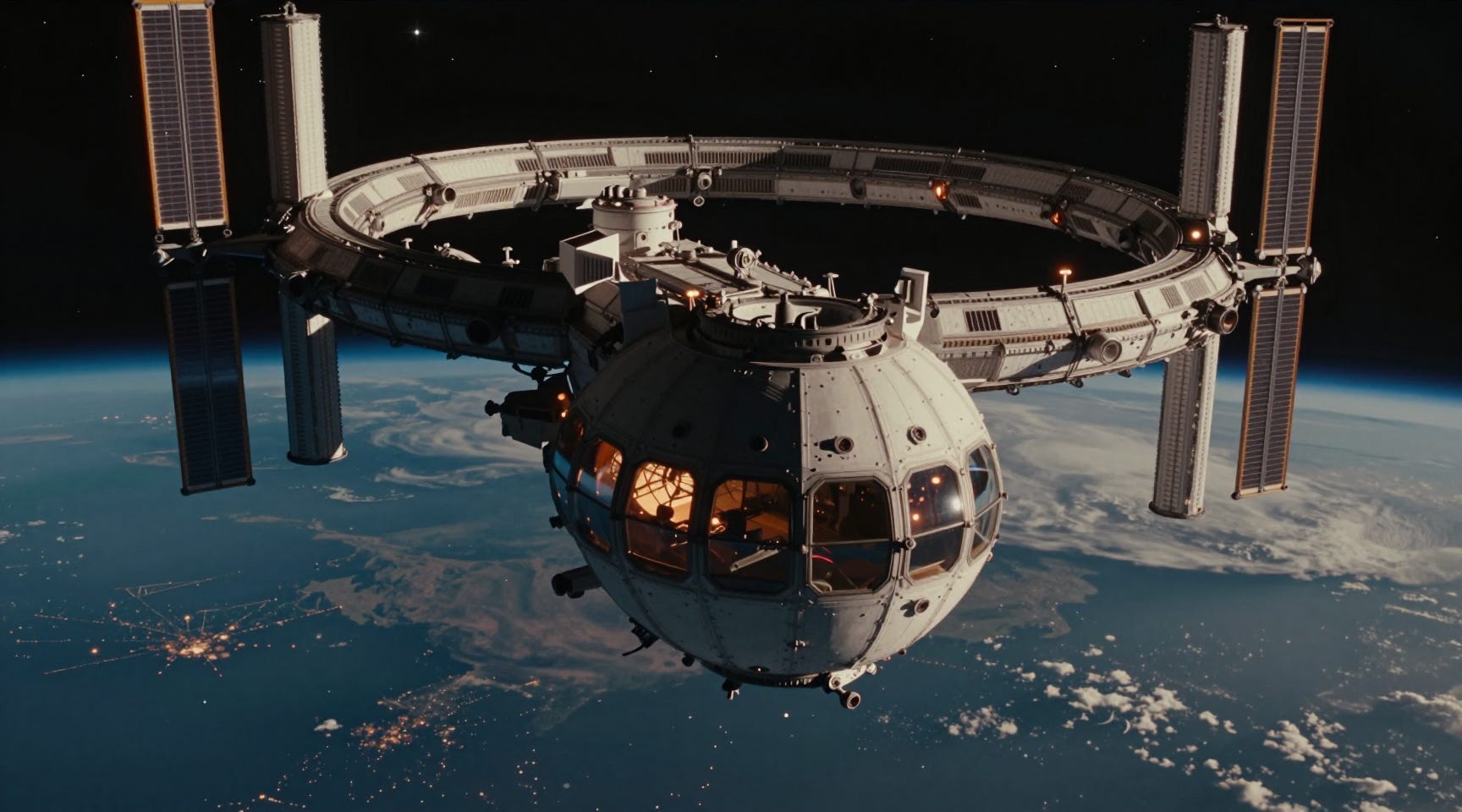
The cadence was off. Stasi had logged nine hundred hours of ground control communication across three rotations, and she knew the sound of a flight controller reading from a script they had not rehearsed.
The commander gathered them in Node 1. Six crew members in various stages of their morning routine: one still working a coffee bulb, another with sleep-shift hair drifting loose in microgravity. The commander’s face was professional, composed, the face of a man who had not yet decided what to feel.
“Houston has confirmed anomalous gravitational signatures at the system edge. Multiple large objects. Artificial. Decelerating in formation.”
The module was quiet. The ventilation fans hummed their constant note.
“Confirmed artificial?”
“Confirmed.”
Stasi pressed her back against the module wall. Her feet floated free. Artificial. The word hung between them like something none of them wanted to touch.
She went to the Cupola afterward. Everyone did, eventually, in the hours that followed. The seven observation windows showed Earth in the slow roll of orbital transit, the terminator line carving daylight from darkness across the Indian Ocean. Familiar. Ordinary. The cloud formations over the Bay of Bengal looked the same as they had yesterday, and the day before, and every day of her three-month rotation.
Nothing in the view had changed. Everything in the view had changed.
Ground control fed them updates on the hour. 09:15 UTC: attempted radio contact, no response. 11:00: the UN Security Council in emergency session. 14:22: the objects crossing Neptune’s orbit. The numbers were precise, and the precision was the worst part. This was not rumor. This was not instrument error. This was a trajectory, a velocity, a destination.
They are coming here.
The crew handled it the way trained professionals handle the unthinkable: with procedure. The commander convened a formal meeting at 16:00 UTC. They reviewed emergency protocols that had never been written for this contingency. They discussed oxygen reserves, food supply, communication redundancy. They discussed the Soyuz capsules.
The capsules could bring them home, if home was a word that still applied. The decision to stay or descend belonged to the ground, and the ground was occupied with calculations that made seven astronauts a rounding error. No order came.
She called Pavel at 19:00 UTC. Moscow relay, standard latency. His face filled the small screen, the apartment behind him lit by the blue glow of a television she could not quite make out.
“Stasi.” His voice. The voice she had married. The voice that had read Mira bedtime stories through a tablet screen for three months.
“I know,” she said.
“The broadcasts here are continuous. Mira is with your mother. She thinks it’s a special visit.”
“Good.”
“How is it up there?”
Stasi turned toward the Cupola window. The terminator was crossing Central Asia. Below, in cities she could not distinguish at orbital altitude, people were learning what she had learned eleven hours ago. In some of those cities, the lights were coming on early.
“The same,” she said. “It looks the same.”
Pavel was quiet for a moment. The latency filled with the hum of the station.
“Come home,” he said.
“When they tell us.”
“Stasi.”
“When they tell us, Pasha.”
She asked him to put Mira on. The girl’s voice came through bright and small, full of the cheerful authority of a seven-year-old reporting important news.
“Mama, Babushka let me have two biscuits.”
“Good girl, Mirochka.”
“When are you coming down?”
“Soon.”
The word floated in the module long after the connection closed. Stasi turned the wedding band on its cord against her collarbone and pressed her forehead to the cold glass of the Cupola window. Below, the terminator crept westward. The Earth kept turning.
Days 2 through 5 passed in the strange compression of crisis time, where hours collapse into minutes and minutes stretch into years. The fleet advanced through the inner system in a formation the crew tracked on the station’s navigation displays. A cluster of returns moving inward with mechanical patience, silent, ignoring every frequency humanity aimed at them.
The crew continued their work. Science experiments ran on automated timelines that no one had thought to cancel. The water recycler needed its filter changed on Day 3 and Stasi changed it, her hands steady on the housing bolts, the small task grounding her in the physical reality of the station while the screens carried numbers she could not look away from and could not bear to watch.
The commander insisted on routine. He was right to insist. The checklists were the last steady ground any of them had.
Stasi spent her free hours in the Cupola. She watched Earth turn beneath her. She watched the lights of cities come on and go off in patterns that no longer followed the rhythms of commerce and sleep. On Day 4 she counted fourteen cities dark that should have been lit, their power grids failing or their populations gone to ground.
On the evening of Day 5, after the crew had eaten and the rotation cycle was winding toward sleep, she floated alone in the Cupola with the station recorder. The Earth filled the windows below, blue and white and impossibly thin against the black.
She pressed record.
“Mira. This is Mama.”
The words came slowly. Not because she had not considered them. She had thought of nothing else for four days. The difficulty was selection: a life of things to tell a seven-year-old, compressed into the minutes a recording could hold.
She did not say goodbye. She did not explain. She listed small things.
The way the light looked on the Volga when you flew over it at dawn. The name of the constellation she had shown Mira through the telescope on their balcony last summer. How to make the tea her grandmother had made, the one with dried mint from the garden. That her father loved her. That he was brave and good and would take care of her.
That the Earth was beautiful from up here.
That she was looking at it when she thought of her.
She pressed stop. Tagged the file. Queued it for the next downlink window.
Stasi went to sleep at 22:30 UTC on Day 5. The crew module was dark. The ventilation fans hummed. Through the narrow window beside her sleeping bag, a strip of black space held the familiar stars in their familiar positions.
She slept the way she always slept in orbit: quickly, completely, the discipline of a woman who had learned years ago that rest was a professional obligation. Her hands were still. The wedding band on its cord rose and fell against her collarbone with each breath.
At 04:00 UTC on Day 6, the Vethrak engaged Earth’s orbital defense platforms.
The ISS had no defenses.
The ISS had no warning system.
The ISS was in the engagement zone.
Stasi Kovrov did not wake up.
Author’s Note: Expedition 73 was the last crew rotation aboard the International Space Station. The ISS was destroyed during the initial orbital strikes of Day 6, five days after an alien fleet was first detected at the edge of the Sol System. There were no survivors among the seven crew members. Anastasia Kovrov’s recorded message to her daughter Mira was recovered from the station’s downlink archive three months after the invasion ended.
If you enjoyed this story, you can follow the main story arc in The Exodus Rush, the first book in The Vethrak Requiem series.