


Ingrid Krause kept her thumb hovering over the abort cover until it ached.
The fold console filled its alcove behind the bridge, a salvaged Vethrak core bolted into human brackets. The status grid glowed green. Green meant the sensors had no language for disaster.
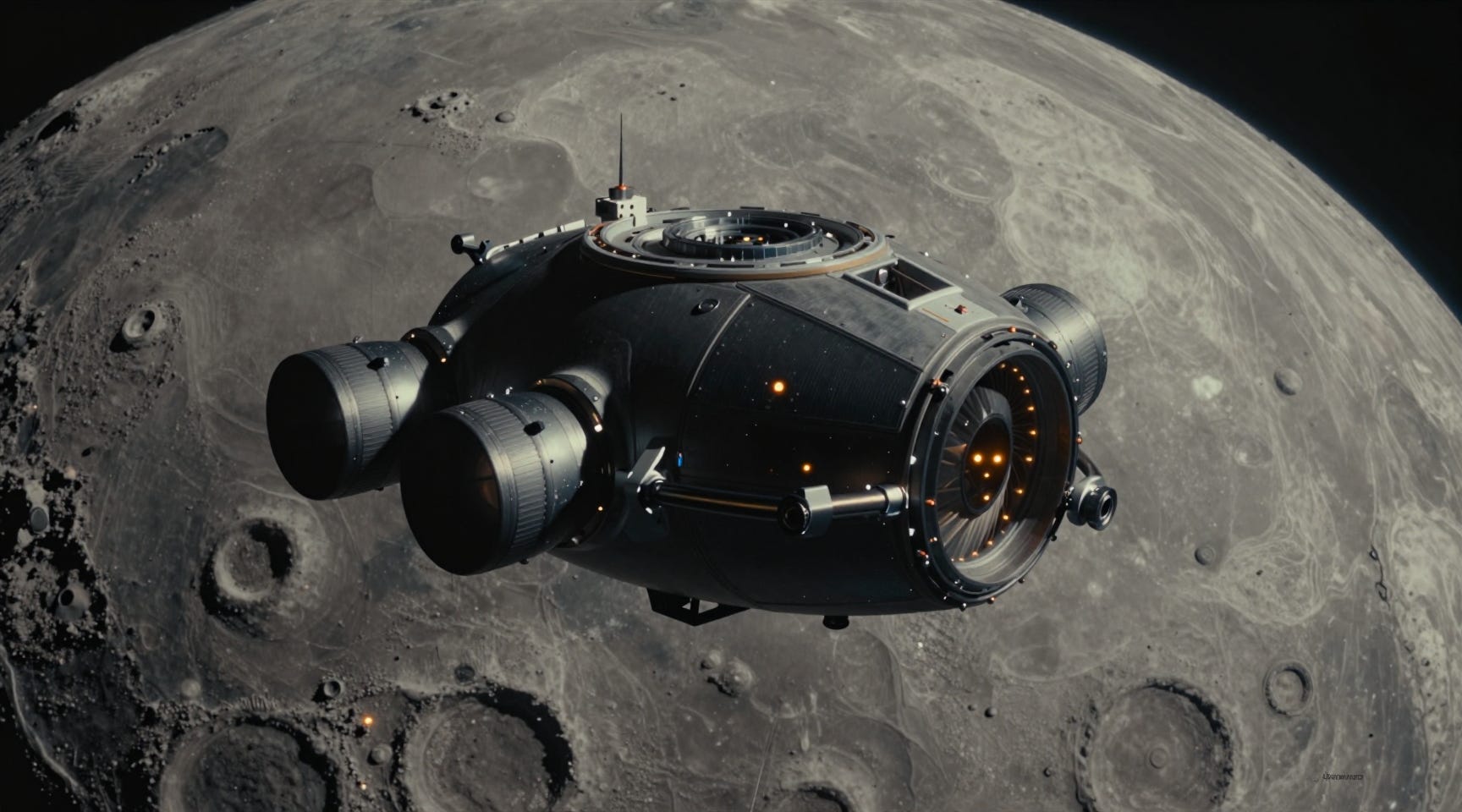
CSV Nightjar held position beyond the corridor beacon, thrusters whispering to keep the ship steady in empty space. Empty space never stayed empty.
Her visor counted down capacitor charge. Seven minutes. The captain wanted the fold on the mark to keep their slot. The canisters in hold two needed cold chain integrity. The contract called it compliance. Barrow Station called it medicine.
Solution One sat clean on the left pane. Origin matched beacon. Destination matched the approved chart. Drift correction fell inside tolerance.
Solution Two, from the backup processor, agreed within a handful of cruel decimals.
The third solution should have sealed it. Three independent calculations. The ritual.
The third solution did not match.
The mismatch lived in the mass map. A density spike near the midpoint, small enough to dismiss, stubborn enough to repeat.
The ship’s intercom clicked.
“Navigator,” the captain said. “Status.”
“Two solutions agree. Third flags intervening mass.” Ingrid kept her voice level.
“Dangerous?”
Dangerous meant binary. Arrive, or cease.
“If the map is wrong, we arrive clean,” Ingrid said. “If it is right, we emerge inside something.” Her tongue stuck to the roof of her mouth. “No survivors from a fold failure.”
Silence. The captain did not need the rest.
Ingrid lifted the abort cover with a fingernail and let it fall. Plastic clacked, absurdly light.
“Resolve it,” the captain said. “Two minutes.”
Two minutes. The charge timer read five forty-eight.
Ingrid opened the beacon feed and forced a constrained third pass through the conservative model her instructors loved to praise and hated to follow. Conservative killed schedules. Conservative kept ships out of stars.
The third solution drifted closer to the first two.
The spike stayed.
It had shape.
Not random scatter. Not a natural field.
A thin sheet of mass crossed the corridor like a crack in glass.
A salvage net.
The black market hunted the same routes as official convoys. Somebody had anchored scrap and cable where a ship would fold blind and die without leaving a wreck.
The intercom clicked again.
“Time,” the captain said.
Ingrid swallowed. “The anomaly looks engineered. Sheet density, straight boundary. Salvage net or tethered debris.”
“Pirates this close?”
“People go where the food goes.”
The charge timer read three twelve.
The captain’s next words came softer, which pressed harder than anger. “If we abort, we lose the slot. Barrow’s infirmary waits on those canisters.”
The abort cover stared back like a child’s toy.
Her gloves slid on the console edge. Sweat pooled under the liner.
“Two solutions agree because they trust the corridor map,” Ingrid said. “The third does not.”
“Your recommendation,” the captain said.
Recommendation. The word carried the academy’s weight, then every missing ship on the casualty rolls.
The spike held steady. No flicker. No noise. Exactly where a trap belonged. Midpoint. Maximum capture.
She pictured the fold field forming around Nightjar, the ship compressing distance, reappearing inside metal cable and jagged scrap.
No survivors.
Ingrid flipped the abort cover up and held it there.
“Abort the fold,” she said. “Reroute to the secondary corridor. Request a new slot.”
One long beat.
“Confirmed,” the captain said. “Abort on my mark.”
The charge timer read one fifty.
A warning flashed.
CAPACITOR DISCHARGE UNSAFE.
The drive did not want to waste energy.
Ingrid ignored it. Safety lived in human hands.
“Three,” the captain counted. “Two. One. Abort.”
Ingrid slammed the switch.
The console screamed in light. The status grid went red as the dump resistors bled charge into heat the ship could barely vent. Nightjar shuddered. The bulkhead vibrated under Ingrid’s shoulder, as if the drive had tried to bite.
The timer hit zero.
Nothing folded.
The silence afterward left her trembling. Ozone cut through the mask filters.
“Engineering reports dump resistors holding,” the chief said over comms. “Heat load high. No breach.”
The ship still existed. That had to be enough.
“Navigator,” the captain said. “Good call.”
Praise did not fill the hollow in Ingrid’s chest.
The corridor interface updated. Their slot vanished. A new queue number appeared.
EIGHT HOURS.
Eight hours meant the canisters warmed. Eight hours meant Barrow Station rationed what it had left.
Ingrid forced breath into her lungs. “Captain. We can burn sublight to the relay buoy and request an emergency fold from there. Different origin. The midpoint shifts.”
“Unauthorized fold,” the captain said.
“Authorized destination. Different origin.” Her voice stayed flat. The only way to keep it from breaking.
A pause.
“Time to the buoy?” the captain asked.
“Three hours at current limits.”
“Drive cool-down?”
“We dumped charge instead of folding. Heat is the limiter. Two hours if Engineering can vent safely.”
Five hours. Not eight.
“Run the math,” the captain said. “Run it until you hate the numbers.”
Ingrid’s mouth tightened into something that might have been a smile. “Copy.”
Nightjar’s thrusters kicked harder. Vibration traveled into Ingrid’s bones as the ship turned toward the buoy, toward another stretch of empty space.
She opened a fresh calculation pane.
Solution One.
Solution Two.
Solution Three.
Three prayers, spoken with different words, all reaching for the same mercy.
Ingrid set her thumb back on the abort cover.
The ache returned.
Author’s Note: Fold Drives keep humanity connected, but every jump still comes down to a brutal truth: the math has to be right every time. This story takes place in the Survival Era, when civilian crews ran medical routes on salvaged alien technology and a single decision could trade schedule for lives.
If you enjoyed this story, you can follow the main story arc in The Exodus Rush, the first book in The Vethrak Requiem series.