


The council chamber was the same temperature as the rest of the colony. The council had been the same five people for three years. The screen at the head of the table displayed the numbers Sarah had run that morning and the night before and the month before. The numbers had not changed in any direction that made the conversation easier.
Eden sat at the far end, tablet at her elbow. The councilor from hydroponics had brought her small potted bean plant, the one she brought to every session. The medical stores representative, the oldest colonist on the council, had not changed expression in two years. The logistics officer sat with his arms crossed. Anders Lund sat at the window side, looking at the screen and not at anyone, as he had for months.
Anders had been listening to Sarah’s broadcasts longer than anyone else in the room. He had stopped believing somewhere in Year 7.
“Three months,” Sarah said.
Nobody spoke. The numbers had already said it.
“Three months at current ration levels. Six months at the proposed cut. A twelve-percent reduction across all non-medical allocations. Hydroponics stays at current. Protein synthesis stays at current. The reduction comes from bulk carbohydrate stores and the cold-pantry reserve.”
The councilor from hydroponics lowered her hands to the pot. The medical stores representative did not change expression. Eden typed something and deleted it.
“That buys us six months,” Sarah said. “By which time something will have changed.”
“The same thing you said the last time we cut rations,” Anders said. His voice was quiet the way a man’s voice went quiet when the argument had been happening inside him long before the meeting started.
“The same thing. And the time before that.”
Anders turned from the screen. He was not angry, which was worse. Anger could be answered. The flat patience of a man who had stopped believing sat in the room and refused to be moved.
“I have been listening to that broadcast for ten years,” he said. “Every morning of every day. Nothing has come back.” He paused. “At what point does a broadcast become a prayer.”
The word landed in the cold air. Eden looked at her tablet. The logistics officer uncrossed his arms.
“It becomes a prayer,” Sarah said, “when you stop believing it will be heard. I have not stopped.”
“You have not stopped because you are the one who holds the rest of us up. I understand the math. I am not asking you to stop. For the record, Administrator, I no longer believe anyone is coming.”
Sarah held his gaze. He had earned the right. He had carried bodies in Year 5 and stood watch in Year 3 and done everything she had asked for ten years. He had stopped believing anyway.
“The record will show your dissent,” she said.
He nodded. He did not look at the screen again.
The vote was four to one. It had not been four to one in three years. The council had always understood that the alternative to Sarah’s math was chaos, and chaos killed faster than a ration cut. The dissenting vote was not about the math. It was about a man who had run out of the thing that made the math bearable.
“Motion carries,” Sarah said. “The ration cut begins in the morning.”
Anders rose and left the chamber without a word of adjournment. The door slid closed behind him with the same half-second hesitation every door on the colony carried. Sarah did not turn to see him go.
The council dispersed. The councilor from hydroponics left her bean plant on the chair. The medical stores representative paused at the door and said nothing, because there was nothing to say. Eden waited with a question she did not ask, and Sarah gave her a look that meant not now, and Eden nodded and left.
Sarah sat alone in the cold chamber with the numbers on the screen. The colony had six months. The broadcast would go out tomorrow and the day after and the day after that. The math was the math and the signal was the signal and neither of them cared whether she believed anyone was listening.
She rose. She went to the next thing.
The hydroponic bay was warm.
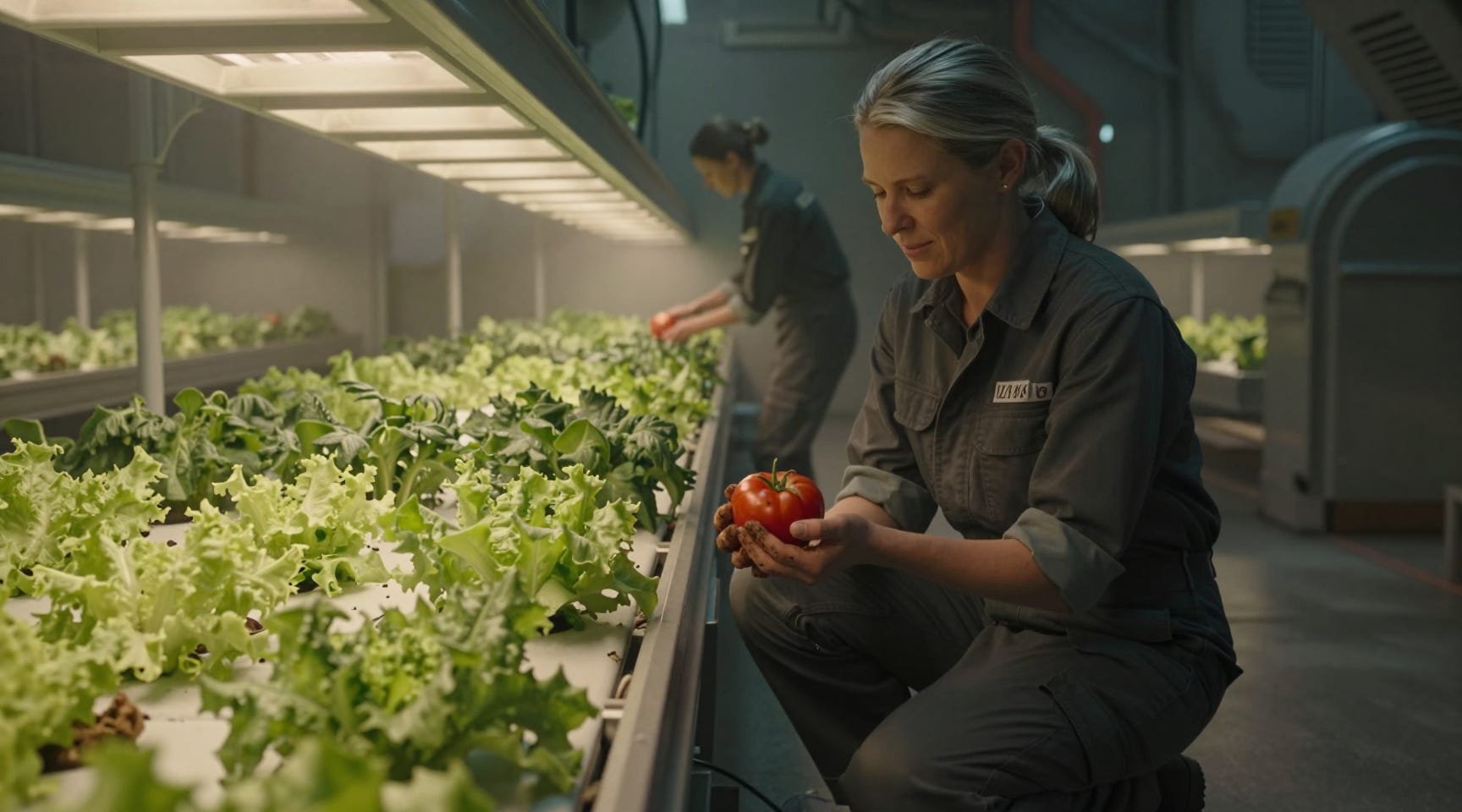
The plants required fourteen Celsius. The lamps gave off a heat that settled in the skin and stayed. The bay ran the length of the primary corridor and fed seventeen thousand people on a footprint designed for twelve thousand. It had not failed once in eleven years. The plants did not care whether rescue was coming. The plants cared about soil and moisture and the lamp cycle. All of those things could be managed.
Sarah stopped at the entrance. Three seconds. She always took three seconds. The warmth and the green and the smell of wet soil and the soft persistent hum of the lamps. All of it held.
She walked the central aisle. The lettuces were good. The tomatoes in the third row were fewer than last month because she had pulled half the rack for the antiseptic herb allotment. The decision had been correct and she hated it anyway. The beans were always the beans.
A woman was harvesting at the end of the row. Her son was with her.
The boy was six. Sarah knew his name and his mother’s name and the name of the sister who had died at four months in Year 9. The colony’s children were seventeen and she had memorized every one. She had written their names on a sheet of paper in Year 3 and carried it in her jacket ever since.
The boy had a tomato in his hand. Small, red, imperfectly round. He had grown it himself in a corner pot that the hydroponics shift had given him permission to use. He had watered it every morning for three months. The tomato was the entire output of a season of waiting and believing a small red thing would appear.
“Administrator,” he said. He held it up.
She stopped in the aisle. The mother was watching from three meters down the row with the small private smile of a parent whose child was doing something she had known he would do.
“That is a very good tomato,” Sarah said.
“I grew it.”
“I know you did.”
She knelt to his level. The tomato was warm from the lamp. The boy’s hands were small, dirt under the nails.
The math came and sat beside the tomato. The colony had six months of food. The colony was eleven years from Earth and eleven years from anywhere. If no ship arrived.
If no one comes, this child will not see his eighth birthday.
She did not say it. She did not let her face change. She handed the tomato back with the same steady hands she had used to sign the ration cut an hour ago.
“Keep growing them,” she said. “The colony needs every tomato you can make.”
The boy nodded and held the tomato in both hands. Sarah rose. The mother’s smile had not changed. Sarah continued the aisle.
She did not look back.
The comms bay was cold again. Nine Celsius. The console was where it had been for eleven years. The chair had been repadded twice with cloth from a body bag they had not needed yet.
She sat. The diagnostic ran clean. The alignment held to within two arc-seconds. The recording channel came online.
She spoke the four sentences she had spoken twelve thousand times.
“Seventeen thousand souls. We are still here. Please. We are still here.”
Her voice was different. She did not let herself hear it. She added the coordinates and the timestamp and the same brief catalogs of needs and failures. She sent the broadcast the way she sent it every morning. The bay gave her back its patient quiet.
The array stood down. The transmission window closed. The viewport screen looped its eleven seconds of borrowed sky.
She sat for a minute.
Somewhere in the dark beyond the Kuiper Belt, a ship’s keel was being laid by hands that did not know her name. Somewhere on that ship, a tactical station waited with a channel that would, on some morning, fail to be empty. The woman who would hear the broadcast did not yet know what she was listening for.
Sarah did not know any of this. She knew the math. Six months was not enough. It would have to be enough anyway.
She rose. She put her hand on the cold edge of the console for a moment longer than the work required. The colony needed a thousand small things and every one of them was a reason to stand up.
She went to the next thing.
The bay held its quiet.
If you enjoyed this story, you can follow the main story arc in The Exodus Rush, the first book in The Vethrak Requiem series.