


The container was the wrong size.
Anya Rask stood in the access lane of Mimas Station’s lower-ring freight transit warehouse and ran her eye down the unit’s flank. Standard ration crate hulls were forty centimeters shorter than this one. Standard ration crate hulls also had ventilation grills along the upper seam. This unit had grills along the lower seam, where condensation would pool, where heat would lift, where supplements designed to stay cold would degrade in three days instead of three months.
She had been on Mimas seven hours. Maren had stayed back with the Underweight to close out the brokerage paperwork on the cell from the Saltline pull. Anya had walked the warehouse rows for a contracted off-skiff job: spot-checking transit manifests for an independent shipping clerk who paid in vouchers and was honest enough about the work. Eleven units cleared. The twelfth was wrong.
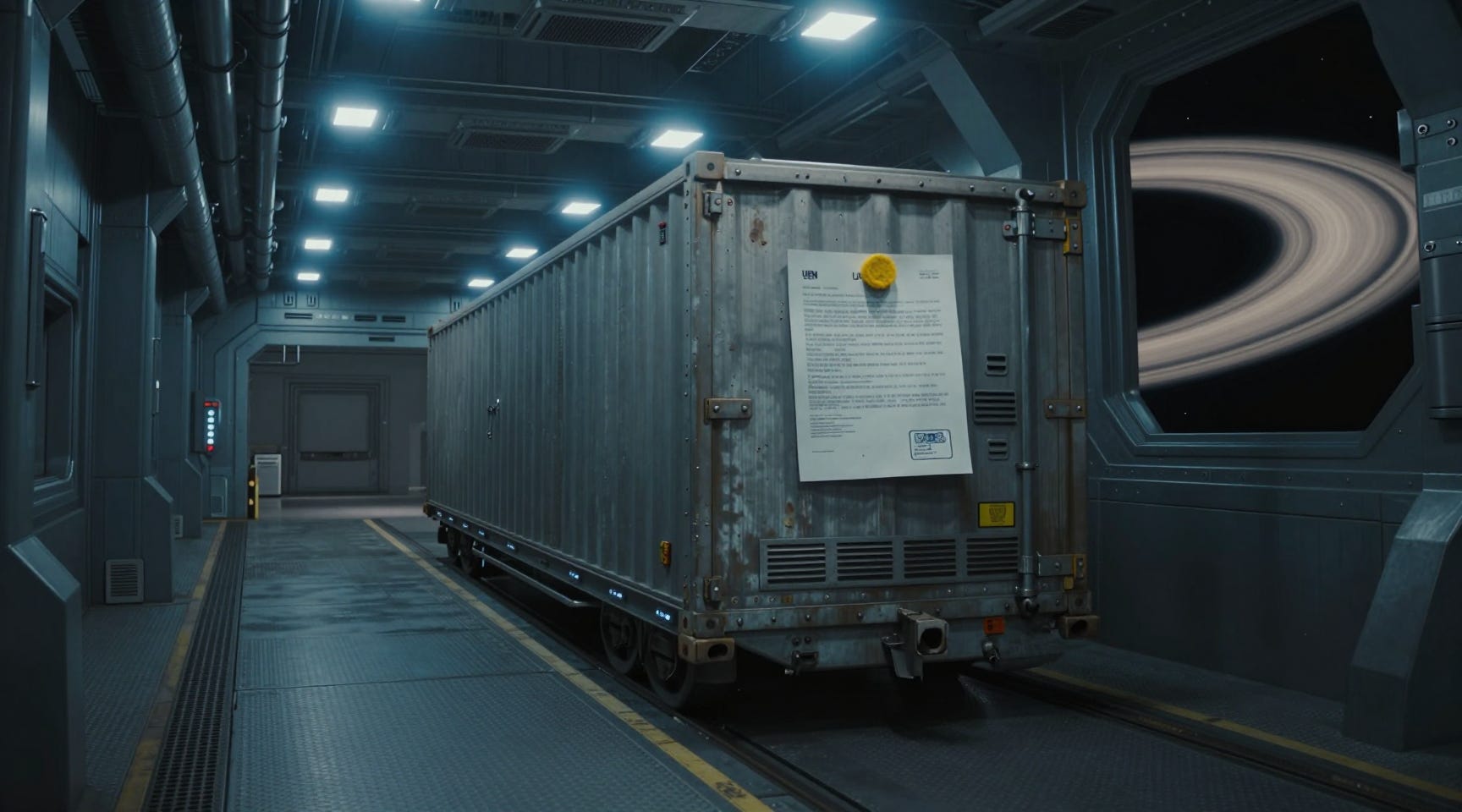
The handler came around the corner of the lane.
He was younger than her, narrow at the shoulders, ring-belt thin. His coverall bore a Pallas freight crest stitched on over an older crest. The older crest was UEN distribution. He had not been careful with the seam.
“You the spot-check,” he said. It was not a question.
“Yes.”
“This one’s previously inspected. Pallas paperwork. Came through clean two days ago.”
She looked at the manifest he handed her. The yellow pip was already on the upper-right corner of the form. A small mark, the size of a thumbprint, made with a felt-stamp she had seen in the Salvage Protocol office. Iso Pruvit’s office had three of those stamps in a drawer. Probably every Protocol office in Sol had them.
The pip meant the container had cleared a prior inspection at another node and the receiving station was being asked to wave it through. An informal courtesy, no statute behind it. The counter-stamp she would apply at the lower-right corner meant she had verified the prior inspection by checking the receiving manifest against the source.
She had not been given a source manifest.
“I’ll need the Pallas intake document,” she said.
“Couriered separately. It’s en route.”
“En route from Pallas.”
“Yes.”
“You want this through tonight.”
“Yes.”
The handler’s hand went to his coverall pocket. He came up with a chip, the small one-time kind, the kind that carried a credit transfer that did not log against any central account. He set the chip on the rim of the container at her elbow.
“For the inconvenience,” he said.
She looked at the chip. She looked at the container’s lower-seam grills. The arithmetic ran clean in her head. The container was not Vethrak. The container was not weapons. The container was rationing supplements, the kind UEN distributed to refugee staging camps on the inner moons, the kind that should never have been on a Pallas freight line at all.
The handler’s eyes were on the chip.
“What’s the inconvenience,” she said.
“Counter-stamp. That’s all.”
“Just the counter-stamp.”
“Just that.”
The chip on the rim did not move. The grills along the lower seam did not move. Somewhere inside the container, the contents that should have been sitting at four degrees in a UEN warehouse on Phobos were, instead, lifting toward seven.
She picked up the chip.
The credit value lit briefly on her wrist comm when she pocketed it. Two hundred forty. The exact amount that would have moved through her Salvage Protocol account in a week of legitimate intake. The exact amount that, three months ago, would have been nothing she thought about.
She set the manifest on the container’s upper plate. Her pen came out of her sleeve clip. She wrote the date. She wrote her certification number. The pen wrote in the slow steady ink that took seventy hours to bond, the kind that could not be unwritten without taking the surface paper with it.
The counter-stamp went on the lower-right corner. A small mark, the size of a thumbprint.
The handler picked the manifest off the plate and was gone before she had clipped her pen back into her sleeve.
She walked the access lane back toward the warehouse exit on legs that did not feel like hers.
Outside, the lower ring’s corridor lights ran cold blue along the deckhead. Mimas at 0400 station-time was a place of low traffic and slow shifts. Three deck workers passed her at intervals. None of them looked at her.
Her wrist comm chimed.
Maren’s voice was tired in a way that meant she had been awake longer than she should have been. “How’d the spot-check run.”
Anya keyed the channel. Her voice came out in the same steady register she had used with the handler.
“Eleven clean. Twelfth had a yellow pip from Pallas. I counter-stamped.”
The channel held.
Three seconds. Four. Five.
“You back at the Underweight by 0500,” Maren said. The pitch had not changed. The subject had.
“Yes.”
“There’s coffee in the recycler. The good batch, not the third pass.”
“Acknowledged.”
The channel cut.
Anya stood at the corridor junction where the lower ring fed into the dock spine. The blue lights ran their slow gradient across the deckhead. She stood with her arm at her side and her hand inside the chest pocket of her work shirt and her fingertips against the small piece of hull plating with the Polaris serial stamp on it.
The metal was the same temperature it had been an hour ago.
The metal would be the same temperature an hour from now.
She held it for a count of ten and told herself that the woman whose brother had been on the Polaris and the woman who had counter-stamped a Pallas manifest at 0400 on a Mimas warehouse floor were the same woman, and that the count of ten would be enough to make that true.
The count went to ten.
She took her hand out of her pocket and walked the rest of the way to the dock spine.
The chip in her side pocket weighed nothing. The pen in her sleeve clip weighed nothing. The mark on the lower-right corner of a Pallas manifest, in ink that took seventy hours to bond, would still be there in seventy hours. It would still be there in seventy weeks.
She did not look back at the warehouse.
She reached the Underweight’s berth and cycled through the airlock and the cabin smelled of the second-pass batch on the recycler and Maren had a cup already poured and waiting.
Maren did not ask.
Anya did not say.
The cup was warm.
Author’s note: Day Four of the Iron Wake Origins arc. Anya Rask is on Mimas Station for an honest contracted job, spot-checking freight manifests for an independent shipping clerk. The twelfth container of the night is not what its paperwork says it is. The handler offers two hundred forty credits for a counter-stamp. Anya signs. The container is not Vethrak. The container is not weapons. The line she crosses is not the last line she will cross. It is the first one. The yellow pip in this story is the informal courtesy that, by Year 13, will be a codified Iron Wake authentication marker on cargo moving through Pallas. Tonight it is a thumbprint of felt-ink on a Pallas manifest, and a sentence Maren does not say across an open comm channel.
If you enjoyed this story, you can follow the main story arc in The Exodus Rush, the first book in The Vethrak Requiem series.