


Tuva had brought no torch to the last inspection. Her empty tool loop kept catching her thumb.
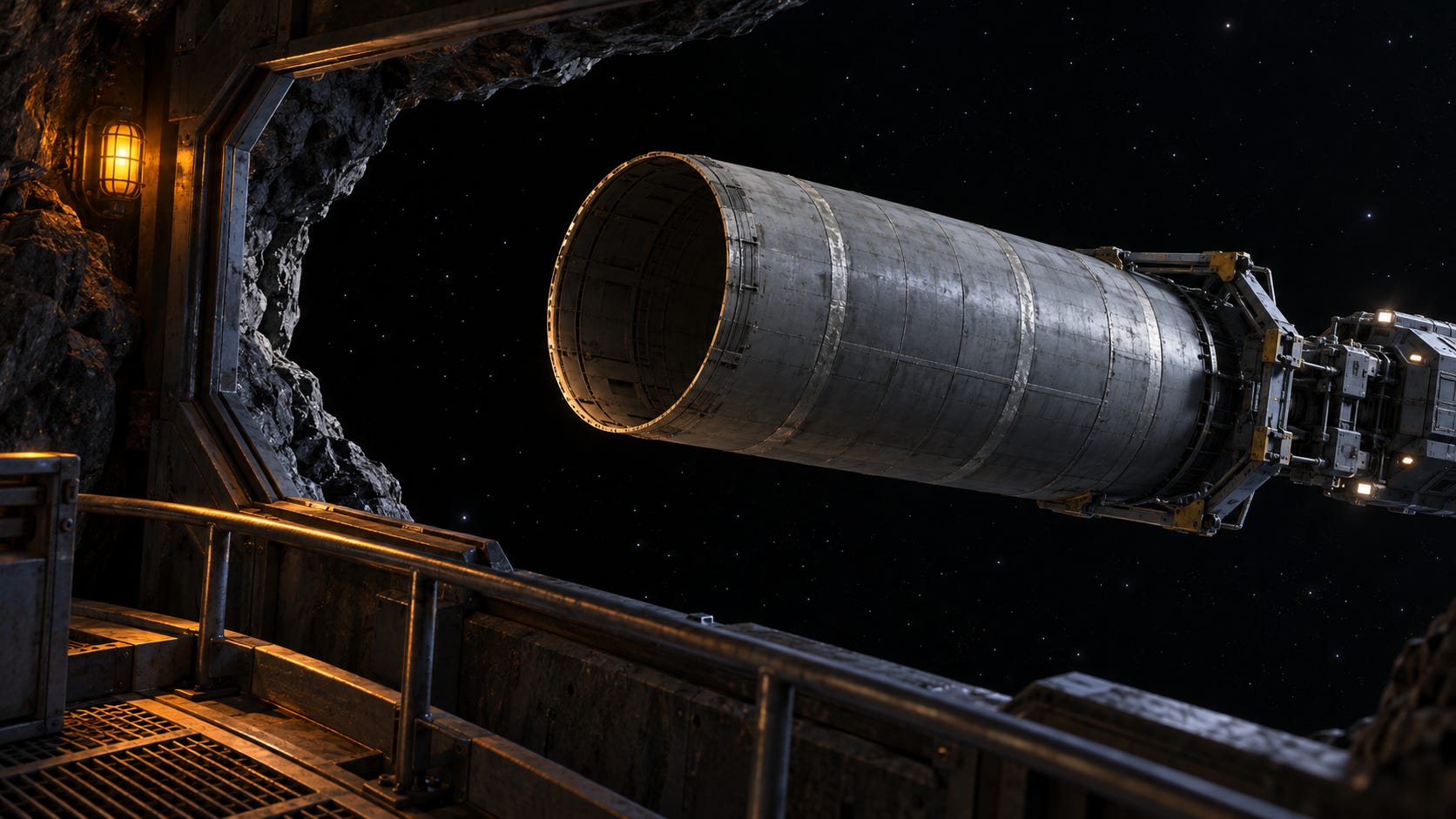
Article Four waited in its cradle, a gray barrel of ordinary steel that would join two pressure-hull sections somewhere beyond the yard. The repaired transitions held a different finish under the work lamps. Yesterday’s removal crew had taken away the temporary tags. Tuva could still put her glove on the places they had covered.
She clipped to the access rail and opened the released work package.
The first repaired transition matched its location drawing. She followed the reference to Wanjiku’s acceptance, then moved to the next position. Nothing in this final check asked her to improve the seam. Heating it again would mean opening work already closed, disturbing metal whose cooling and proof records were complete.
Her thumb found the empty loop once more. She hooked it around the rail instead.
A transfer rigger waited beyond the cradle boundary. Their reader carried the separate custody code Onur had issued. A covered lamp made a small white patch on their glove.
“Anything left for you?”
Tuva checked the third location against the package. The last field asked her to confirm the execution references for handoff. Her original conditional signature remained behind the repair, still saying only what she had been willing to sign then.
“No work left,” she said.
She confirmed the references. Wanjiku’s structural release stayed in its own field. Tuva closed the reader and drew herself back along the handrail, clearing each clip before moving the next. At the boundary she counted her equipment into its carrier. The empty torch loop was correct.
The rigger acknowledged her clearance.
Slings tightened under controlled tension. Once the crane had accepted the load, the cradle restraints withdrew from the barrel. A narrow gap opened where steel had occupied Tuva’s reach for weeks. The crane moved along tracks bolted into the asteroid, carrying the module toward the internal transfer lock.
She followed through the personnel corridor.
At the lock station, the local crew compared the recessed data tag with the outgoing engineering package. The random lifecycle token matched. Tuva leaned against her restraint strap while the reader passed from one gloved hand to another. Nobody touched her seams.
The handler nearest her caught a loose turn of tether and secured it. “You made the transitions?”
“The originals and the repairs.”
They glanced at the barrel, then back to their transfer display. “Good to have the repair limits in the package.”
Tuva had expected a question about the delay. She opened her mouth and found she had no explanation to give this person. They already had the part they needed.
“Keep them with it,” she said.
“They go with it.”
Beyond the station, a second crew member checked the local approach clearance for the unnamed tug. Their route display ended at the assigned handoff. Nothing showed the barrel’s eventual vessel. These people could bring it out of the yard without knowing where it would spend the rest of its life.
Tuva almost asked whether they ever received news of what they carried. The handler turned to answer a rigging call, and she let the question stay with her.
Samrawit came through the corridor with a closed sample carrier held against her chest. Its tether ran short to her harness. Tuva recognized the fitted case that held the removed material.
“Those aren’t going?”
“Retained here.”
Samrawit shifted her grip to clear the station. The case passed close enough for Tuva to recognize a scrape near its latch. Inside were pieces cut from the work she had once defended, each still identified by its place and orientation. Sound metal could leave. The evidence of what had failed would remain.
“All of them?”
“All of them.”
Tuva gave her room. Samrawit took the rail toward the materials bay, carrying the old seams away from the new ones for the last time Tuva would see them together.
The lock crew called the corridor clear. Tuva moved into the shielded observation recess and secured both feet. Through its narrow view, Article Four passed beyond the inner threshold. Bare plate crossed the light without a manufacturer stamp or a hull name. The slings moved so slowly that a small patch of pale finish took several breaths to pass the edge of the frame.
Cho’s voice entered the local circuit from construction control.
“Slip Two clear. Next package coming through.”
Behind Tuva, a carrier caught its stop on the corridor rail. She turned. Her next work package was clipped to its front, alongside a closed gauge case. A handler held the carrier until she took custody, then pushed back toward the bay.
She wanted the empty slip to stay empty a little longer.
The transfer lamp still glowed beside the observation view. Article Four had not finished leaving, and already someone had measured the space it would leave behind.
Tuva clipped the carrier to the recess rail. “Received.”
Cho left the circuit open. Through the construction-control window across the corridor, his face remained turned toward the lock display. He had sent the next job. He was staying for this one.
The inner door closed. Tuva waited through the lock cycle with one hand on the carrier’s retaining strap. The outer transfer appeared in the recess view afterward: the barrel captured in the tug’s handling frame, the tug itself mostly hidden by shielding. No name came over the circuit. The local crew reported their checks in voices flattened by the channel.
Departure clearance followed.
Article Four moved across the narrow field. Its repaired bands disappeared first, then the rim nearest the light. Tuva searched for the recessed tag, although she knew its pocket faced away from her. There was nothing to read on the departing curve.
She kept her hands on the strap until the last gray edge slipped beyond the shield.
The transfer lamp remained lit. Local departure was not remote acceptance.
Tuva released her foot restraints and took the next package back to Slip Two.
Hours later, she was matching its joint drawing to a gauge when the custody acknowledgment arrived. The temporary code disappeared from the active board. Its completed transfer record remained in the history; the lifecycle token still stood beside the engineering package.
She put the gauge in its fitted recess before opening anything else.
Wanjiku closed the release record’s transfer follow-up. Onur’s local confirmation left the source partition and builder roll under their retained restrictions. Neither announcement named a destination. Tuva would receive no view of the next crew fitting her work into theirs, no face to attach to the pressure the barrel might someday hold.
The engineering package still offered the blind return path Onur had tested. A later inspector could ask what had been examined, or which repair limit applied, without learning this corridor or the names of the people in it. The answer could reach them. Her name did not have to travel with it.
Tuva brought her glove close to the display, then stopped short of touching it. She had wanted to leave some small mark on the barrel, something the next pair of hands might recognize as another person’s work. The pale repaired bands would have to serve. Any scratch she added now would give them one more unexplained thing to examine.
She opened her builder-roll receipt.
Her name appeared beside her accepted work references and the sealed-record confirmation. The receipt confirmed her own association. It offered no list of the people whose hands had shared the barrel with hers.
She checked the original execution reference, then the repair. Both remained. Somewhere in the protected record, Cho’s decisions had their own accountable owner. She did not need to open them to make hers more real.
Tuva closed the receipt.
The new package waited at the fit-up drawing. She secured the reader where she could consult it without releasing the gauge. There would be another seam, another point at which somebody needed her answer to mean exactly what it said.
First, she checked the material history.
The last view of Article Four stayed with her: blank steel turning darker against space. Her name had stayed in the rock.
Author’s Note
Site Anvil is one hidden piece of humanity’s emergency reserve in late Year 3. Its builders are protected and obscured by the same secrecy. This story closes October’s Article Four arc without opening the yard’s records to the public.
New to The Vethrak Requiem? Start with The Exodus Rush, Book 1, where humanity fights for survival after an alien invasion using technology it barely understands. These short stories explore the wider universe; the novel begins the main story.