


The diagnostic screen showed green across every system and Thomas Okonkwo did not trust it.
He ran the calibration sequence a second time. The same screen. The same green indicators scrolling down the list like a report card that refused to show a failing grade. Reactor calibration within point-zero-three percent of nominal. Fold drive cooldown complete, all harmonics damped to standby thresholds. Aurora Drive alignment holding at ninety-seven-point-eight percent efficiency despite eleven weeks of continuous combat readiness. Shield generators cycling through diagnostic mode with no detected anomalies. Every subsystem on Vanguard reporting the same thing: functioning. Nominal. No action required.
The engineering bay was quiet around him. Docked ships were quiet ships, their reactor outputs dialed down to standby, their ventilation fans running at habitation minimum, their hulls still and cool in the Prometheus Station construction frameworks. During the depot raid the engineering bay had been a cacophony of status alerts and intercom traffic and the subsonic vibration of systems running past their design thresholds. Thomas had known exactly what to do with every alarm, every anomaly, every moment of crisis. His hands had moved from console to conduit panel to diagnostic override without conscious thought, an engineer’s muscle memory forged in months of Park’s training and years before that of his father’s voice in his head: systems break, but they can always be fixed.
The diagnostic finished its second pass. Green. Green. Green.
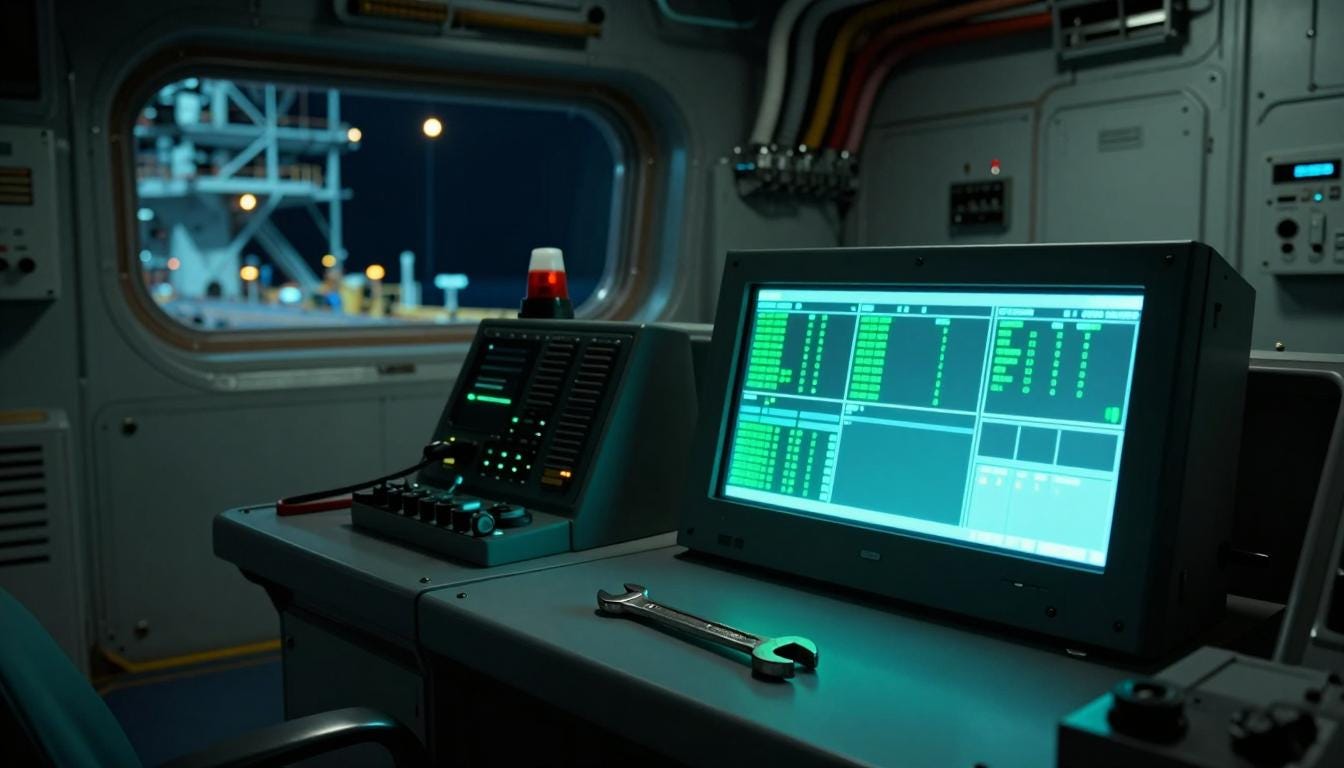
A wrench lay on the console beside his right hand. He had placed it there at the start of the diagnostics, the way he always placed it there, the way Park had taught him: a tool at hand is a tool you do not have to think about reaching for. Thomas’s hand had reached for it twice during the first diagnostic run, automatically, before his brain caught up with the fact that there was nothing to fix.
He picked it up. Turned it once in his palm. The weight was familiar in a way the quiet was not.
His father had held this wrench. A Nigerian Navy engineer, Lagos yard, the Auxiliary Fleet before the invasion. He had died of radiation exposure three years after the Vethrak came, the cleanup operations claiming the men who had crawled into dying reactors to salvage components the fleet needed. Thomas had been nine. His mother had given him the wrench at the funeral, wrapped in cloth his father had used to clean it after every shift. The cloth still smelled faintly of machine oil after fourteen years. The wrench traveled with him to engineering every day.
His father’s voice was fading. Not the words. The words were still there, etched into memory: the litany of maintenance checks, the diagnostic mnemonics, the low opinion of factory-standard calibration tolerances. What was fading was the sound of the voice itself. The Lagos accent, softened by years of UEN service but still present in the vowels, in the cadence. Thomas could recite his father’s lessons in his own voice now. He could not remember the last time his father’s voice had been there in its own sound.
Park’s voice was still clear. Park had been in this same bay eight months ago, leaning against this same console, a cup of coffee going cold at his elbow while he walked Thomas through the Cascade Reactor’s maintenance logs. Park had never raised his voice. He had never needed to. He had delivered hard truths with the same inflection he used for engineering advice, which was the same inflection he used for weather observations and coffee complaints: flat, unimpressed, faintly amused. He had pointed at the reactor readout and said the machine tells you when it is unhappy. You just have to learn to listen. Thomas had thought at the time that Park was talking about the reactor. He understood now that Park had been talking about everything.
The wrench was warm from his hand. He had been holding it for three minutes without turning it.
Park had died in the Battle of Earth. The reactor pulse. Thomas had been at the engineering station on Vanguard’s bridge, running power distribution while the ship shook around him. Park had been in the auxiliary control room two decks down, manually rerouting coolant lines because the automated system had failed and someone needed to keep the reactor from breaching. Park had kept it from breaching. He had also absorbed enough radiation that the medical team classified his survival chances as negligible before they finished the scan. Thomas had not been there when he died. He had been on the bridge, keeping Vanguard fighting, because Park had taught him that the ship comes first and the grief comes after.
The grief had come in the engineering bay at 0300 during the first depot raid planning sessions, when Thomas had reached for the intercom to ask Park a question and remembered. It had come during the fold extraction, when the harmonic dampeners had drifted and Thomas had fixed them without thinking, because Park had taught him how, and the fix had held. The grief had become a steady presence after that. Not a wound. A weight. The kind of weight a tool carries.
He set the wrench down. The diagnostic screen refreshed, still green. There was no threat. There was just a ship in drydock with every system functioning and an engineer who had spent the last eleven weeks running on adrenaline and was now running on nothing at all.
The hatch cycled. A junior engineer entered the bay. Young, younger than Thomas, which meant he was fresh from the Academy replacement rotations that had filled the gaps the Battle of Earth had left in the fleet. His uniform was too new. His collar was too stiff. His expression shifted through the sequence of someone who had expected an empty bay and found a lieutenant instead.
“Sir.” He hesitated. “I’m Sung-min. Kang. Shift change.”
Ensign Kang straightened. His eyes took in the bay: the diagnostic screens, the wrench on the console, the lieutenant who had been sitting in the dark for what the ensign’s eyes probably calculated was longer than necessary. Thomas remembered being that ensign. He remembered Park watching him take in the bay the same way, his first week aboard Vanguard, his uniform stiff, his hands uncertain. Park had let the silence stretch for exactly five seconds before he had said the engineers who ask questions live longer than the engineers who pretend they know the answers. Ask me anything. Thomas had asked him twelve questions in the first hour. Park had answered all of them.
“Everything’s working,” Thomas said.
Kang nodded. His eyes went to the diagnostic screen. Green. Green. Green.
“That’s good,” Kang said, and something in his voice said he meant it, and something else said he did not yet know that green across the board meant the shift would be long and quiet and entirely without the kind of crisis a newly assigned ensign hoped would prove his worth.
The hope in the ensign’s voice was unmistakable, and Thomas remembered being that hopeful. Park had been gentle with the hope without indulging it. The exciting shifts are the ones where people die, Park had said, on Thomas’s third day. The boring shifts are the good shifts. Boring shifts look like this. Green. Boring shifts mean the ship gets to fly tomorrow with the same crew it had yesterday. Thomas had not understood that until after Park died. He understood it now.
“Your section’s numbers are clean,” Thomas said. He pointed at the shield generator readout. “The tertiary harmonic dampener has a calibration drift of point-zero-one percent. It’s within tolerance. But if you track it over the next three shifts and the drift accelerates, the fix is a manual recalibration through the secondary bus. The manual says to cycle the primary bus, but that requires taking shields offline for forty minutes and the primary bus is fine. The secondary route does the same thing in six minutes. Park taught me that.”
Kang stared at him. Thomas had delivered that entire block without stopping. The way Park used to. The way his father used to.
“Write it down,” Thomas said.
Kang fumbled for a datapad. Wrote something. Looked up. “The secondary bus route. That’s not in the manual.”
“The manual was written before the depot raid. The depot raid taught us things the manual hasn’t learned yet.” Thomas stood. His hand found the wrench on the console, the weight settling into his palm. He turned it once. “The gaps close, Ensign. You just have to track them.”
Kang looked at the wrench. Looked at Thomas. Something in his expression shifted the way Thomas’s had shifted, eight months ago, when Park had said the machine tells you when it’s unhappy. The moment when a lesson landed and the person receiving it did not yet know what it meant, only that it meant something.
“Lieutenant,” Kang said. “Do you need anything? For the next shift.”
Thomas looked at the diagnostic screen. Green. Green. Green. The ship was working. The crew was working. He had just taught someone something Park had taught him, and the someone had listened, and the someone would track the drift, and the drift would get fixed, and the ship would keep flying.
“No,” he said. “Everything’s working.”
He put the wrench in his toolkit. The toolkit closed with a click that was louder in the quiet bay than it needed to be. He walked toward the hatch. Paused. Park had always paused at the hatch, a habit Thomas had never understood. He understood it now. The pause was a check. Not of the systems. Of the person replacing you. The pause asked: are you ready? And the pause gave the person being asked the chance to say no.
Kang was still looking at the diagnostic screen. His datapad was in his hand. The secondary bus route was written down.
“Ensign,” Thomas said.
Kang looked up.
“Good work.”
The hatch cycled behind him. The corridor was quiet, the shift change traffic not yet at its morning peak, the reactor sound a soft standby hum beneath the deck plating. Thomas walked toward the mess. His hand was empty. The wrench was in the toolkit and the toolkit was in his hand and the diagnostic screen behind him was still green.
He did not look back.
If you enjoyed this story, you can follow the main story arc in The Exodus Rush, the first book in The Vethrak Requiem series.