


The wrench was on the dresser where Thomas had put it three hours ago when he started packing.
He had not moved it since. The bag was half full: two sets of duty uniforms, a spare pair of boots, a pad with engineering manuals he had been annotating since his second year at the Academy. The wrench sat on the dresser, wrapped in a square of oilcloth gone soft with twenty years of use. Thomas could not bring himself to put it in the bag.
He put it in. He took it out. He put it in again and closed the bag and opened the bag and took it out.
Outside the small window, Lagos was a low grid of lights and noise and heat. The apartment was two rooms and a kitchen. Thomas had lived here his whole life except for the Academy years, and in those years the apartment had grown smaller every time he came home. Tonight it was the smallest it had ever been.
His father had given him the wrench when Thomas was nine years old. Three days before the end.
The final cleanup rotation had been a reactor site in the Abuja exclusion zone. His father had pulled three shifts in four days and had not told anyone. When the fever started, he was already too far gone.
His father’s last words were not about the wrench. The wrench had come earlier, at home, in the small workshop behind the apartment building where his father kept a bench and a vise and a drawer of bolts organized by thread pitch. Thomas had been struggling with a coupling on an old water pump. The bolt was stuck.
Feel it, his father said. You do not force a stuck bolt. You feel where it resists, and then you work the resistance.
He put the wrench in Thomas’s hand and guided it. Systems break. Every system. Water pumps, reactor housings, ships. The ones that break are not the ones that were weak. They are the ones that were pushed past their give. You feel the give. You work the give. You do not push harder than the give allows.
Thomas loosened the bolt. His father smiled, and the smile meant something Thomas only understood later: his father was already sick. He had chosen to spend the hour showing his son how to loosen a bolt.
His mother was in the kitchen.
The smell of jollof rice filled the apartment. Fish frying in a pan beside it. She had been cooking since the late afternoon, which meant she had been cooking since the morning, which meant she had not slept. The night before every departure that mattered.
He leaned against the counter. She did not look at him. Her hands worked the fish with the wooden spoon she had used since he was a child.
You packed? she said.
Almost.
She nodded. The fish sizzled. Outside, the neighbor’s generator coughed and settled into its evening rhythm.
They ate at the small table.
They talked about the neighbor’s generator and the price of fish and whether the rainy season was coming early. She told him about the new spice shop that had opened two streets over. He told her about the engineering manuals. The assignment sat between them like a third person who had not been invited.
He had not told her the ship name or the billet. He had not told her that an ensign fresh from the Academy had no business on the first warship humanity had built in twelve years and everyone in his graduating class had said so.
She knew. She had always known. She let him not say it.
After dinner, Thomas washed the dishes.
His mother dried her hands behind him. The radio on the windowsill played something low and old, a song his father used to hum.
Your father would have wanted to see you on a ship that did not have to fight a war that was already over, she said.
She said it without looking at him. She said it the way she said everything that mattered: quiet, direct, as if the words had been sitting in her chest for eleven years and she was only now giving them permission to leave.
Thomas kept washing the plates. He had been six when the sky caught fire. He remembered his mother pulling him under the table. He remembered his father coming home two days later with his uniform burned on one side and his eyes on something Thomas could not see. The months after. The years after. The rebuilding his father had worked himself into a grave for.
I know, Thomas said.
His mother put the towel down.
You do not know, she said. You think you know. You will know later, when you are on that ship and you understand that your father did not die because the war was lost. He died because the war was so close to being won that he could not stand to stop fighting.
She walked past him, pausing at his shoulder. She did not touch him. She did not need to.
Thomas stood alone in his room.
The bag was packed. The wrench was inside it, wrapped in its oilcloth, tucked into the side pocket. He had carried it through three duty postings. He had carried it through the Academy, through the night the instructor had pulled him aside and told him his reactor-core diagrams showed promise but his attitude needed adjustment, through the semester he almost failed because he had stopped believing that a boy from Lagos whose father died in a cleanup rotation belonged among officers whose fathers died in fleet actions.
The Academy had almost not let him graduate. He had passed the engineering exams with the highest reactor-score in his class. The command track had flagged him as difficult. The review board had spent six weeks deciding whether an ensign who argued with instructors was worth the trouble.
The Vanguard assignment had settled the question. Somebody at Prometheus had read his file. Somebody had seen the reactor scores and the safety-margin argument and decided that a kid who argued for the margins was worth putting on a warship that would need to operate far from a dockyard.
Thomas did not know who that somebody was. He was going to find out.
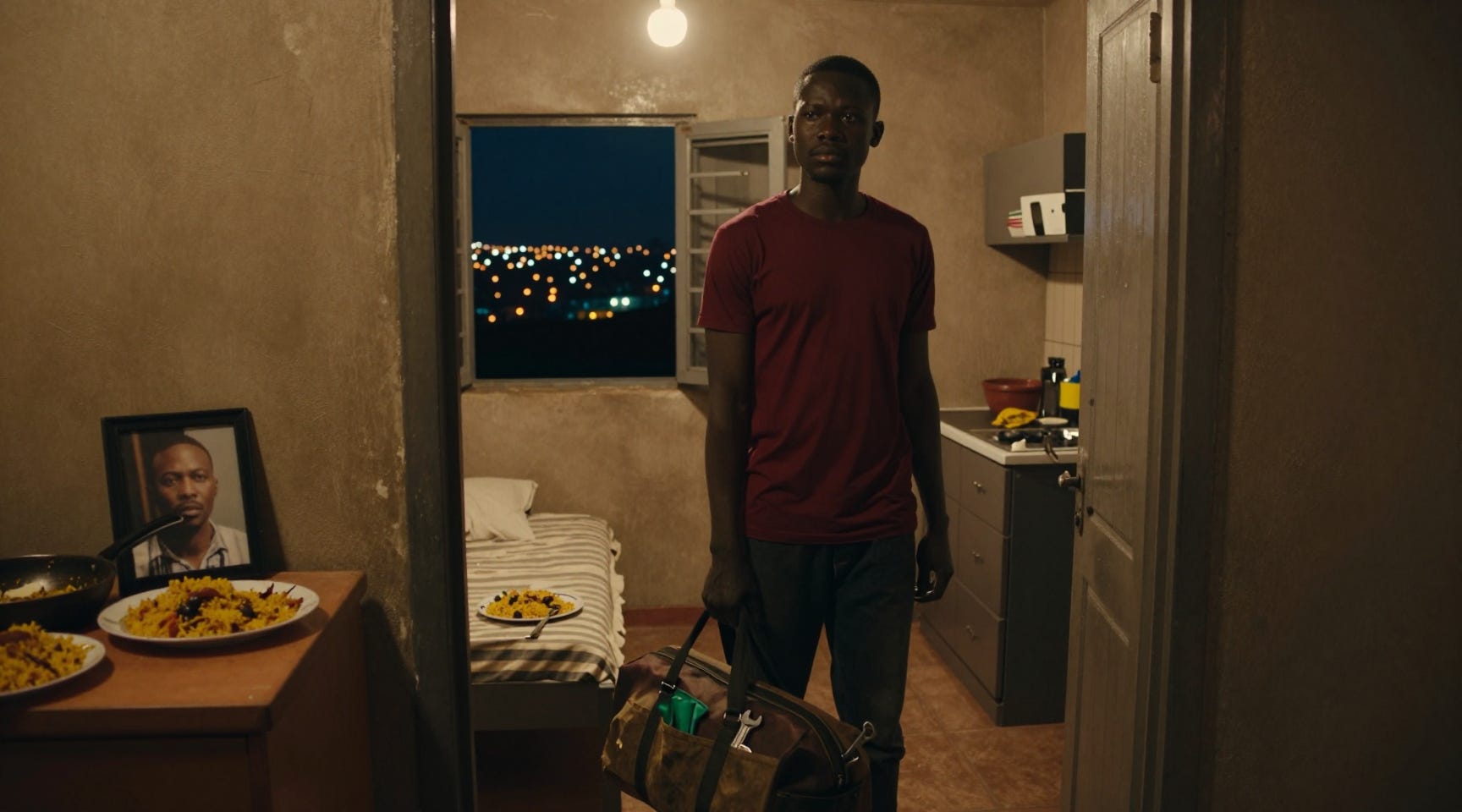
The framed photograph of his father was on the dresser.
A small photo in a metal frame, taken at the workshop bench three months before the cleanup rotation. His father was holding a manifold coupling from a civilian transport, the kind of repair he did when he was not in uniform. He was smiling.
Thomas picked it up. He looked at it for a long moment. Then he set it down, face up.
The wrench was enough. The wrench had always been enough. Carrying both would be carrying a grave, and he was not carrying a grave onto a warship. He was carrying the thing his father had taught him: how to feel the give. How to work the resistance. How to know that every system breaks at the point where it was pushed past what it could hold.
He picked up his bag. The apartment was quiet. His mother was in her room with the door closed.
Thomas stood in the doorway of the apartment he had lived in his whole life and did not look back.
Outside, the shuttle depot was a twenty-minute walk through streets rebuilt once and due to be rebuilt again. The first warship humanity had built in twelve years was waiting in orbit. An ensign who had almost not graduated was reporting for duty in the morning. Somewhere in the ship’s hold was an engineering station that did not know it was about to get a boy with a wrench and a dead father’s instructions.
Thomas walked.
If you enjoyed this story, you can follow the main story arc in The Exodus Rush, the first book in The Vethrak Requiem series.