


Foreman Cho removed the next proof block from Slip Two. The thermal forecast still crossed its limit before the observation window ended.
Article Four occupied the yard’s largest load cradle with its transfer code locked. Three cracked transitions held the barrel in place. Canceling the test had saved power, but the people investigating it still needed light, instruments and air.
Cho tightened his station restraint and put the forecast beside the reactor allocation. Below both, the geometry clock counted down toward the interval when the yard’s usual heat rejection would become too visible along a known line of sight.
No contact alarm. No report of a vessel searching the Hilda group. The same calculated window had sat in his schedule before the first plate entered Article Four.
The environmental technician clipped her slate into the adjacent bracket.
“That version includes the laboratory request,” she said.
Cho opened it. Preparation equipment, examination lamps, instrument power. Each load looked small beside a torch bank. Together they took storage margin already assigned to the people breathing inside the rock.
“Which part can wait?”
“The equipment request is yours. The heat limit isn’t.”
She displayed the reservoir readiness record. The coolant had been chilled ahead of closure. The phase-change store could take a measured quantity of heat while its material changed state. The rock would absorb another bounded share. None of those reserves renewed itself because he moved a job to a different column.
Cho checked the starting temperatures against the forecast. The technician had used the measured values, not the colder targets from the preparation plan.
He kept her version.
The first shutdown acknowledgment came from Bay Three.
Cho opened the test supervisor’s retained work position. The equipment had reached its safe stopping condition. Stored results were secured; the high-output request was withdrawn. No unfinished test hid beneath the word complete.
He accepted the shutdown and watched the reactor demand step down.
The environmental technician confirmed the coolant transfer path before the radiator configuration changed. External surfaces moved into their scheduled masked or reoriented positions, away from the observation geometry. Heat still traveled out of working equipment. Pumps still carried it. During this interval, more of it would stay inside the yard’s prepared stores.
Cho moved the thermal-capacity clock alongside the reactor limit, where a shift controller would have to read both.
An equipment panel could show spare electrical capacity while the heat store had no room for the work that capacity could perform. He linked the two constraints to the same authorization screen.
The ventilation outlet brushed his cuff with cool air.
“Habitat circulation?”
“Held. Scrubbing held. Cooling flow confirmed.”
He read back the protected loads before reducing the work allocations. Task lighting stayed where crews needed it. Unoccupied scaffold banks went dim. Torch output and nonessential high-power equipment lost their scheduled permissions.
The proposal to borrow a laboratory block returned to his screen with a shorter duration.
Samrawit Assefa joined the local channel.
“I can reduce the preparation set,” she said. “Microscopy and the retained sections first. The rest can wait for a reviewed allocation.”
Cho applied the smaller request. The forecast settled beneath the limit with its reserve intact.
“This is the allowance,” he said. “Not a target to use up.”
“I’ll keep the actual operating times.”
He attached her revision to the first request. The larger figure belonged in the history. The next shift needed to know which version had been approved.
Cho pulled himself through the narrow access corridor toward Slip Two. His slate stayed clipped close to his harness; one hand remained on the rail through each junction.
The quieter yard exposed smaller sounds. A restraint buckle closing. Air through a grille. Tool clips tapping their captive rack as a technician checked them.
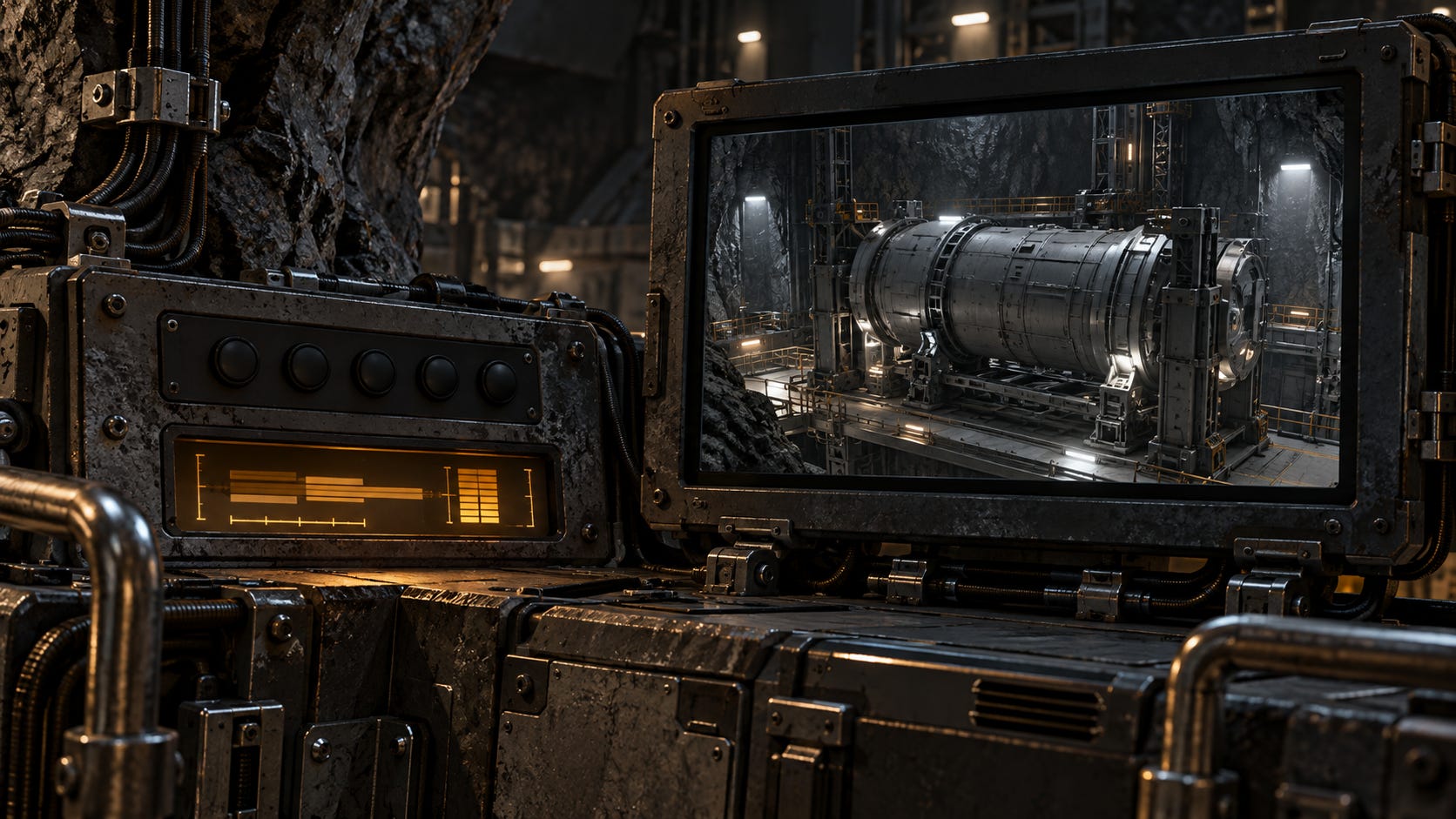
At the inspection boundary, Article Four filled the same volume it had occupied before Wanjiku Bett refused release. Its blank shell caught a strip of task light. The cradle’s reaction members remained anchored into the asteroid, with the actuators isolated and the crane slings restrained clear.
The fixture allocation on Cho’s slate still named no successor.
A rigger fastened beside him and opened the waiting assembly’s dimensions. The worker had put its outline over the occupied cradle, a clean shape drawn through another clean shape.
“There isn’t another fixture with this reach,” the rigger said.
“I know.”
“Can we prepare its mounts here? Leave the barrel captured.”
Cho checked the work against the inspection boundary. Preparing the next job in the occupied space would send people and tools through the area Wanjiku needed to preserve. It would create the appearance of progress by making two unfinished jobs interfere.
“Use the off-fixture checks,” he said. “The boundary stays clear.”
The rigger closed the overlay. The waiting assembly returned to its own record, still waiting.
Cho assigned the displaced crew to tool maintenance and manual dimensional surveys within the approved access areas. He kept cutting and heating out of the Article Four assignments. Existing measurements could be checked; the evidence could not be ground away to make room for a repair nobody had qualified.
Wanjiku read the allocation at the boundary station.
“My release conditions stay attached.”
“All three.”
Root-cause evidence. Approved repair procedure. Repeated full-load proof. Cho left the signed refusal in the work package rather than compressing it to a red icon.
Samrawit’s low-power examination request joined the queue. Onur Tekin had the records work. Rework planning could proceed as a list of dependencies and questions, with no issued repair instruction pretending those questions had answers.
Cho entered the missed tug slot in the sealed schedule ledger. He added the recovery period required to reject the heat they would store through the window. The next available power block could not begin merely because the external links reopened.
He left the replacement transport date unset. No public traffic notice went out to explain why an unnamed module from an unlisted yard would not appear.
The cost stayed on his board.
Back in construction control, the external-status lights were going out in sequence.
The communications operator held the last closure step while its scheduled checks finished. Cho secured his boots and reopened the thermal display. Measured flow and storage temperatures remained inside the approved envelope.
The operator brought up a local proposal beside the remaining link.
“The materials question is short. Two hashes and five fields. We could put it through before this closes.”
Cho opened the attached authority. Samrawit’s technical need was signed. Onur’s design request was signed. The transmission authorization remained incomplete.
The two signatures asked for a safe path. They did not establish one.
“Has the return scope been authorized?” Cho asked.
Onur answered from the records station.
“No. The existing retrieval still exposes the broader package. This request hasn’t been cleared for transmission through the chain.”
The operator’s fingers stayed off the send control.
“Keeping the link open would give us more time.”
Cho put the geometry clock beside the question. The remaining seconds belonged to the closure checks, not to Article Four. A short packet could still leave the yard with an unsupported promise about who might connect its contents to its origin.
“Close on schedule,” he said. “Retain the proposal and the incomplete authorization here.”
The operator read back the instruction. Onur confirmed that the local request remained available for reconstruction during the silence.
Cho watched the final check complete. Nothing had answered the five process questions. Nothing in his thermal forecast repaired a seam. He had given the crews work they could perform and kept the work they could not perform visible.
The last external-status light went dark.
On the internal Slip Two view, Article Four remained captured beneath its work lamps, lit by the share Cho had left it.
Author’s note: This story continues the Site Anvil arc in late Year 3, as the scheduled dark-state window begins. Foreman Cho must keep essential work within the yard’s thermal limits.
New to The Vethrak Requiem? Start with The Exodus Rush, Book 1, where humanity fights for survival after an alien invasion using technology it barely understands. These short stories explore the wider universe; the novel begins the main story.