


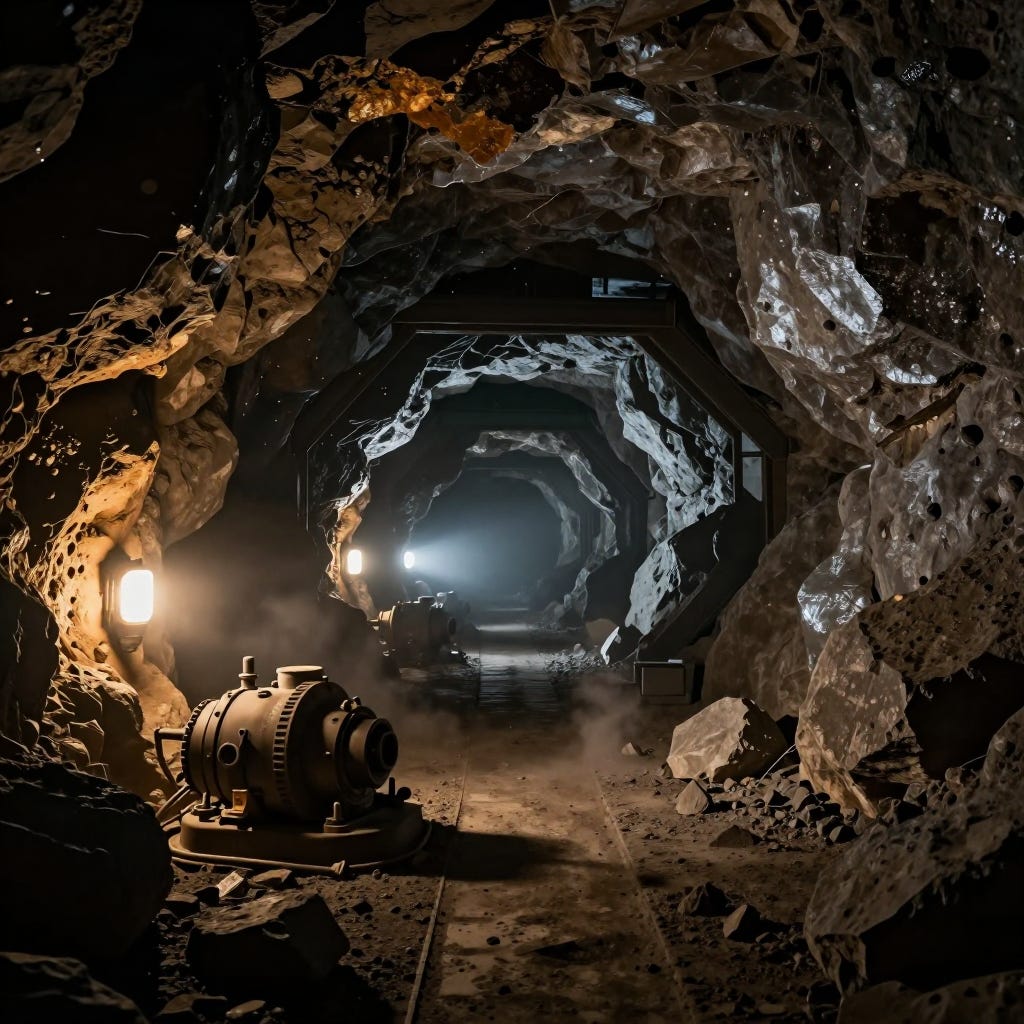
Lena Vasquez pressed her helmet against the rock face and listened.
The vibration hummed through her skull, faint as a whisper, steady as a heartbeat. Twenty years in the belt had taught her what stone sounded like before it moved. This was different. This was wrong.
“Vasquez, you’re three minutes behind schedule.” Foreman Reyes’ voice crackled through her earpiece. “Section 7-Delta needs clearing before shift change.”
She pulled back from the rock. Her headlamp cut through the dust, illuminating the cramped tunnel ahead. Ceres Station paid well because the work killed you in a dozen different ways. Cave-ins. Equipment failure. The slow accumulation of radiation in your bones. She’d watched friends cough their lungs out in medical bays, watched others simply vanish when support beams gave way.
“Copy that. Moving now.”
The drilling rig waited where she’d left it, a squat machine bristling with carbide teeth. She ran her glove across the control panel, checking charge levels, coolant pressure, bit wear. Everything nominal. Everything fine.
The hum in the rock said otherwise.
Lena keyed her radio to the private channel. “Chen, you on?”
Static. Then: “What’s up, old woman?”
“I need you to run a seismic scan on 7-Delta. Full spectrum.”
A pause. Chen was young, maybe twenty-three, born on Luna to parents who’d fled Earth during the invasion. He’d never known gravity heavier than point-sixteen G, never breathed air that hadn’t been recycled a thousand times. The belt was all he’d ever wanted.
“Seismic’s going to take forty minutes. Reyes will have your head.”
“Run it anyway.”
“Lena, if this is another hunch…”
“It’s not a hunch.” She stared at the wall in front of her, at the subtle fracture lines spider-webbing through the gray stone. “The rock is talking. I’m listening.”
Chen didn’t argue. He’d been on the crew when Tunnel 3-Bravo collapsed two years ago. He’d helped dig out the bodies.
Lena settled onto an equipment crate and waited. Around her, the asteroid breathed. Tiny shifts, imperceptible movements, the endless settling of a body four billion years old. She’d spent more time in these tunnels than in any apartment, any station berth, any place that might be called home. Her ex-husband lived on Mars now, remarried, raising kids who’d never know their mother chose rocks over them. Her sister had died in the invasion, one of 2.1 billion who never saw the enemy coming.
The belt made sense. The belt was honest. It would kill you, sure, but it wouldn’t pretend to be something it wasn’t.
“Vasquez.” Chen’s voice cut through her thoughts. “You need to see this.”
“What’ve you got?”
“Void space. Big one. Maybe thirty meters past your current position.” A long breath. “The wall’s holding, but barely. Seismic shows stress fractures propagating. If you’d fired up that drill…”
He didn’t finish. He didn’t need to.
Lena stood, her joints protesting. Fifty-two years old and she moved like seventy. The belt took its toll in more than blood. It carved itself into your spine, your hips, the cartilage between your vertebrae.
“Mark it. Flag the whole section for structural assessment. No one enters 7-Delta until engineering clears it.”
“Reyes is going to lose his mind. We’re already behind quota.”
“Let him lose it. Better than losing a crew.”
She began the long walk back to the main shaft, her boots finding purchase on the uneven floor. The tunnels of Ceres stretched for hundreds of kilometers, a labyrinth carved by generations of miners who’d traded their lives for the iron and nickel that built humanity’s fleet. Every warship hunting Vethrak wreckage, every freighter hauling supplies to distant colonies, every station keeping the species alive; all of it started here. In the dark. In the stone.
The surface airlock cycled her through, and she emerged into Ceres Station proper. Habitat domes rose around her, their transparent walls revealing the star-scattered void beyond. Fifteen thousand people lived here, worked here, died here. The largest concentration of humanity between Mars and the outer colonies.
Shift change had begun. Miners streamed past her, faces gray with exhaustion, eyes hollow with the particular emptiness of those who spent their days underground. She knew most of them by name. Had shared meals with them, argued with them, mourned with them.
Her locker held the usual detritus. A faded photograph of her sister. A union card, worn soft from years in her pocket. A letter from the Salvage Protocol Commission thanking her for her service during the Tunnel 3-Bravo recovery operation. They’d found salvageable alien alloy in the rubble. The miners who’d died had posthumously contributed to humanity’s survival.
She wondered if that comforted anyone.
The mess hall was half-empty when she arrived. Synthetic protein and recycled vegetables, the same meal she’d eaten ten thousand times. A screen on the wall displayed news from Earth. Something about fleet construction, new ships coming online, the inexorable march toward war.
She ate without tasting.
Chen found her there an hour later, datapad in hand. “Engineering confirmed it. Void space is forty-three meters across. Natural formation, probably gas pocket from the accretion period. Wall thickness at your drill site was less than two centimeters in some places.”
Two centimeters. The width of her thumb.
“They’re rerouting extraction to 8-Alpha. Reyes had to push the timeline back six weeks.” Chen sat across from her, his young face caught between relief and something darker. “You saved eight people today. Maybe more.”
Lena looked at him, at this boy who’d chosen to spend his life in the dark so that others might live in the light. The same choice she’d made, all those years ago. The same choice a hundred thousand miners across the belt made every day.
“I listened to the rock,” she said. “That’s all.”
Chen nodded. He understood. Out here, that was everything.
Author’s Note
The asteroid belt’s mining operations represent the unglamorous foundation of humanity’s post-invasion survival. Without the “rock hounds” of Ceres Station and dozens of smaller outposts, the fleet cannot build, colonies cannot grow, and the species cannot endure. This story is dedicated to those who do essential work in dangerous places, far from recognition or reward.