


Captain Elizabeth Shaw drew the late watch on Vanguard every time it came up on the rotation. Twelve watches since her promotion. Twelve nights at 0300 with nothing to fight and everything to notice. A captain who did not stand the worst watch had forgotten what the worst watch taught: that a docked ship was still a ship, and the crew who stood watch in the dark deserved to see their captain standing it with them.
Tonight the bridge held only Shaw and Lieutenant Reyes, a junior officer two years out of the Academy who carried the sensor scan cycle with the steady rhythm of someone who had internalized it. Shaw approved.
The engineering status board showed green across every system. The diagnostic log held a notation from earlier in the day: a tri-species power coupling prototype submitted for fabrication review by Lieutenant Thomas Okonkwo. The one-line comment read: Skarreth efficiency, Keraneth durability, human interface. First article estimated at 72 hours.
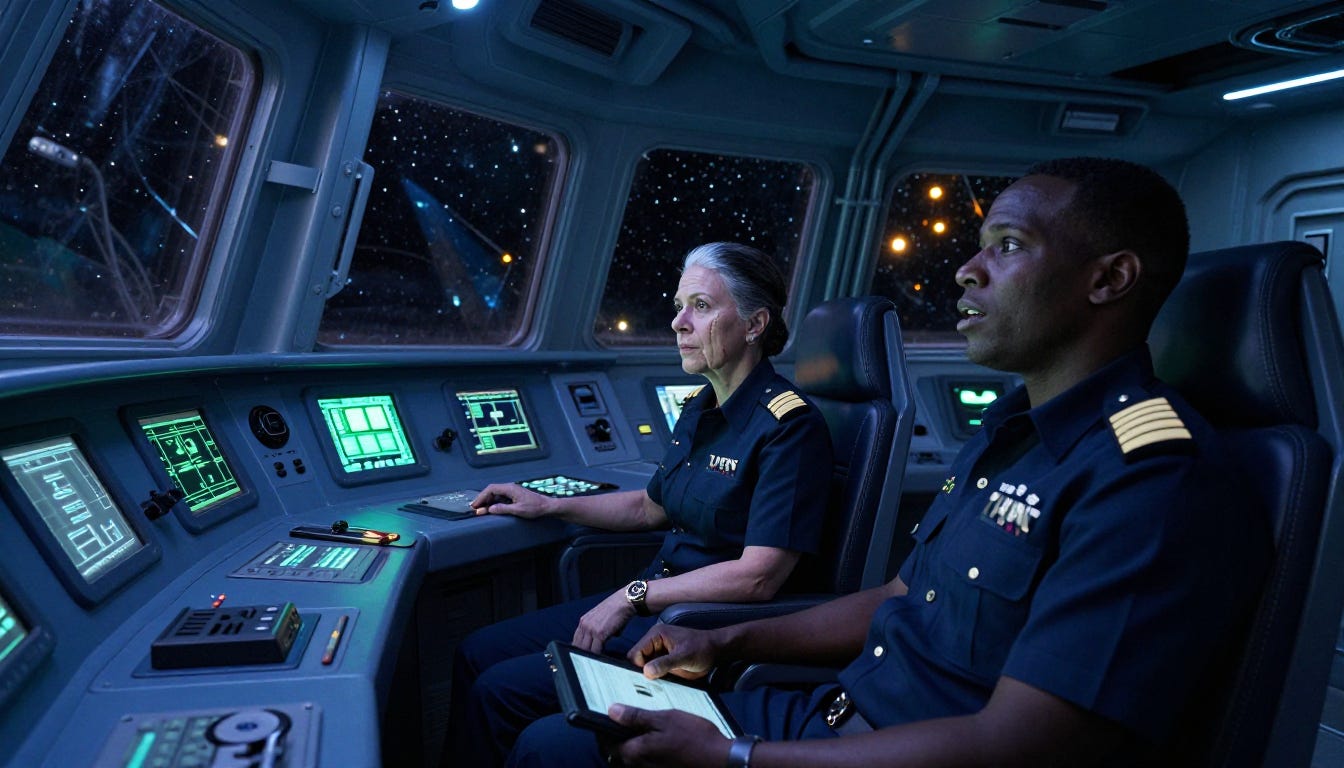
Shaw pulled up the full submission on her command display. The coupling design was elegant. More than elegant. It was the work of an engineer who had stopped thinking in terms of one ship’s systems and had started thinking in terms of an alliance’s. Skarreth core architecture at the center. Keraneth housing wrapped around it. Human interface bus bridging the gap. Three incompatible engineering traditions speaking the same language.
Shaw closed the submission. Her reflection in the dead screen showed a face she recognized: the facial scar from temple to jaw, the silver-streaked hair, the expression of a captain who was thinking something she did not want to say out loud.
Thomas Okonkwo was not Vanguard’s engineer anymore.
He had not been since the depot raid. Since the fold extraction. Since the moment he had made Revenant’s captured Vethrak systems work with human power grids, Skarreth stealth technology, Keraneth beam-lance targeting arrays. The tri-species coupling was not a new direction. It was the direction he had been moving in since the day Park died and Thomas stepped into the gap without being asked.
A good captain built people who outgrew her. That was the job.
Shaw had not expected it to feel like this.
The bridge door opened. Thomas Okonkwo stepped through, a datapad in one hand and his father’s wrench wrapped in its worn cloth in the other. He stopped at the sight of Shaw in the command chair.
“Captain. I did not mean to interrupt.”
“You are not interrupting.” Shaw gestured to the engineering station. “Sit.”
Thomas settled into the engineering station and called up his diagnostic interface with the automatic ease of someone who had done it a thousand times.
“I saw the coupling submission,” Shaw said.
Thomas looked up. “It will need fabrication testing. The Keraneth housing tolerances are tighter than our standard mills. We may need the Skarreth fabrication bay for the first article.”
“That is not what I meant.”
Thomas waited. The wrench sat beside his datapad, cloth worn soft from years of handling.
Shaw turned her command chair to face him. The tremor in her right hand was visible for a moment before she rested her palm on the armrest, stilling it with her weight.
“The coupling is good work, Lieutenant. It is the kind of work that gets noticed by people who make fleet-wide decisions.”
Thomas absorbed this without deflecting. That was new. The ensign she had taken aboard two years ago would have credited Park, or Vasquez, or the Skarreth design team. This Thomas only nodded. “Thank you, Captain.”
“Admiral Chen asked me this morning whether I would release you for a fleet-level technical integration role.”
Thomas went still. The wrench was in his hand. He had picked it up without thinking.
“What did you tell her,” he asked.
“I told her yes.”
The words landed in the quiet. Thomas did not speak. The wrench turned once in his hand, the unconscious rhythm of an engineer processing data.
“I have until the end of the repair cycle,” he said.
“You have until the end of the repair cycle. Then you report to Admiral Chen’s technical integration staff, with a mandate to standardize alliance engineering protocols across all three species. You will still fly with Vanguard during combat operations. You will not be mine the rest of the time.”
Shaw had meant to say this differently. She had planned a speech about his service and his growth and the pride she took in watching him become the officer he was.
What came out was simpler: “You have been ready for this for six months. I have been waiting for the right time to lose you.”
Thomas looked at the wrench. The cloth was worn to translucence, the impression of his father’s grip still visible in the wear pattern. He folded the cloth around the wrench with the deliberate care of a ritual performed a thousand times.
“The ship will need a new chief engineer,” he said.
“Lieutenant Commander Reyes has been shadowing your watch rotations for eight weeks. She is ready.”
Thomas glanced toward the duty officer’s station. Reyes was focused on her sensor board, her attention squarely where it belonged. The conversation had not reached her, or she had the discipline to pretend it had not.
“You planned this,” Thomas said.
“I planned for the possibility. You did the rest.”
The bridge was quiet. Shaw’s hand rested on the armrest, the tremor absorbed by the weight of her palm. Thomas stood at the engineering station, the wrench in his hand, the datapad still glowing with unfinished diagnostics.
“Thank you,” Thomas said. “For telling me. For”, he stopped, searching for words. “For the watch.”
Shaw understood. Not the late watch. The watch she had kept over him since the day he walked aboard Vanguard as an ensign who could not stop touching his father’s wrench.
“You earned promotion to lieutenant in a combat reactor pulse,” Shaw said. “You designed the fold extraction architecture that made the depot raid possible. You just built a power coupling that a Skarreth called acceptable. From a Skarreth, that is practically a standing ovation. You did not need my watch. You have not needed it for a long time.”
Thomas was silent for a moment. “It helped anyway.”
Shaw nodded once. The gesture was small, economical, the way everything about her was. She turned her command chair back toward the forward viewport, the stars holding their positions, Prometheus Station’s lights burning steady in the distance.
“Finish your diagnostics,” she said. “Then go get some sleep. You have seventy-two hours to deliver a first article that three species are waiting on.”
“Yes, Captain.”
Thomas returned to his station. The diagnostic interface refreshed, green across every system. The wrench sat beside his datapad, cloth-wrapped, present.
The late watch continued, quiet and steady. And somewhere in the silence of a docked ship at 0330, Captain Elizabeth Shaw allowed herself the recognition that came to a good captain when a good officer outgrew her command: not loss. Pride.
If you enjoyed this story, you can follow the main story arc in The Exodus Rush, the first book in The Vethrak Requiem series.