


Renata Cardoso learned the rules of Mimas Station her first week on the ring. Keep your head down. Don’t ask questions about the packages in Bay Twelve. Accept payment in water credits, never ration serials.
The third rule saved her life more than once.
She worked the relay hub on Level Four, routing agricultural telemetry between Saturn’s moons and the inner-system receivers. Legitimate work. The kind of job that earned a UEN allocation stamp and a bunk with recycled air that only tasted like copper twice a day. The kind of job that paid enough to keep her and her daughter Mila alive, provided neither of them got sick.
Mila had been sick twice this quarter.
The Iron Wake supplement covered the difference. Thirty minutes after her shift ended, Renata would stop at Bay Twelve, collect a package wrapped in thermal foil, and carry it to the docking arm for Alfie Blackburn’s courier shuttle. Small items. Alloy samples stripped from Vethrak wreckage in the outer rings, sealed in static-proof casings. Each delivery paid three hundred water credits. Three hundred credits bought antibiotics at Mimas rates. The math was clean.
Tonight the math was different.
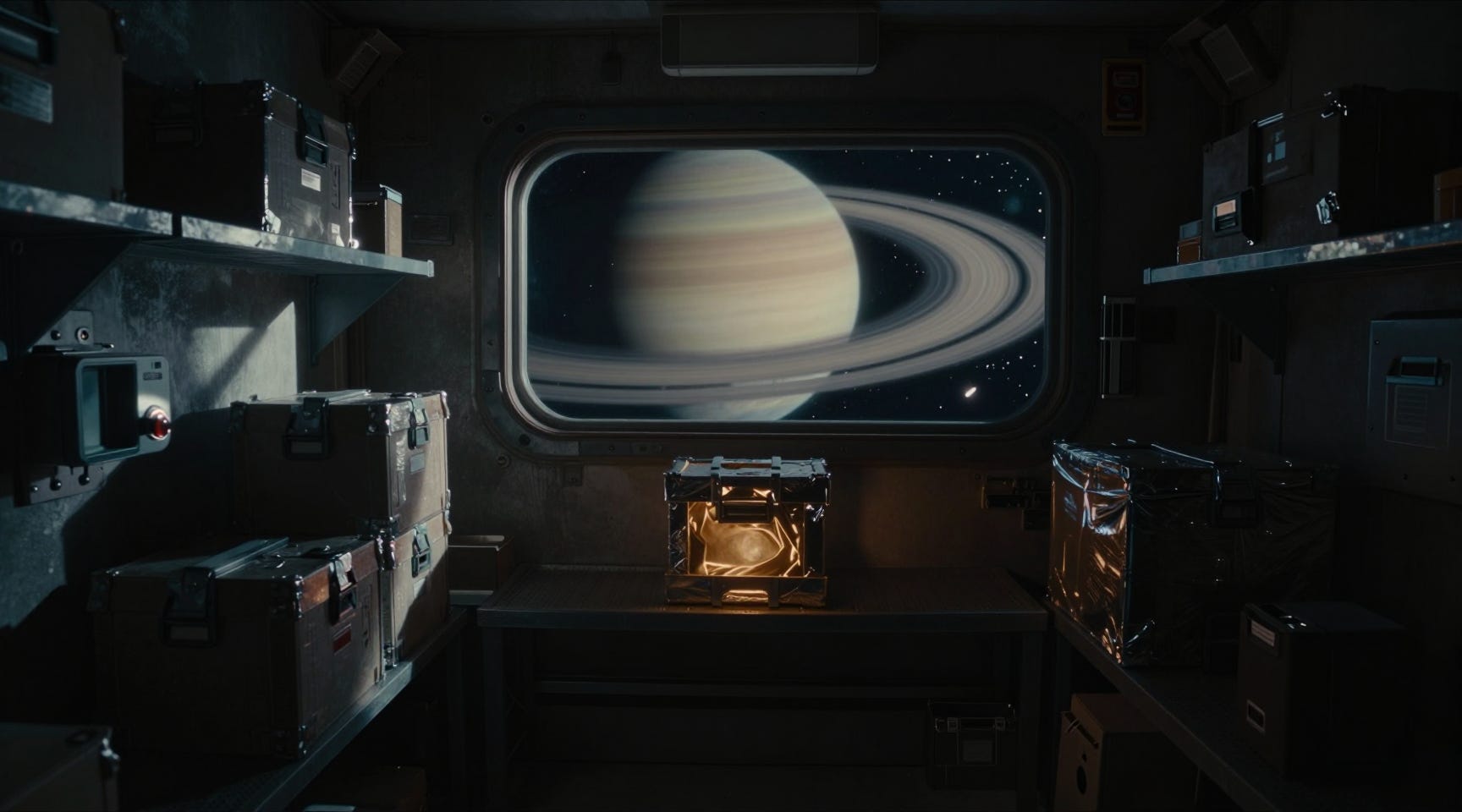
The crate waiting on the Bay Twelve shelf was twice the usual size. Renata touched the thermal foil and pulled her hand back. Warm. Not residual-engine warm. Active warm. The kind of heat that meant the material inside was still cycling through whatever alien process kept Lurker Core fragments from going inert.
She stood in the dim bay, her breath visible in the cold air, and counted to ten.
Active Lurker Core was not alloy samples. Active Lurker Core was UEN Combat Research Division priority cargo, tagged and tracked across every relay station in Sol. Moving it meant prison. Moving it meant losing Mila.
Not moving it meant losing the Iron Wake contract. Losing the supplement. Going back to counting every milliliter of water, every dose of medication, every calorie.
Renata picked up the crate.
It weighed less than she expected. The warmth spread through the thermal foil and into her palms, steady as a heartbeat. She tucked it under her arm and walked the service corridor to the docking arm, her station ID clipped to her jacket, her face composed.
Three checkpoints. The first two were automated, scanning her ID without interest. The third was human. A young UEN enlisted rating, barely twenty, sitting on a stool with a tablet propped against his knee. He glanced up as she approached.
“Late shift?” he asked.
“Relay maintenance,” she said. “Bay swap for the agricultural uplink.”
He waved her through. The crate’s heat pressed against her ribs like a second pulse.
Alfie Blackburn waited at Dock Nine, his courier shuttle cycling through pre-flight checks. He was thin, pale, the kind of man who’d spent too many years in low gravity without proper calcium supplements. His hands shook when he wasn’t gripping something, a tremor he blamed on a reactor accident he never described in detail.
He saw the crate and his expression changed.
“That’s not standard,” he said.
“No.”
“You know what that is?”
“I know what it’s worth.”
Alfie studied her face. “Fifteen thousand water credits. Passage for two to the Mars settlements. New allocation stamps. Medical priority status.”
Fifteen thousand. Renata’s throat tightened. Mila’s cough had deepened last week. The station medic said it was bacterial, treatable, nothing to worry about. The station medic also hadn’t had antibiotics to prescribe in three days.
“Who’s buying?” she asked.
“Private lab on Ceres. Consortium research.”
“That’s what the manifest says?”
Alfie’s hands trembled. He gripped the edge of the cargo hatch. “That’s what the manifest says.”
She handed him the crate. The warmth left her palms, and the cold rushed in like a debt coming due.
Renata was halfway back to her bunk when the message arrived. Encrypted, routed through three relay bounces, stripped of origin data. Iron Wake standard. She opened it on her personal tablet, standing in the corridor where the overhead lights flickered on their twelve-second cycle.
The payment confirmation: fifteen thousand water credits, deposited to her anonymous allocation account. Below it, a routing confirmation she wasn’t supposed to see. A forwarding address. Not Ceres. Not a consortium lab.
The destination tag read Themis Point, and the recipient code matched a pattern she’d recognized from UEN security bulletins posted on the relay hub board. Children of Earth. Splinter cell logistics. The fragments would feed whatever operation Themis Point was running. She’d read enough security bulletins to know what Children of Earth built with materials like these.
She closed the message. Deleted it. Stood in the corridor until the lights completed four full cycles.
Then she walked to the bunk she shared with Mila.
Her daughter was asleep, curled on the lower shelf with a thermal blanket pulled to her chin. The cough had quieted for now. Her breathing was shallow, steady, the sound of a body fighting an infection it might win.
Renata sat on the floor beside the bunk. The station hummed around her: recyclers, air processors, the deep vibration of the cascade reactor three levels below. Mimas turned in Saturn’s shadow, and the ring debris caught distant sunlight in brief, cold flashes through the porthole.
Fifteen thousand credits. Passage to Mars. Medicine. A future.
She pressed her back against the bulkhead and listened to Mila breathe.
The math was no longer clean. It never had been. She’d told herself the alloy samples were harmless, that Iron Wake moved materials to researchers who needed them, that the system she fed was about survival. The system was about survival. Hers. Everyone’s. The difference between a courier and a collaborator lived in the space between what you carried and what it became.
She didn’t know what it would become. She knew enough.
Mila shifted in her sleep, and Renata reached up to adjust the blanket. Her daughter’s skin was warm. Not the alien warmth of the crate, not the steady heat of something cycling through processes no human fully understood. This warmth was simple. Human. Fragile.
Outside the porthole, Saturn’s rings turned in silence, carrying debris from a war that had ended four years ago and never stopped taking.
Author’s Note: In the years following the Vethrak invasion, humanity’s survival depended on salvaging alien technology from the wreckage scattered across the solar system. The official Salvage Protocol governed most recovery operations, splitting resources between research and humanitarian needs. In the gaps between policy and desperation, networks like the Iron Wake emerged, moving materials through channels the UEN couldn’t monitor and didn’t want to acknowledge. For couriers like Renata, the line between keeping your family alive and arming the wrong people was measured in thermal foil and manifest codes.
If you enjoyed this story, you can follow the main story arc in The Exodus Rush, the first book in The Vethrak Requiem series.