


The laser inscribed twelve names per minute. Sana Okonkwo watched them appear on the black granite, each letter burning white-hot before cooling to gray permanence.
Mikhail Petrov. Johannesburg.
Yuki Akiyama. Osaka.
Ahmed Hassan. Alexandria.
She verified each entry against the master database, checking for duplicates, misspellings, birth dates that didn’t align with death records. The system caught most errors, but machines couldn’t see everything. Machines didn’t know that Mikhail Petrov from Johannesburg had been forty-two years old and built bridges. They didn’t know that Yuki Akiyama from Osaka had three daughters who survived. They didn’t know that Ahmed Hassan from Alexandria had written poetry that his mother still recited every morning.
The machines knew only names.
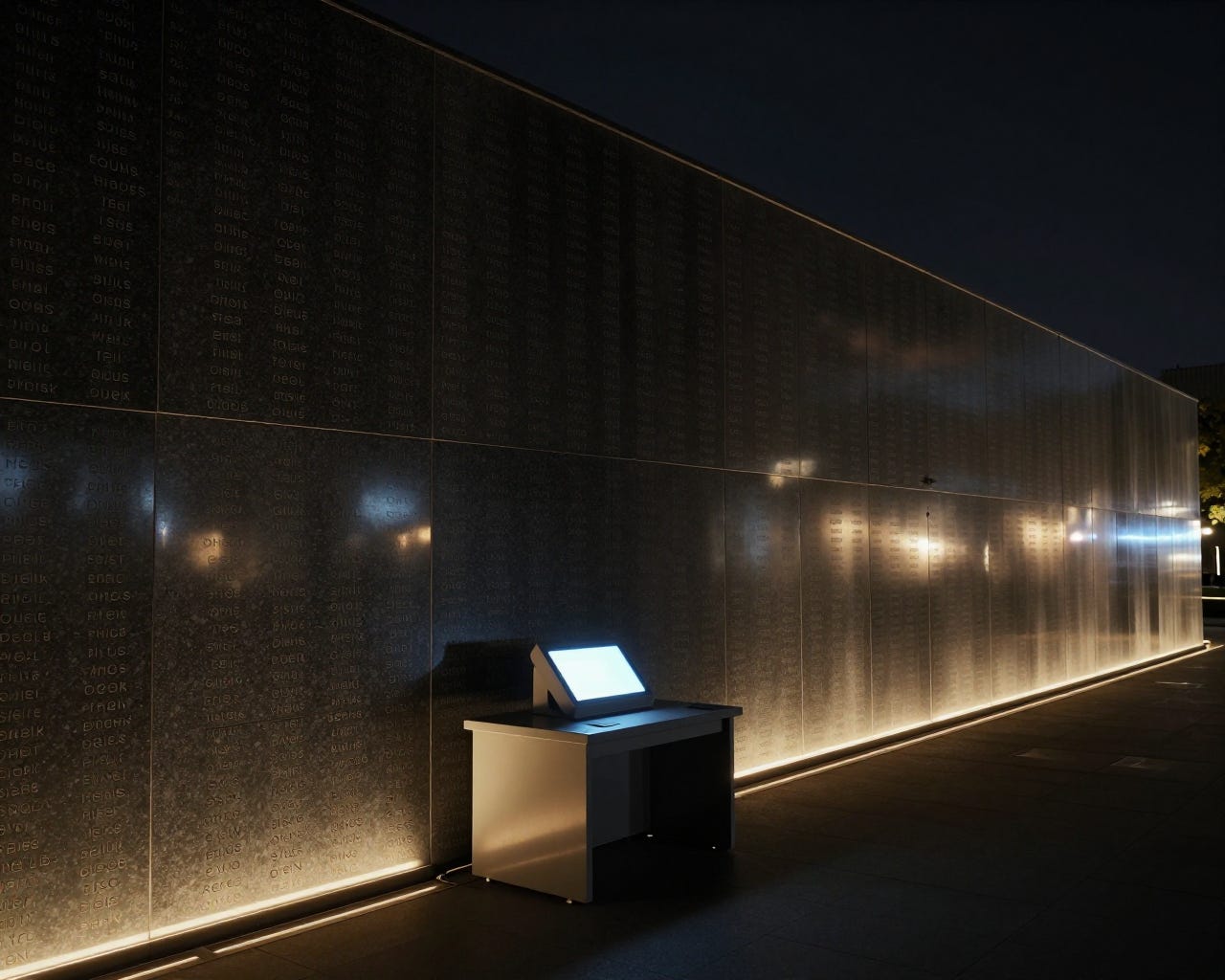
The Memorial Wall stretched fourteen kilometers along the remains of UN Plaza, curving through the reconstructed district like a black ribbon laid across the earth. At its current pace, the inscription system would need another eighteen months to record every confirmed death. Eleven billion names. Eleven billion people who had lived and died and deserved more than a line on a stone.
Sana’s shift ran eight hours. In that time, she verified approximately 5,700 entries. Her eyes ached by hour six. Her hands cramped by hour seven. By hour eight, she could barely see the names anymore.
That was the mercy. If she saw them too clearly, she couldn’t continue.
The oversight office occupied a prefab structure adjacent to Section 7-Delta, one of forty-two inscription stations along the Wall’s length. Sana shared the space with three other verification specialists: Marcus, who had lost his entire family in the Chicago bombardment; Priya, who never talked about what she’d lost; and Yosef, who hummed old songs while he worked, melodies from a country that no longer existed.
They didn’t speak much. The work didn’t encourage conversation.
Sana arrived at 06:00 each morning, logged into her terminal, and began reviewing the queue. The names came from census records, hospital registries, identification databases, and personal submissions from survivors who wanted their dead remembered. Each entry required verification: name, location of death, date if known, next of kin if available.
Some entries were incomplete. Unknown female, approximately 35 years old, Mumbai, April 14. Others carried too much detail: Jonathan Marcus Webb, age 7, brown hair, loved dinosaurs, died in his mother’s arms when the Riverside apartment complex collapsed, Los Angeles, April 9.
The system stripped those down to standard format. Name. Location. Date. The Wall couldn’t hold life stories. It could only hold names.
But Sana read every word before she processed them. Someone had written those details. Someone had needed to say that Jonathan Webb loved dinosaurs. Someone had needed the world to know.
The least she could do was witness.
On her forty-seventh day, Sana found a name she recognized.
The entry appeared in her queue at 14:23, unremarkable among the thousands that preceded it: Amara Okonkwo. Lagos. April 12.
Her sister.
Sana’s hands froze over the keyboard. The room contracted around her, the hum of equipment fading to silence. For six months, she had processed names: strangers, abstractions, data points in an endless catalog of loss. She had told herself that the work mattered. That giving the dead their place on the Wall was a form of respect. That someone had to do it.
She had never considered that her sister’s name might appear in her queue.
Amara had been in Lagos during the invasion. Sana knew this. Their last conversation had been a video call, eighteen days before the Vethrak arrived. Amara had been complaining about her landlord. Sana had been distracted, half-listening while sorting laundry. She couldn’t remember what she’d said. Something dismissive. Something about calling back later.
Later never came.
She had searched the databases herself, in those early weeks. Lagos had been hit hard on April 12, orbital strikes followed by ground forces. The death toll exceeded nine million. Recovery teams were still excavating rubble. Still finding remains.
Sana had assumed Amara was among the dead. Assumed, but never confirmed. The uncertainty had been a wound she’d learned to ignore.
Now the wound was open.
She stared at the entry. Amara Okonkwo. Lagos. April 12. Three words. Seventeen characters. A life reduced to its final coordinates.
The verification prompt blinked: Confirm entry? Y/N
Sana typed Y.
The system added her sister’s name to the inscription queue. In approximately four hours, the laser would burn those letters into black granite, and Amara would take her place among the dead.
Permanent. Official. Gone.
That night, Sana walked the Wall.
The inscription stations fell silent after dark, but the monument itself remained illuminated, soft lights running along its base so visitors could find their dead. Tourists rarely came. The Wall was not a destination. It was a reckoning.
She walked past thousands of names, her fingers trailing across the cool stone. Each letter had depth, texture. Someone had calibrated the laser to cut precisely 0.3 millimeters into the granite, deep enough to last centuries. Engineers had calculated the optimal spacing between names, the font size that maximized legibility while minimizing surface area. Planners had debated the curvature of the Wall, the height of its sections, the materials that would endure.
So much precision. So much care. All to record the simple fact that these people had existed.
Sana stopped at a blank section: tomorrow’s canvas. The stone was polished, waiting. In a few hours, the lasers would wake, and new names would join the dead.
Amara would be among them.
She sat on the ground, her back against the Wall, and looked up at the night sky. Earth’s lights still dimmed the stars, but fewer now than before the invasion. Fewer cities. Fewer people. Fewer reasons to burn electricity through the night.
“You would have hated this,” she said aloud. Amara had always been practical. Unsentimental. She’d have called the Wall a waste of resources, asked why they didn’t build housing instead, argued that the dead didn’t care about monuments.
Sana smiled. The dead didn’t care. The living did.
That was the point.
She returned to her station at 06:00. The queue held 6,200 entries, same as yesterday. The work continued.
Marcus glanced up as she logged in. “You okay?”
“Fine.”
He nodded and returned to his screen. He didn’t push. None of them pushed. They all carried weight here.
Sana opened the first entry: Elena Marquez. Buenos Aires. April 8.
She verified the name. Checked the records. Confirmed the date. Sent it to the laser.
One down. Billions to go.
The Wall would hold them all. Every name, every life, every loss. Stone and laser and time, working together to ensure that eleven billion people would not be forgotten.
Sana read the next entry and typed Y.
The work continued.
Author’s Note
The Memorial Wall at UN Plaza stands as the largest monument in human history, inscribed with the names of every confirmed casualty of the Vethrak invasion. Construction began in Year 5 and completed in Year 6, though verification and inscription continue as new records are recovered. The wall is maintained by the Global Memorial Commission, staffed largely by survivors who chose to make remembrance their life’s work. Many found healing in the task. Others found only duty. Both are honored.
If you enjoyed this story, you can follow the main story arc in The Exodus Rush, the first book in The Vethrak Requiem series.