


Ambassador Kenji Tanaka watched the holographic display cycle through casualty estimates for the third time. Eleven billion dead. The numbers felt abstract, too large to comprehend. Somewhere in those billions were his parents, his sister, his nephew who’d just turned seven the week before the invasion.
The Emergency Council chamber was silent except for the hum of backup generators. Most of the UN building had been destroyed on Day 3. They were meeting three levels underground, in what used to be a storage facility, sitting on salvaged chairs around a table made from prefabricated panels.
Twenty-three people. That’s all that remained of the United Nations Security Council, the General Assembly, and the various committees that had governed international relations for over a century. Twenty-three survivors out of hundreds, pulled from the rubble or evacuated before the bombardment reached New York.
They were about to decide humanity’s future.
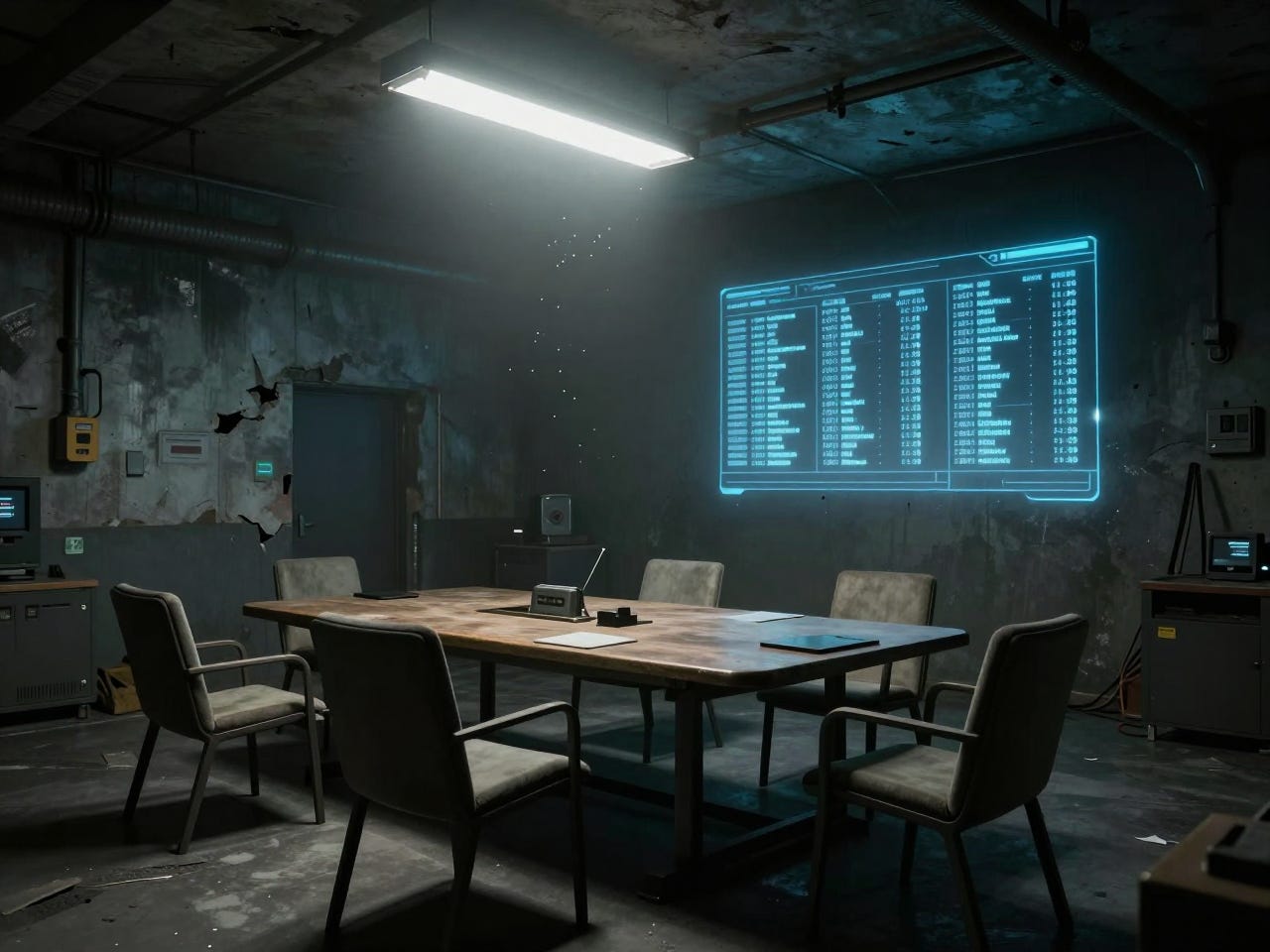
“The motion before us is clear,” Secretary-General Elena Marquez said. Her voice was steady despite the bandages covering half her face. “Do we accept the Salvage Protocol as proposed by Director Chen? Do we authorize our people to study Vethrak technology, to reverse-engineer their weapons, to learn from our enemy?”
Ambassador Okoye from Nigeria raised her hand. “We need clarification. This isn’t just research. This is weaponization. We’re talking about taking technology we don’t understand and building weapons we can’t control.”
“The alternative is remaining defenseless,” Director Chen replied. He looked exhausted, gray-haired and gaunt, a man who’d aged a decade in forty-seven days. “The Vethrak withdrew. They did not surrender. They did not negotiate. They simply left. Every intelligence analysis we’ve conducted suggests they will return. When they do, we need to be able to fight back.”
“With their own weapons.” Ambassador Volkov from Russia leaned forward, his artificial arm clicking softly as it moved. He’d lost the original on Day 12. “We’re proposing to arm ourselves with technology we recovered from the wreckage of our own cities. Does anyone else see the irony?”
“I see survival,” Chen said flatly. “I see the only path forward that doesn’t end with human extinction.”
Kenji watched the faces around the table. These weren’t politicians anymore. The old games, the careful diplomatic language, the endless negotiations over minor details had all burned away with the cities. These were survivors making desperate choices with incomplete information.
“Let’s be honest about what we’re proposing,” Ambassador Williams from what remained of the United States said. “We’re creating a military-industrial complex focused entirely on alien technology. We’re prioritizing weapons development over reconstruction, over humanitarian aid, over everything else humanity needs right now.”
“We can’t rebuild if we’re dead,” someone muttered.
“We can’t fight if we’re starving,” Williams shot back.
Secretary-General Marquez raised her hand, calling for order. “The Salvage Protocol, as drafted, allocates sixty percent of remaining resources to technology recovery and analysis. Forty percent goes to humanitarian relief and reconstruction. Director Chen has provided projections showing this ratio maximizes both our defensive capability and our survival prospects.”
“Projections based on incomplete data,” Okoye said. “We don’t know how the technology works. We don’t know if we can even use it safely. Three researchers died last week trying to dismantle a Vethrak power cell. How many more will we lose learning to use their weapons?”
“As many as it takes,” Chen said quietly.
The chamber fell silent.
“That’s the truth none of us want to say,” Chen continued. “People will die. Researchers, engineers, test pilots. People will die because we’re working with technology designed by a species that wanted to kill us, technology that has built-in failsafes and self-destruct mechanisms we don’t fully understand. People will die, and we will learn from their deaths, and eventually we will master these systems. Because the alternative is waiting for the Vethrak to return while we huddle in our ruins, defenseless and defeated.”
Kenji looked at the casualty estimates still cycling on the display. Eleven billion dead. His parents. His sister. His nephew who’d wanted to be an astronaut and would never get the chance.
“I move we vote,” he said.
Marquez nodded. “All in favor of implementing the Salvage Protocol as proposed?”
Hands went up. Kenji counted thirteen.
“All opposed?”
Seven hands.
“Three abstentions.” Marquez closed her eyes for a moment. When she opened them, they were wet. “The motion carries. The Salvage Protocol is hereby authorized. Director Chen, you have your mandate.”
After the session ended, Kenji stood alone in the chamber, staring at the casualty display. Thirteen votes to seven. Humanity’s future decided by a margin of six votes, in a basement, by twenty-three people who’d survived because they were lucky or stubborn or both.
Ambassador Okoye approached him. She’d voted against the protocol.
“Do you think we made the right choice?” she asked.
“I don’t know,” Kenji admitted. “I just know we made a choice. Doing nothing was also a choice, and I couldn’t live with that one.”
“Chen said people will die.”
“People are already dying. At least this way, their deaths might mean something.”
Okoye shook her head. “You sound like you’re trying to convince yourself.”
“I am.”
They stood together in silence, watching the numbers cycle. Eleven billion dead. The ones who would die learning to use Vethrak technology wouldn’t even register as a rounding error on that total. But they would have names, families, lives that mattered to someone.
“My nephew wanted to be an astronaut,” Kenji said. “He had posters of the Mars colonies on his bedroom wall. He used to make me quiz him on the names of Jupiter’s moons.”
“Past tense,” Okoye observed gently.
“Past tense.” Kenji turned away from the display. “He died on Day 6. He was seven years old. He never got to see space, never got to touch a star. The Vethrak took that from him. They took everything from him.”
“So we take their technology.”
“So we take their technology,” Kenji agreed. “We take it, we learn it, we use it. When they come back, we make them regret leaving any of us alive.”
Okoye studied his face. “That’s not very diplomatic.”
“I’m done being a diplomat. We all are. We’re survivors now. Survivors who just voted to bet everything on a desperate gamble that might kill hundreds more people before we learn anything useful.”
“Thirteen to seven,” Okoye said. “Six votes. That’s what humanity’s future came down to. Six votes in a basement.”
“Six votes,” Kenji repeated. He looked around the chamber, at the salvaged furniture and the backup generators and the twenty-three people who’d decided the course of human civilization because there was nobody else left to ask. “I hope it was enough.”
“Me too, Ambassador. Me too.”
Three years later, the first successful Fold drive test would prove them right. Twenty researchers would die before that success. Director Chen would call it an acceptable cost. Ambassador Tanaka would attend every funeral.
The Salvage Protocol would become humanity’s defining project, the desperate gamble that paid off, the choice that saved the species. History would call it visionary, necessary, inevitable.
The people who voted for it in a basement, surrounded by the ashes of civilization, would remember it differently. They would remember the uncertainty, the fear, the terrible arithmetic of survival that said some deaths were acceptable if they prevented others.
They would remember thirteen hands raised in a room where billions of voices would never be heard again.
They would remember voting to bet humanity’s future on stolen technology and borrowed time, because there was no other bet left to make.
Author’s Note: This story takes place in Year 1 of the Post-Invasion calendar, during the chaotic months when human leadership was reorganizing and making critical decisions about survival. The vote to implement the Salvage Protocol happened in the ruins of the UN complex in New York, conducted by the remnants of international government. The protocol would shape everything that followed, defining humanity’s path toward learning Vethrak technology and preparing for the inevitable return of the invasion fleet.
If you enjoyed this story, you can follow the main story arc in The Exodus Rush, the first book in The Vethrak Requiem series.