


Chiara Hoffmann counted vials the way other people counted breaths: automatic, constant, the rhythm beneath everything else she did. Forty-eight in the first case. Forty-eight in the second. Ninety-six total, packed in shock foam, sealed under vacuum lids stamped with lot numbers that matched nothing in any UEN pharmaceutical registry.
The lot numbers were Davi’s work. He printed them in a machine shop on Ring Four using a thermal press salvaged from a wrecked CSV freighter, and they looked perfect. Better than perfect. They looked boring, which was the point. Nobody inspected boring.
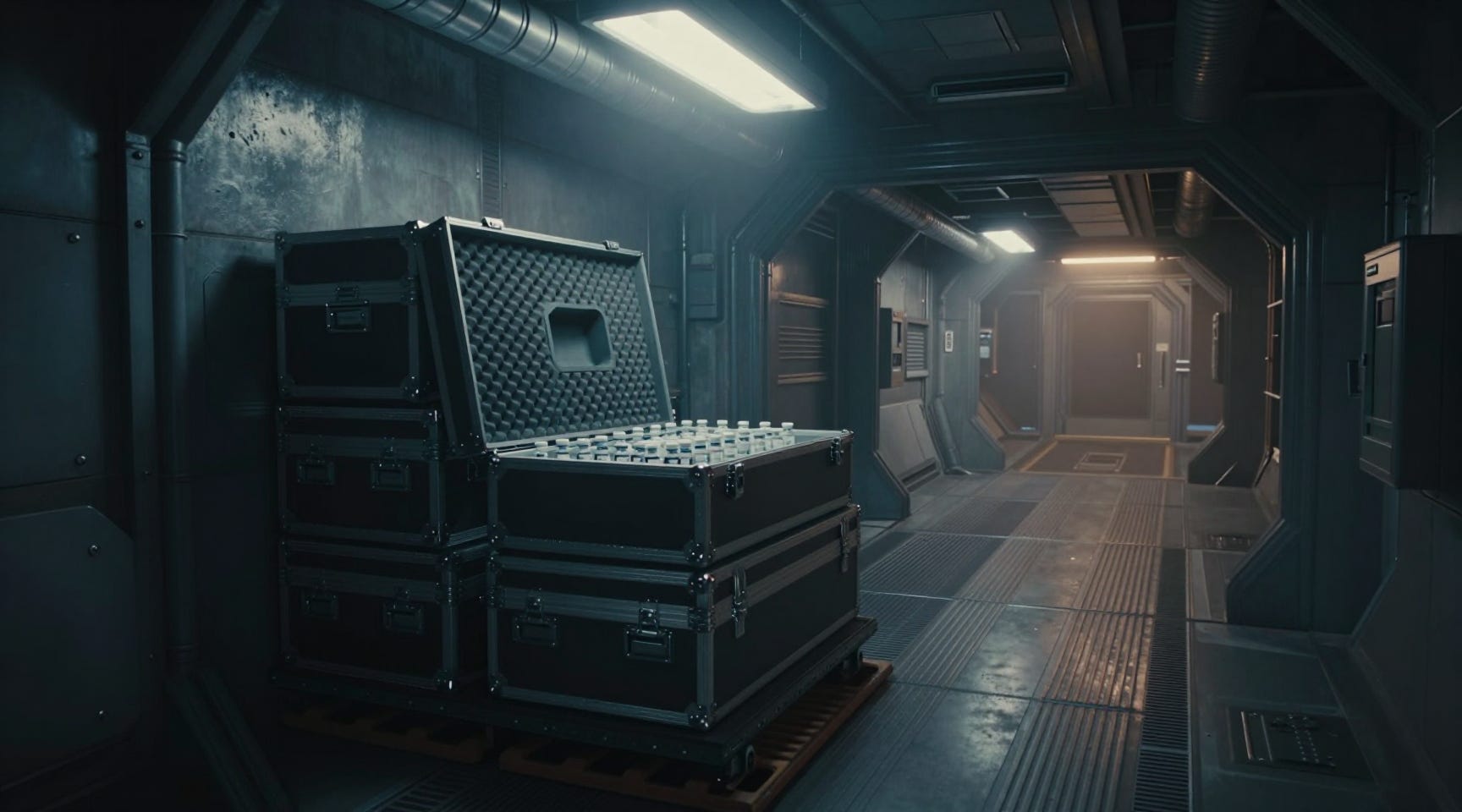
She lifted the third case onto the cargo pallet in Bay Twelve’s service corridor and cracked the seal. Forty-seven.
Chiara stopped. She counted again, touching each vial’s cap with the pad of her index finger, moving left to right across four rows. Twelve, twelve, twelve, eleven.
One short.
The corridor hummed with station ventilation. Recycled air pushed through overhead ducts, carrying the faint mineral taste that every Belt station shared, the residue of rock dust that filtration systems reduced but never eliminated. Bay Twelve was a maintenance access point between the cargo ring and the hab levels, unused during third shift, which made it the Ashvein Crew’s preferred staging area for medical transfers. Chiara had run product through here eleven times in the past five months. The count had never been wrong.
She sealed the case, set it beside the other two, and pulled up the manifest on her handheld. The screen’s glow turned her fingers blue in the corridor’s dim emergency lighting. Lot 7741-C: broad-spectrum antibiotics, forty-eight units. Lot 7741-D: analgesic compounds, forty-eight units. Lot 7741-E: immunosuppressants, forty-eight units.
The manifest said one hundred forty-four. She had one hundred forty-three.
One missing vial of immunosuppressant was not a rounding error. Immunosuppressants were the most controlled substance in post-invasion pharmacology. The UEN tracked them by individual unit, because they were the only reliable treatment for cascade rejection syndrome, the condition that killed roughly one in six patients who received Vethrak-derived medical implants during emergency triage. The implants kept people alive. The immunosuppressants kept the implants from killing them three months later.
A single vial represented fourteen days of treatment. Fourteen days someone with cascade rejection could keep breathing without their own immune system shredding the alien material fused to their bones.
Chiara opened the case again. Forty-seven. She photographed the interior, the empty slot visible in the foam where a twelfth vial should have sat in the bottom row. Then she sealed it and waited.
Javier Acosta arrived nine minutes late, which was unusual. He walked the service corridor with the measured pace of someone who had decided not to hurry, a pace that communicated calm without achieving it. His boots were clean. He carried a transit bag over one shoulder and a scanner in his right hand.
“You’re late,” she said.
“Docking took longer. New compliance checks on the commercial ring.” He set the transit bag on the deck and glanced at the three cases on the pallet. “All good?”
“Forty-seven in the third case.”
Javier’s expression did not change. He was good at that. Three years of moving product through stations where UEN inspectors checked manifests and counted inventory had trained the reaction out of his face.
“Should be forty-eight,” he said.
“It should.”
He looked at the case. “Lot E?”
“Immunosuppressants.”
The word sat between them. They both knew the weight of it. The antibiotics and analgesics were valuable, the kind of valuable that bought fuel credits and food rations and passage on freighters heading to settlements where UEN supply drops arrived late or not at all. The immunosuppressants were different. They were life-or-death valuable, the kind that made desperate people pay whatever the seller demanded, because the alternative was watching their body reject the implant keeping their heart beating.
“Shrinkage happens,” Javier said.
“Not on immunosuppressants. Not from this supplier.”
“You want to hold the shipment.”
Chiara looked at the three cases. Ninety-six vials of antibiotics and analgesics going to the Vesta Corridor settlements, where a respiratory infection had been burning through hab blocks for two weeks because the UEN’s official distribution queue was backed up behind a priority shipment to Mars. People were coughing blood. Children, mostly. The meds in those first two cases would reach them twelve days before the official supply chain delivered.
The forty-seven immunosuppressant vials were going somewhere else. A clinic on Hygiea Station run by a doctor who had lost her UEN medical license for refusing to stop treating patients after her supply allocation ran out. She treated cascade rejection patients. She did not ask where her supplies came from. She could not afford to.
Holding the shipment meant holding all of it. The Ashvein Crew did not allow partial deliveries. Complete manifests or nothing. Insurance against couriers skimming product and selling the difference.
“If I deliver forty-seven and the count comes up short on the other end, that’s on me,” Chiara said.
“It’s on whoever shorted the case.”
“The Crew won’t see it that way.”
Javier set down his scanner. “Then what do you want to do?”
Chiara looked at the empty slot in the foam. One vial. Fourteen days of someone’s life, diverted somewhere between the supplier and Bay Twelve. Stolen, lost, or pocketed by someone who either needed it or knew someone who did. She would never know which.
She sealed the case.
“I deliver one forty-three and I report the short to Emmerich. Full documentation. Photographs. If someone in the chain is skimming immunosuppressants, Emmerich needs to know before it becomes a pattern.” She loaded the cases onto the pallet’s magnetic clamps. “The Vesta settlements get their meds tonight. Hygiea gets forty-seven instead of forty-eight.”
Javier picked up his transit bag. “And the missing fourteen days?”
Chiara powered on the pallet’s drive motor. The corridor stretched ahead of her, two hundred meters of maintenance tunnel leading to the freight lift that would carry her down to the docking level.
“Someone out there is breathing because of it, or someone out there is going to stop.” She pulled the pallet forward. “Either way, I count what I have.”
Author’s Note: In the years after the invasion, official supply chains struggled to reach every settlement in the Belt. Unauthorized distribution networks filled the gaps, moving medicine, food, and fuel to communities the UEN couldn’t supply fast enough. The moral calculus was never clean: every diverted vial saved a life and undermined the system trying to save everyone. This story explores one small moment in that larger tension.
If you enjoyed this story, you can follow the main story arc in The Exodus Rush, the first book in The Vethrak Requiem series.