


The room was a leased back office on the fourth commercial ring of Mimas Station, one corridor over from a stevedores’ union hall and three doors down from a hydration vendor that had not changed its sign since before the invasion. The door had no lettering. Davit had given Anya a number and a time. The number was 47-B. The time was the back end of second shift.
Anya cycled the manual lock and stepped through.
Five chairs around a freight-rated folding table. A wall slate showing nothing. A coffee maker on a side counter that was not on. The air smelled like old solder and the recycled exhalation of a room that had been used for a hundred different purposes and remembered none of them.
Four people were already seated.
Davit stood near the slate, not at the head of the table, and gestured Anya to the open chair. He did not introduce her. He did not introduce them.
“First names only,” he said. “Anya.”
She sat. The chair was not warm.
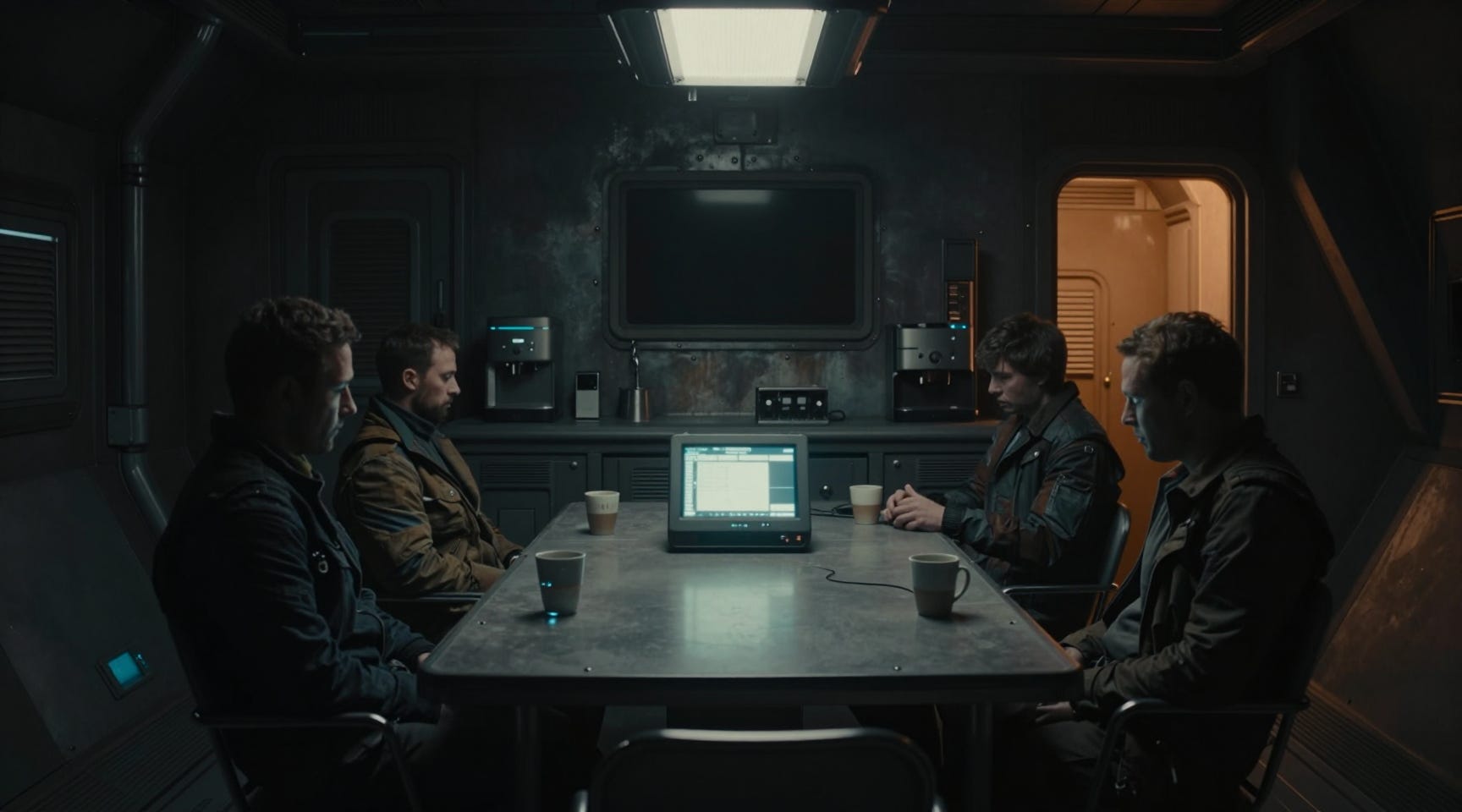
The captain to her left went first. Older woman, mid-fifties, the close-cropped silver of a long-time EVA worker whose hair had given up arguing with helmet seals. “Solveig.”
The man across from her had a burn scar that ran the length of his left hand from wrist to fingertip, the kind that came from an unsheathed plasma lance contacting a glove gusset. “Lars.”
The other two gave only their first names and Anya filed them under physical detail because physical detail was what the room was offering. The thin one with the recessed ring-belt eyes. The compact one whose suit liner was visible at her collar, still bearing the faded stencil of a freight company that had stopped existing two years ago.
The introductions stopped there.
Nobody asked where anyone had come from. Nobody offered. The silence was not awkward. It was the silence of people who had agreed in advance that the only credentials in the room were the credentials of being in the room.
Davit poured five cups of water from a thermos that was not coffee and set them down without ceremony.
He sat.
Solveig opened. Her voice was dry and very even, the voice of someone who had been running meetings for longer than the post-invasion calendar had existed.
“We work the rings. We work them clean. We share what we know about the fields, and when two of us land on the same wreck we don’t shoot at each other. That’s the short version. The long version is what we do tonight.”
Anya nodded once. She did not speak.
Lars leaned back. He held his scarred hand flat on the table the way some people put a sidearm on a desk to indicate it was not in play yet.
“We woke a power cell off the Cassini drift last cycle,” he said. “Clean recovery, no overlap. Davit moved it inside a week. That’s the kind of arithmetic this room makes possible.”
She filed the verb. Wake a piece. Salvager slang. New to her ear. She heard it as a slang word and she also heard it as something else, something underneath it, the vocabulary of a group that had named a thing because it was already a thing.
The thin captain spoke for the first time. “We track a wake between us when two crews coordinate a recovery. The wake is the path the work travels. Field to skiff to courier to buyer. We don’t all touch every wake. We all know about every wake.”
“The wake,” Solveig repeated, and the way she said it carried the small weight of a phrase the room had agreed on without ever holding a vote.
Anya filed that one too.
The compact captain slid a slate across the table. The interface was simple. A registration log format Anya recognized from her UEN training, modified.
“Our terms,” she said. “You share your field-registration logs with the group through the slate I just pushed to you. You receive ours in return. If two of us land on the same field, the earlier registration prevails. We arbitrate disputes here, in this room, with majority binding. You accept the arbitration before you bring the dispute. Not after.”
Anya read the terms. Then she read them again.
The slate was telling her that the rivalry standoff she had walked away from in the outer ring six weeks ago was being solved on paper by people who had decided not to walk away from the next one.
“What do I get,” she said.
“Backup,” Solveig said. “If a crew outside the group leans on you, two of us are inbound inside six hours. You don’t ask for the backup. We hear about it on shared comm and we move.”
“Buyers,” Lars said. “Davit prices our material together. The pool gets better rates than any of us would get alone. The premium for being in the pool is real.”
“Couriers,” the thin one said. “We move material through a chain that splits the UEN scrutiny across four crews instead of stacking it on one. Your transit risk drops by three quarters.”
“Vetting,” the compact captain finished. “We accept your registration logs as authentic. The room confirms this. If you bring a fraudulent log into this room, the room handles it. I don’t recommend testing what that means.”
Davit had not spoken once.
He sat at the slate and watched Anya’s face and waited, the same way he had waited in the back room of his cargo expediting office six weeks earlier. He was not the one offering the terms. He was the one who had brought the room into being and then stepped out of the way and let the room do its work.
Anya thought about Maren on the Underweight, sleeping the dead sleep of someone who had welded for fourteen straight hours.
She thought about the rival captain in the outer ring, the comm exchange that had ended with the words Your field. We’ll find another, and the certainty in her stomach as she had watched them leave that next time it would not be that easy.
She thought about her brother’s Polaris fragment in her chest pocket, and about the cabin paneling she had cataloged as personal effects, and about the thermal credit transfer that had cleared on her wrist comm before she had reached the corridor outside Davit’s office.
The line had crossed in the field. The paperwork was catching up. Tonight the paperwork was a slate and four first names and a verb she had heard for the first time.
“I accept the terms,” she said.
Solveig nodded once. Lars nodded once. The other two did not need to nod.
The compact captain reached across the table and took the slate back. She tapped through one screen. She turned the slate around and pushed it toward Anya.
“Sign.”
Anya signed.
The signature was a cryptographic acknowledgment, not a name. It would not appear on any registry the UEN could access. It would appear, exactly once, on a ledger that lived on five slates in five hands in five berths spread across two stations.
The compact captain pulled the slate back. She did not say welcome.
The meeting ended without a closing remark. Solveig stood first. Lars second. The other two together. Davit was last. He held the door for her.
Anya walked back to bay seventeen with the verb in her head and the noun under it.
Maren was awake when she came through the airlock. The galley light was on. Maren was drinking the recycled coffee that was not coffee and looking at a slate of her own.
“Vetted?” Maren asked. She did not look up.
“Vetted.”
Maren nodded. She turned the slate toward Anya. The screen showed the same registration-log format Anya had just signed off on. The compact captain’s interface, the same group ledger, already populated with Maren’s logs from the last three months.
“We were already in,” Maren said. “They just told you today.”
She pushed the slate aside. She drank her coffee. She did not look surprised. She did not look anything.
Anya sat down on the bunk across from her.
The verb sat in her head. Wake a piece. The noun sat under it. The wake.
Outside, in the rings, the work was already moving.
Author’s note: Day Eight of the Iron Wake Origins arc. Anya Rask is invited to a back-room meeting on Mimas Station and meets four salvage crew captains who have been working with Davit Kade quietly. The price of admission is shared field-registration logs and binding group arbitration on disputes. In return she gets backup, pooled buyer rates, a four-crew courier chain, and authenticated logs the room will defend. Two pieces of vocabulary enter her ear for the first time. “Wake a piece,” the verb. “The wake,” the noun. The slang predates the institution. The institution will eventually be named after the slang. By Year 14 the Iron Wake is the dominant black-market clearinghouse for Vethrak technology in Sol. Tonight it is a folding table, a leased room, four first names, and a slate that Anya did not need a night to think about. Maren was already in. They just told Anya today. Year 1, Month 11.
If you enjoyed this story, you can follow the main story arc in The Exodus Rush, the first book in The Vethrak Requiem series.