


A red seal dot meant safety. A green one meant paperwork.
The dot on Fiona Thornton’s wrist pad pulsed amber.
Calibration overdue: 00:17.
The salvage bay’s inner doors cycled behind her with the soft cough of pressure equalization. Luna Station Alpha never stopped breathing. Pumps, fans, condensers. Quiet turned into another kind of noise.
A Vethrak canister waited on the work cradle like a blunt coffin. Matte black. Geometry that refused right angles. Human clamps cinched a containment collar around its middle, each numbered, each tied to a seal housing with a window no wider than a thumbnail.
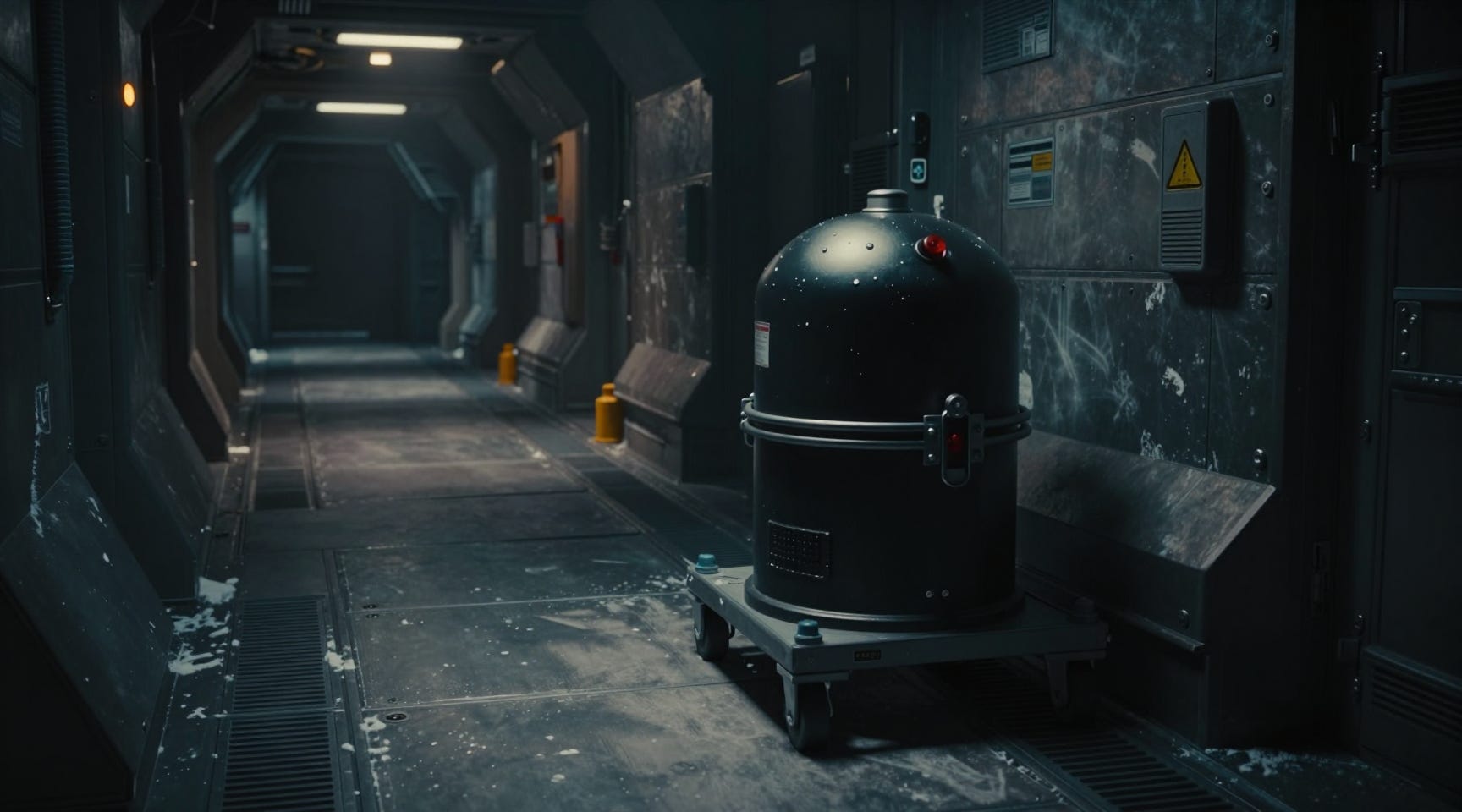
Fiona checked the clamp numbers. Eight. All seated.
Amber still pulsed.
Her calibration kit opened with a hiss of vacuum lock. She laid out the pieces in a neat row: stamp head, micro-gauge, vacuum puck, and a sleeve of single-use seal dots.
The dots mattered. Ration chits kept air flowing and water cycling. Seal dots kept alien salvage from becoming a station-wide obituary.
A seal dot carried a cryptographic thread and a chemical signature that matched the stamp head’s microfracture pattern. Fake one, and the vacuum puck would tell on you.
People still tried.
Fiona had watched a counterfeit lift at the edges under pressure, adhesive outgassing like bad breath. The man who brought it in had cried while he begged for another chance.
The memory clung to her as she seated the vacuum puck over the stamp head. The gauge climbed. Numbers steadied.
Amber pulsed.
Calibration overdue: 00:09.
A shallow bite meant a dot that read valid and still peeled under stress. A deep bite meant a dot that never peeled, even when it needed to.
Seals existed for one job: to break when something inside wanted out.
A message request blinked on her wrist pad. No sender name, only a station routing tag.
A second blink followed.
She finished the calibration cycle with seconds to spare. The amber dot turned green.
Paperwork.
A new notification stacked on top of it.
Meeting. Service corridor B-12. Ten minutes.
The routing tag resolved into a name.
Mara.
Fiona’s mouth went dry. Mara was not supposed to know where Fiona worked. Mara was the kind of person who treated station access like a deck of cards, always shuffling, always holding something back.
Chits kept a bed on the station. Credits still reached Earth clinics.
Credits paid for antibiotics.
Fiona sealed her kit, logged the calibration, and left the bay.
Corridor B-12 sat two decks down, past the med pods and the memorial wall where names filled a curved panel of steel. The wall had been blank once.
Blankness had meant possibility.
The service corridor smelled like coolant and old insulation. Lighting strips ran along the floor instead of the ceiling, a concession to power rationing.
Mara waited near a junction box with a missing cover plate. No uniform. No tool belt. Hair twisted tight like someone who expected to crawl through vents.
“You came,” Mara said.
Fiona stopped at arm’s length. Her hands stayed close to her body, fingers flexing inside her gloves. Cameras were sparse in service corridors, not absent.
“Say it,” Fiona said.
Mara’s gaze flicked to Fiona’s wrist pad. “Seal tech. True?”
“Who told you?”
“Everybody knows somebody.” Mara’s voice stayed light. “You work containment. You have access to stamp heads. I need a dot.”
“No.”
The word came clean, too fast. Relief and fear tangled in it.
Mara stepped closer. “You need credits.”
Fiona’s jaw locked. “You do not know what I need.”
Mara pulled a small foil packet from her pocket and held it between two fingers. A medical courier seal. Earth-side.
Amikacin.
Heat crawled up Fiona’s neck, trapped under her collar ring. Her brother’s infection had chewed through two rounds of older antibiotics. The clinic in Tulsa had started using words like resistant and complicated.
Chits could not cross the gravity well.
“Dot for a dose,” Mara said. “One dot. One canister. Nobody dies.”
“Nobody dies,” Fiona repeated.
Mara nodded. “You take a dot from a sleeve, press it on a blank, run it through your reader, and pass it to me. I handle the rest.”
A dot did not exist alone. A dot lived on a clamp that held something shut.
“What is inside?” Fiona asked.
Mara shrugged. “Salvage. Tech. Something valuable enough to move.”
Fiona pictured the canister in Bay 3. The alien geometry. The human collar. A seal dot sitting in its little window, bright as a target.
A third option sat inside her wrist pad, buried under menus and warnings.
Protocol contact.
Informant rewards existed, whispered about like a superstition. Sometimes the station paid out.
Sometimes.
Mara watched Fiona’s hesitation and misread it as surrender. “You keep helping, I keep helping. Medicine keeps coming.”
A future built on a leash.
Fiona’s throat tightened. The memorial wall flashed in her mind, names packed tight, endless.
Her brother’s name was not there.
Not yet.
Fiona lifted her wrist pad and opened her work log. The stamp head serial number sat in her last entry, tied to Bay 3.
One dot for one canister. One canister for one dose.
The math tried to make itself humane.
Her thumb moved across the pad.
Security request: Protocol contact.
A confirmation box bloomed.
Mara’s hand darted toward Fiona’s wrist.
Fiona stepped back. “Do not.”
Mara froze, then smiled without warmth. “You’re going to burn me.”
“You walked into a salvage station and asked for a seal dot.” Fiona’s voice stayed steady. The steadiness surprised her. “You burned yourself.”
Mara’s eyes narrowed. “Security pays out in promises. Your brother needs medicine today.”
Fiona hit confirm.
The pad chimed. Calm. Bureaucratic.
Protocol contact received.
Footsteps rang at the corridor’s far end. Two sets. Reinforced heels.
Mara’s gaze flicked past Fiona. Her hands twitched at her sides, measuring doors and corners.
“You can run,” Fiona said.
Mara’s laugh came out sharp. “Run where?”
Security rounded the corner, visors down, sidearms holstered but visible. Station security did not swagger. They moved like people who knew their walls were thin.
Mara lifted both hands. “This is a misunderstanding.”
A guard scanned Mara’s badge. Red flashed across his visor.
“Unauthorized solicitation,” he said. No anger. No triumph. “Protocol violation.”
Mara’s eyes locked on Fiona’s. Hate lived there, bright and simple.
Fiona held it. Her stomach churned, but her feet stayed planted.
The guard turned to Fiona. “Technician Thornton?”
“Yes.”
“Full statement required.”
“I will give it.”
They led Mara away without drama. The corridor swallowed the echo of her steps.
Fiona stood alone in the floor lighting, waiting for the shaking to stop.
It did not.
The guard paused before he followed the others. “Informant credit reward applies. After review.”
“When?”
“Forty-eight hours.”
Forty-eight hours could be too long.
Panic rose, hot and ugly. Fiona crushed it with a breath and forced her voice into something usable. “Who handles expedited medical transfers? Earth side. Tulsa clinic.”
The guard hesitated. His posture shifted, not softer, but less rigid.
“Medical liaison office,” he said. “Deck five. Window nine. Bring documentation.”
“Thank you.”
He nodded once and left.
Fiona walked back through the station with the memorial wall at her side. Names flowed past in rows, too many to count.
Her brother’s name was not there.
Not yet.
She pressed her palm flat against the cold steel and held it there until her breathing steadied.
A red seal dot meant safety.
A green one meant paperwork.
Fiona turned away from the wall and headed for deck five.
Author’s Note: Luna Station Alpha became one of humanity’s first true salvage hubs in the years after the invasion. Nothing there is clean. Everything there matters.
If you enjoyed this story, you can follow the main story arc in The Exodus Rush, the first book in The Vethrak Requiem series.