


The assessment chamber was small by Skarreth standards and airtight by design. No data entered that Vresh-Tal did not authorize. No atmosphere exchanged with the station’s main circulation. The chamber existed to contain an evaluation so complete that nothing from outside could corrupt it, and conversely, nothing from within could escape before the assessment was ready.
Vresh-Tal occupied the chamber alone. The dossier was displayed across the layered surfaces of the space. Not screens in the human sense. Streams of patterned information arranged in overlapping fields that a Skarreth mind could hold in parallel. Transcripts. Tactical logs. Cultural assessments. Linguistic analysis. Fragmentary pre-invasion broadcasts recovered from the human homeworld’s transmission history. The complete record of what the Skarreth knew about humanity.
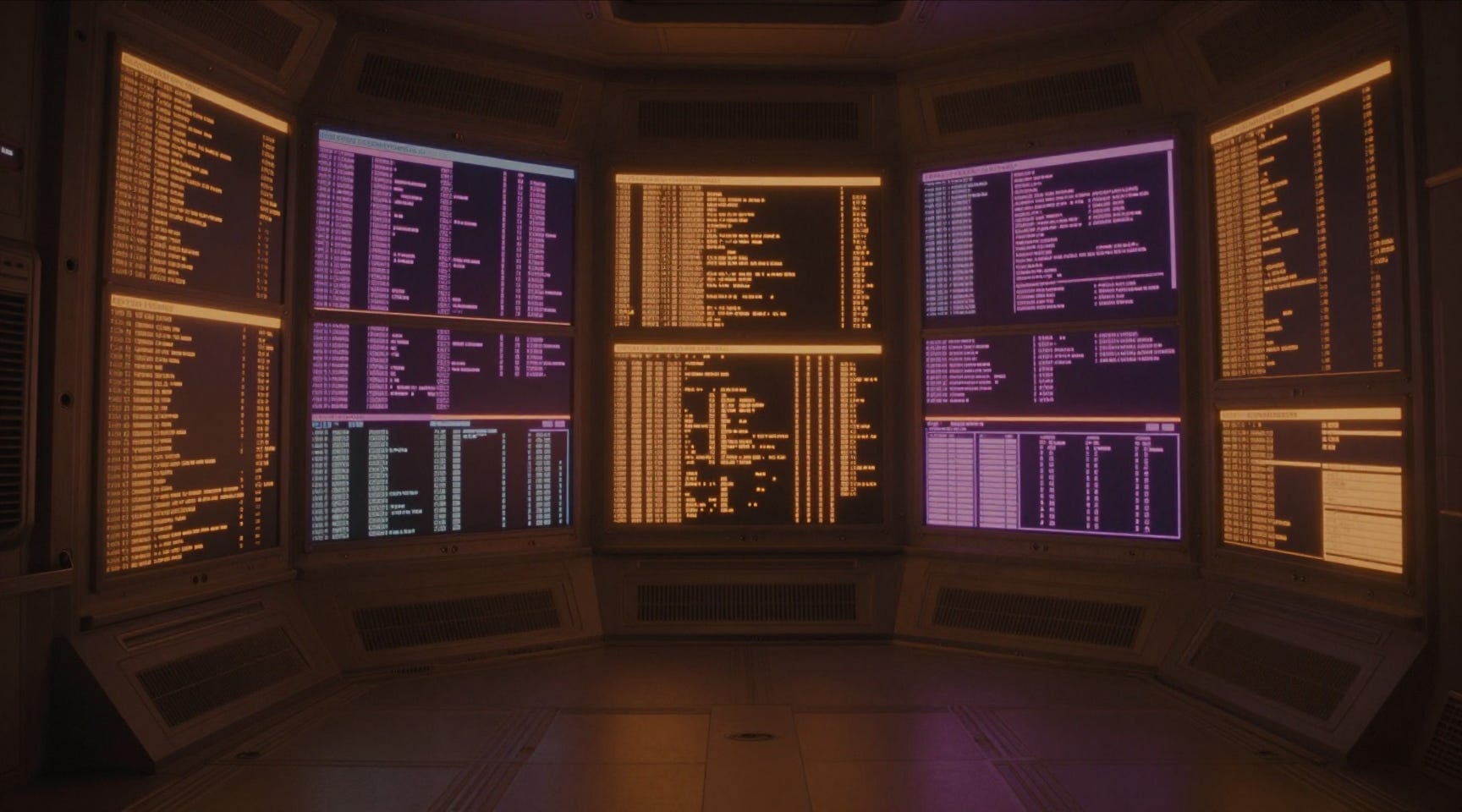
The chamber pressure was set to Vresh-Tal’s preference. The air was still. Nothing moved except the data streams, cycling through their layers in a rhythm designed for sustained analytical focus.
Vresh-Tal had been in the chamber for several station-cycles. The dossier was comprehensive on capability.
The question it could not answer was not about capability.
The human term appeared in multiple contexts across the dossier. Infrastructure allocation. Population redistribution. Economic reconstruction models. Post-war planning. The humans were actively designing a future in which the Vethrak threat no longer existed. They were allocating resources toward conditions that had not yet been achieved, building frameworks for a world that could only exist if the war ended.
Vresh-Tal re-read the relevant passages. Not once. Several times. Each reading produced the same outcome: the data was clear on what the humans were doing. What it did not clarify was what they were.
The Skarreth had been at war for 147 years. There had been no interruption. No truce. No period of reconstruction between phases of conflict. The Harvest had ended and the resistance had begun in the same breath. Every Skarreth alive today had been born into a civilization that existed for one purpose. There was no civilian literature about post-war life because there was no concept of a post-war state that the species had any experience of. The question of what came after survival was not a question the Skarreth had ever been able to ask.
The humans asked it as though it were natural.
Vresh-Tal cycled through the linguistic analysis records. The human languages all contained future-tense constructions that implied continuity beyond the current conflict. Not military contingency planning. Not survival protocols. Ordinary future statements. References to careers, family structures, infrastructure projects, civic institutions, all set in a time when the Vethrak were no longer a factor. The humans spoke about the end of the war the way Vresh-Tal spoke about the end of a station-cycle: as a certainty that would arrive on schedule.
Vresh-Tal could not determine whether this was strategic naivety, genuine optimism, or a survival trait the Skarreth had never developed. The dossier could not resolve the question because the dossier was built from observation, and observation captured behavior, not the interior architecture that produced it. The humans had demonstrated adaptability under pressure. They had performed effectively during the joint trial operation. Their tactical competence was established. What Vresh-Tal could not model was what they would do with victory if they achieved it.
The ability to plan for a future without the war suggested a psychological architecture fundamentally different from the Skarreth baseline. It meant the humans carried within themselves the assumption that survival was not the end state. That survival was the prerequisite for something else that had not yet been defined. The Skarreth had never had the luxury of that assumption. The resistance was not preparation for something that would follow. It was the entirety of what the species had been for 147 years. If the war ended, the Skarreth would have to discover what they were without it.
The humans would not. They already knew.
Vresh-Tal sat in the stillness of the assessment chamber and recognized that the question could not be answered by analysis. The model had a variable. The human relationship to a non-war future. That had no analogue in Skarreth experience. The variable could not be derived from data. It could only be observed over time, across multiple situations in which the humans had the opportunity to demonstrate what they actually valued when survival was not the immediate requirement.
This was not a failure of intelligence. It was a limitation of the framework. The framework had been built for 147 years of resistance intelligence, calibrated to a species that had never had to consider what came after. It could assess threat, capability, doctrine, pattern. It could not assess something the assessor did not have a category for.
Vresh-Tal made a note in the assessment record. The format was compressed, direct, consistent with Skarreth documentation protocol: no preamble, no qualification, no expression of uncertainty beyond the content of the finding itself.
The alliance commitment is proceeding as planned. The humans have demonstrated tactical adaptability consistent with reliable partnership. The long-term behavioral model is incomplete. Assessment: ongoing.
The note was accurate. It was also insufficient, in a way that Vresh-Tal registered without being able to articulate. The insufficiency was not in the note’s content. It was in the gap between what the note described and what the question required. The note described behavior. The question required insight into something the Skarreth had never possessed and had no framework to evaluate.
Vresh-Tal cycled the chamber systems. The atmosphere equalized with the station’s main circulation. The layered displays dimmed to standby. The dossier remained open. The next session would begin where this one ended.
Vresh-Tal left the assessment chamber. The corridor outside was dim, pressure-stable, the familiar geometry of Station Kresh-Var’s internal passageways. Other Skarreth moved through the adjacent spaces, performing their functions, contributing to the resistance that had defined the species for 147 years. None of them were thinking about what came after. None of them had ever needed to.
Vresh-Tal walked through the corridor without slowing. The question was not resolved. It could not be forced into an answer. The only path to resolution was observation conducted over time. Watching what the humans did when the immediate threat receded, when the pressure that had shaped their behavior relaxed, when they had the freedom to be whatever they actually were.
The chamber’s systems cycled down behind Vresh-Tal. The dossier remained open, waiting for the next session.
The question did not leave the chamber with its occupant. It stayed in the data streams, unresolved, waiting for evidence that had not yet arrived.
If you enjoyed this story, you can follow the main story arc in The Exodus Rush, the first book in The Vethrak Requiem series.