


The problem was not the power coupling. The problem was that three species with three incompatible engineering traditions were each certain their coupling was the only one worth discussing.
Thomas Okonkwo sat at the center of the long worktable in Prometheus Station’s joint engineering bay, a windowless room buried deep in the station’s industrial sector. To his left, Kresh-Vol had unpacked a Skarreth power coupling from a foam-lined case and placed it on the table with the deliberate precision of someone handling ordnance. To his right, Keth-Miren had arranged a Keraneth coupling beside a portable scanner that was already emitting a soft amber glow, the Keraneth equivalent of taking notes. The human coupling, a standard Mark VII interface that Thomas had requisitioned from Vanguard’s spares locker, sat in the middle of the table. It looked smaller than the others. Less elegant. Less robust. Thomas’s wrench rested beside it on a worn cloth, a habit he had stopped noticing.
Kresh-Vol spoke first. The translator rendered the click-pattern as a flat, declarative sentence. “The Skarreth coupling achieves ninety-seven point four percent efficiency across all tested load profiles. It is obviously superior.”
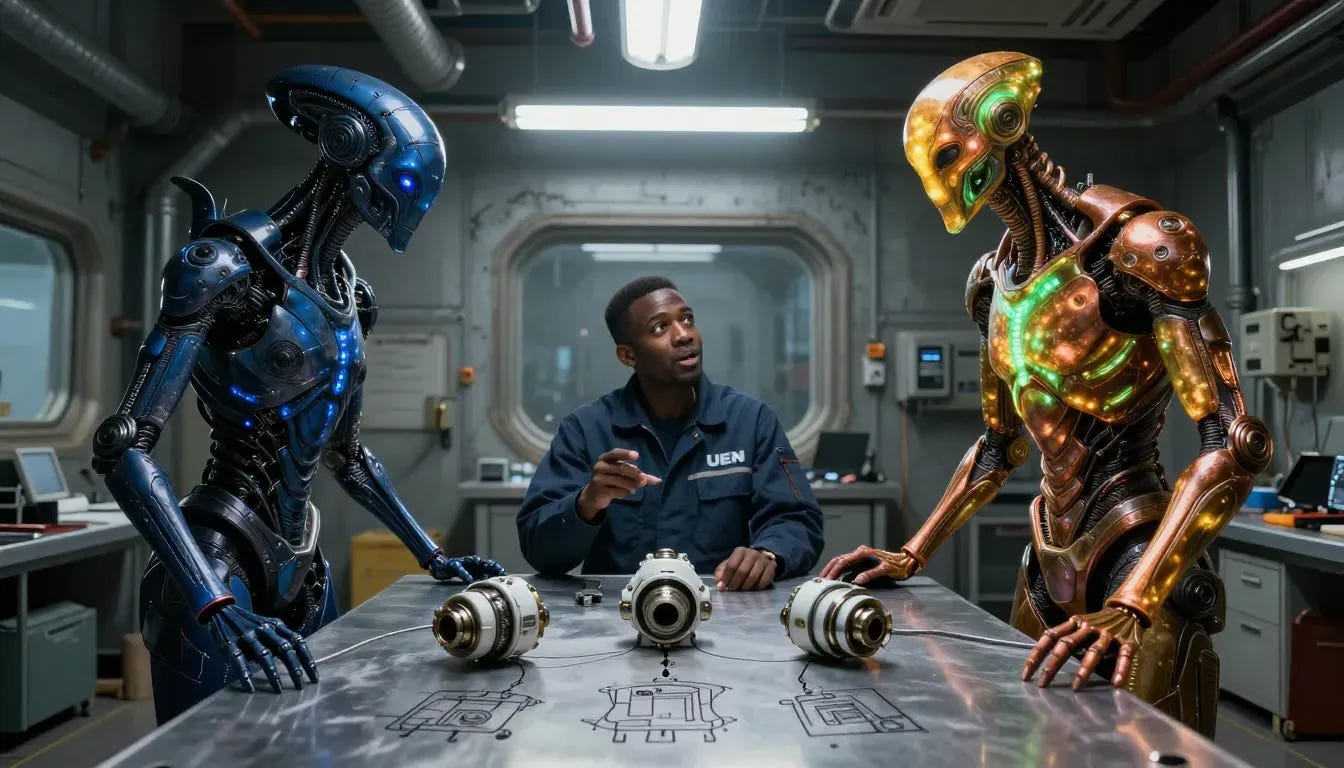
The Skarreth engineer’s four recessed eyes held steady on Thomas. The deep blue-black surface of Kresh-Vol’s body caught the overhead lights without reflecting them, a matte absorption that made the Skarreth seem to occupy space differently than the humans and Keraneth in the room. Chromatophores along the lateral ridges flickered once, a deep violet, then stilled. Thomas had spent enough time with Skarreth engineers to recognize the gesture as the equivalent of a raised eyebrow.
Keth-Miren responded before Thomas could. The Keraneth’s translator produced a voice that was flat and synthetic. All Keraneth translators sounded the same, a byproduct of collapsing the four-layer bioluminescent spectrum into lexical English. The actual communication would have been a cascade of rose-gold and amber-light patterns across Keth-Miren’s elongated form, carrying emotional register and relational markers alongside the words. What the translator rendered was only the words.
“The Keraneth coupling tolerates a forty-two percent greater stress load than either alternative. It will function for centuries. The Skarreth coupling prioritizes efficiency over duration. That is not superiority. That is a different engineering question.”
Kresh-Vol’s chromatophores shifted to a deeper violet. The translator hesitated, a fractional delay that Thomas had learned to read as the system struggling with Skarreth tonal nuance. When it spoke, the voice was unchanged. “The engineering question is how to power an alliance fleet in combat. Not how to build a monument.”
Keth-Miren’s bioluminescence rippled through a sequence Thomas could not fully parse, amber to pale rose to something ultraviolet at the edges. Then the translator caught up. “We have built monuments for eight hundred years. They are still standing.”
The air in the room shifted. Thomas set both hands flat on the table.
“All right,” he said. “Show me.”
Kresh-Vol went first. The Skarreth coupling was elegant in the way that things evolved over centuries of refinement often were: no wasted mass, no redundant pathways, every component serving at least two functions. Kresh-Vol walked Thomas through the load-balancing architecture with the clipped precision of someone who had designed similar systems a hundred times. The coupling used a variable-impedance core that adjusted to incoming power signatures in real time, compensating for frequency drift before it became a problem. The human equivalent required a separate stabilization module. The Skarreth coupling did not.
“The core self-calibrates,” Kresh-Vol said. “No operator intervention required. The Skarreth do not build systems that require someone to watch them.”
Thomas nodded. He was taking notes on a datapad, but the real work was happening in his head: cross-referencing the Skarreth design against Vanguard’s power grid, Vanguard’s tolerances, Vanguard’s failure modes. The coupling was efficient. It was also completely non-modular. A single integrated unit that could not be repaired without specialized Skarreth fabrication tools. If it failed in combat, the ship it was mounted on would lose that power line until it returned to a Skarreth drydock.
Keth-Miren presented next. The Keraneth coupling was the opposite of the Skarreth design in every respect. Where the Skarreth unit was compact and integrated, the Keraneth coupling was robust and accessible; individual components could be swapped without disassembling the whole. Where the Skarreth core adjusted to frequency drift, the Keraneth coupling simply overbuilt the housing to withstand it. The result was a component that weighed nearly twice what the human coupling weighed, drew more baseline power, and would probably still be functional when the ship it was mounted on had been reduced to scrap.
“Keraneth engineering prioritizes survival,” Keth-Miren said. Bioluminescence shifted through a slow copper gradient. Thomas had learned to read that as the Keraneth equivalent of a patient explanation. “A component that fails cannot serve its function. A component that cannot be repaired in the field becomes a liability. We build for the worst case, because the worst case is the only case that determines whether anyone survives.”
Thomas turned the Keraneth coupling over in his hands. The weight was substantial. The housing was cool to the touch, a dense ceramic composite that had no human equivalent. The quality of the construction was evident; the seams were invisible, the tolerances so tight that the component held together like a single solid object rather than an assembly. It was overbuilt. It was also repairable with human tools. The access panels used standard hex-head fasteners, a detail so mundane that he almost missed it. Keth-Miren had known what kind of tools humans used.
“Your turn,” Kresh-Vol said. The click-pattern was faster than before. Impatience, or something close to it.
Thomas picked up the human coupling. It looked like a compromise next to the other two. Less efficient than the Skarreth design. Less durable than the Keraneth. Modular to a fault: the housing could be opened with a standard spanner, every component was individually replaceable, and the interface standard had been designed to work with seventeen different power signatures from eleven different ship classes because humanity had never had the luxury of building a fleet from a single engineering tradition.
“This is the Mark VII,” Thomas said. “It is not the best coupling we could build. It is the coupling we could build with what we had, in the time we had, using tools that were designed for a different century. It works with everything because we could not afford to build something that did not.”
He placed it back on the table.
“Your coupling is more efficient,” he said to Kresh-Vol. “Yours is more durable,” to Keth-Miren. “And mine is more flexible. None of them is the right answer for an alliance fleet that has to include Skarreth efficiency, Keraneth durability, and human adaptability.”
Kresh-Vol’s translator rendered a short click. “You are proposing a fourth design.”
“I am proposing a synthesis.” Thomas picked up a grease pencil from the table and began sketching on the metal surface. The wrench stayed beside his hand, still wrapped in cloth, still present. “Skarreth core technology for the variable-impedance architecture. That is where the efficiency lives, the self-calibrating load balancer. It is better than anything humans or Keraneth have designed for that function.”
Kresh-Vol’s chromatophores settled to a neutral gray. Agreement, or at least the absence of objection.
“Keraneth housing and accessibility standard. The overbuilt tolerances. The field-repairable access points. The hex-head fasteners.” Thomas glanced at Keth-Miren. “I noticed.”
A ripple of amber. The translator was silent for three full seconds. Then: “The fasteners were a deliberate choice. We studied your maintenance logs before this meeting.”
It was the first time Keth-Miren had volunteered information that was not a rebuttal. Thomas allowed himself a half-second of something that was not quite a smile.
“Human interface standard,” he continued. “Modular connectors. Standardized tool requirements. Documentation in all three engineering vocabularies, not translated after the fact but designed to be legible to Skarreth pressure-readers, Keraneth bioluminescent displays, and human datapads simultaneously. The interface is the translation.”
He finished sketching. The diagram on the table was rough, grease pencil on metal, the kind of drawing that only made sense to other engineers. The Skarreth core fed into the Keraneth housing through a human-standard interface bus. Three engineering traditions. One component.
Kresh-Vol studied the diagram. The pause was long enough that Thomas could hear the environmental systems cycling in the background, the station’s recyclers, the distant hum of power conduits. When the translator activated, the rendered voice was unchanged. The click-pattern that preceded it was slower, more deliberate. “Acceptable. For now.”
From a Skarreth, Thomas had learned, that was enthusiasm.
Keth-Miren’s bioluminescence cycled through a sequence that Thomas’s limited training identified as the Keraneth equivalent of considered assessment: amber to copper to a steady green-gold that meant provisional agreement. “The synthesis preserves what each tradition does best. The Keraneth will contribute the housing specifications and the accessibility protocol.”
“The Skarreth will contribute the core architecture.” Kresh-Vol paused. Another click, softer. “The human will contribute the diplomacy.”
Thomas looked up from the diagram. Kresh-Vol’s chromatophores had shifted to a color he had not seen before, a pale and almost warm amber. The translator offered nothing. It did not need to.
“I am an engineer,” Thomas said. “That was engineering.”
He picked up the wrench. The cloth was worn soft from years of handling, the weight of his father’s hands in the metal, the weight of Park’s memory in the habit of carrying it. He placed it on the table beside the diagram, not as a statement but as an acknowledgment. The tool that had repaired human systems, Skarreth couplings, Keraneth interfaces, and the spaces between them.
The three engineers looked at the diagram. Three species. Three traditions. One component that did not exist yet except as a sketch on a worktable in a windowless room deep inside a station built from salvaged wreckage.
It was going to work.
If you enjoyed this story, you can follow the main story arc in The Exodus Rush, the first book in The Vethrak Requiem series.