


The numbers were wrong again.
Florian Cruz ran his thumb along the readout strip, checking the displacement figure against the manifest entry for Bay Fourteen. The freighter Harken sat on the dock pad, cooling clicks ticking through its landing struts, its cargo ramp still sealed. According to the manifest filed by its pilot, the ship carried 4,200 kilograms of agricultural substrate bound for Titan Hydroponics Sector Three. According to the mass displacement sensor embedded in the dock pad, the ship weighed 4,412 kilograms over its registered empty mass.
Two hundred and twelve kilograms of something that didn’t exist on paper.
Florian pulled up the Harken’s docking history. Monthly visits stretching back eleven months. He cross-referenced the displacement readings with the filed manifests. Every arrival showed the same pattern: mass over declaration by 180 to 230 kilograms. Every departure showed mass under declaration by a similar range. The ship came in heavy and left light, month after month, and the variance fell inside the calibration tolerance band that most auditors treated as sensor drift.
It wasn’t drift. Drift was random. This was consistent.
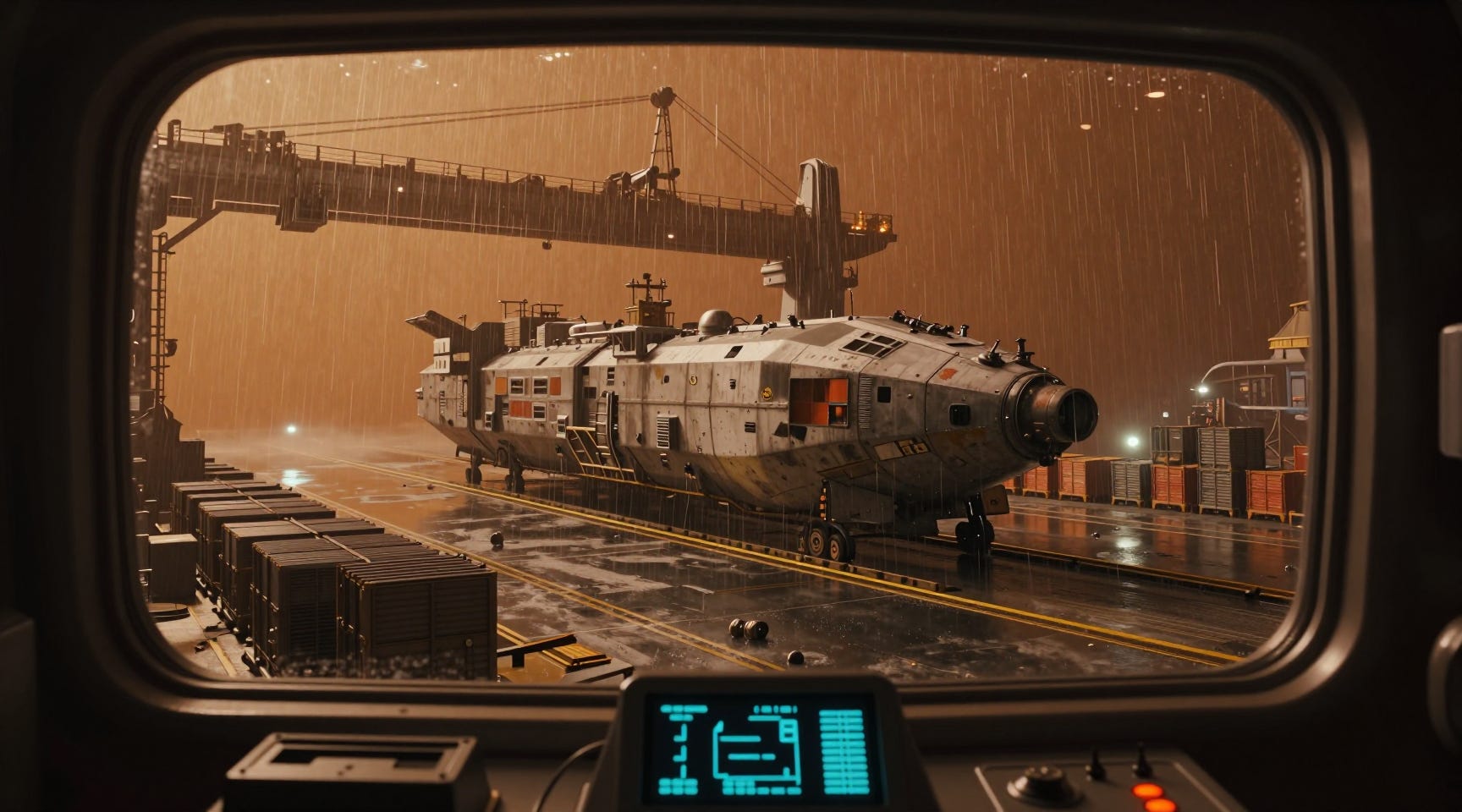
He sat in the weigh station, a pressurized booth bolted to the wall of Titan Main Dock’s cargo processing level. The booth had a viewport overlooking sixteen landing bays, a terminal running mass verification software, and a chair that had lost its cushioning three years ago. Beyond the viewport, methane rain streaked the exterior cameras in amber threads. Titan’s atmosphere pressed against the dome like a living thing, dense and cold and patient.
The Harken’s pilot was Busaba Moreira. Florian had processed her manifests dozens of times. She ran belt-to-Saturn routes carrying agricultural supplies, water treatment components, and occasional medical resupply. Her paperwork was clean. Her cargo seals were always intact. She was polite in the brief interactions that docking protocol required, and she never lingered on the pad longer than her berth window allowed.
Two hundred kilograms. Every month. In and out.
He could file a discrepancy report. The form sat in his terminal’s queue, templated and waiting. Filing it would trigger a physical cargo inspection on the Harken’s next visit. Customs enforcement would open the containers, weigh each item against the manifest line entries, and find whatever Busaba Moreira was carrying that she hadn’t declared. The inspection would take six to ten hours. The pilot would be detained. The ship would be impounded pending investigation.
Florian pulled up the departure records instead. The Harken left Titan lighter than declared. That meant Moreira was bringing something in and taking something out. Two different cargoes, both hidden, both roughly the same mass. A swap.
He queried the station’s import-export database for items in the 200-kilogram range that moved through Titan’s economy. The list was long. Methane fuel cells. Atmospheric filter cartridges. Cascade reactor cooling rods. Processed nitrogen compounds. Medical-grade oxygen concentrators. Any of these could be packed into a standard cargo container alongside legitimate agricultural substrate without changing the container’s external profile.
The Harken’s cargo ramp unsealed. Through the viewport, Florian watched the dock crew begin offloading. Standard containers, standard markings, standard handling procedures. Nothing visible to distinguish the declared cargo from whatever else rode inside.
He should file the report.
He pulled up Moreira’s flight plan instead. Her route originated at Ceres Transfer Station, with a stopover at Vesta Seven before the Saturn transit. Vesta Seven. The name triggered a memory: an internal bulletin from three months ago, flagged low-priority, noting that Vesta Seven’s atmospheric filtration system was operating at thirty-one percent capacity following a cascade failure in its primary recycler bank. The settlement had filed seventeen resupply requests through UEC allocation channels. Fourteen had been denied. The remaining three were pending review, expected timeline eight to fourteen months.
People on Vesta Seven were breathing through backup filters rated for ninety days. The bulletin was three months old.
The knock on the weigh station door came forty minutes later. Busaba Moreira stood in the corridor holding a docking receipt, her flight jacket marked with fuel stains and the faded logo of a charter company that had folded six years ago. She was small, dark-haired, and she moved with the economy of someone who’d spent years in low-gravity corridors where every motion cost energy.
“Mass verification for Bay Fourteen,” she said. “I need the stamp before I can begin reload.”
Florian looked at the receipt. Standard form. The declared cargo weight matched the manifest. It did not match the displacement reading.
“Your inbound mass is over declaration by two hundred and twelve kilograms,” he said.
Her expression didn’t change. Her hands stayed still at her sides. She’d been expecting this, or she’d prepared for the possibility. Either way, the reaction was too controlled for surprise.
“Sensor calibration on Pad Fourteen has been flagged twice this quarter,” she said. “The maintenance log shows a variance window of plus or minus three hundred kilograms. Your own station records support the reading as within tolerance.”
She was right. He’d checked. The maintenance log did show those flags, and the tolerance window was generous enough to cover her discrepancy. Someone had either tampered with the calibration records or exploited a genuine maintenance gap.
“The variance is consistent,” he said. “Every visit. Same direction. Same range. That’s not calibration error.”
“I carry agricultural substrate. Moisture content varies by batch. A wet batch reads heavier.”
“Your departures read light. Wet substrate doesn’t evaporate in a docking bay.”
Silence. The corridor hummed with ventilation. Somewhere below them, a dock crane repositioned with a hydraulic groan.
“What are you carrying?” he asked.
“Atmospheric filter cartridges. Salvaged from Pallas Station before it was decommissioned. Two hundred kilograms per run, packed inside the substrate containers. The cartridges go to a redistribution crew on Titan who break them down and reship to three outer settlements that can’t get allocation through official channels.”
“Vesta Seven.”
“Vesta Seven. Hygiea Station. Themis Point.”
Three names he recognized from the same internal bulletin. Three settlements bleeding air through failing filters while resupply requests sat in administrative queues.
“What do you take out?”
“Methane fuel cells. Titan produces a surplus of twelve hundred units per quarter. The surplus sits in warehouse storage because the UEC export allocation model caps outbound fuel shipments to prevent strategic stockpiling in the belt. The cap was set in Year 9. Nobody’s updated it. The cells go to the same three settlements. They need fuel for heating. Their cascade reactors are too small to handle thermal load during opposition, when they’re farthest from the sun.”
“Who runs the redistribution?”
“A crew called the Ballast. Four people. They operate out of a maintenance sublevel on Deck Nine. They’ve been moving surplus resources to underfunded settlements for two years. Nothing weaponized. Nothing Vethrak. Filters and fuel cells. The things people need to keep breathing and keep warm.”
Florian looked at his terminal. The discrepancy report sat in the queue. Filing it would take thirty seconds. The investigation would dismantle the Ballast’s operation within a week. The atmospheric filter pipeline to Vesta Seven would stop. The fuel cell shipments to Hygiea and Themis Point would stop. The UEC would not accelerate the pending resupply requests, because the requests were already in the system and the system moved at its own speed.
“The tolerance window on Pad Fourteen,” he said.
“Three hundred kilograms.”
“The maintenance flags are real. The sensors need recalibration. I’ve been meaning to submit a work order.”
“A recalibration would tighten the window.”
“It would. If someone filed the work order.” He closed the discrepancy report without saving it. “Recalibration requests go to station engineering. Current backlog is four months. I’ll submit it next quarter.”
Four months. Enough time for four more runs. Eight hundred kilograms of atmospheric filters moving toward people whose air recyclers were failing. Eight hundred kilograms of fuel cells moving toward people whose heaters couldn’t survive opposition.
He stamped the docking receipt and handed it back.
“Your mass verification is within tolerance,” he said. “You’re cleared for reload.”
Moreira took the receipt. She didn’t thank him. Gratitude would have acknowledged what had happened, and what had happened needed to exist in the space between sensor tolerance and official record, where neither of them would have to name it.
She left. The corridor swallowed her footsteps. Florian turned back to his terminal and pulled up the next manifest in the queue. Bay Seven. A tanker carrying liquid nitrogen. The displacement reading matched the declaration within two kilograms.
The numbers were right.
He processed the stamp and moved to the next ship.
Author’s Note: Titan Main Dock processes an average of six hundred docking events per month, everything from Navy patrol vessels to single-operator charter freighters running Saturn’s moon circuit. Mass verification is a security checkpoint designed to catch smuggling, but the system depends on sensor accuracy and human judgment. When sensors drift and auditors look the other way, gaps open. The Ballast is one of many small crews exploiting those gaps, moving surplus resources from stations that have more than they need to settlements that have less than they can survive on. The UEC’s allocation model was designed for a civilization still finding its footing after the invasion. Fifteen years later, some of its formulas haven’t been updated, and the people living at the edges of the system have learned not to wait for permission to survive.
If you enjoyed this story, you can follow the main story arc in The Exodus Rush, the first book in The Vethrak Requiem series.