


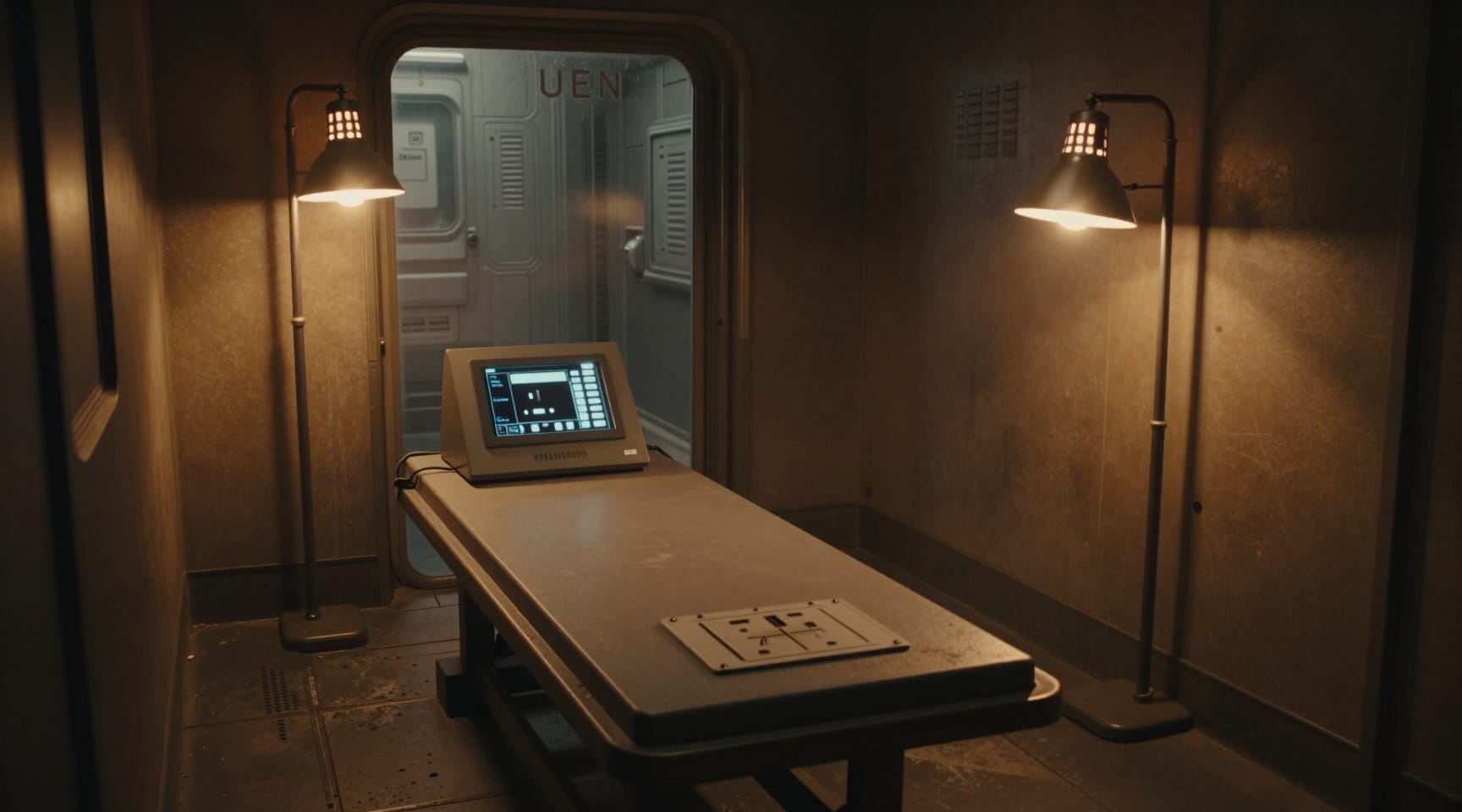
The bell above Ginevra Mahlangu’s door sounded like nothing, a dry click on a cheap piezo strip, and she had kept it that way on purpose. A loud bell drew attention from the corridor. A silent bell left her deaf to her own shop. The dry click was the compromise she had lived with for four years.
She looked up from the scan bed.
Dawit Osborne stood in the doorway with a work bag slung over one shoulder and the posture of a man who had not slept in two days. His ration overalls were Ceres-issue, third revision, the ones they handed out to dock rotators after the post-Defiant Stand consolidation trimmed the independent longshore crews off the benefits rolls. He looked like half her clientele. That was either a good sign or the worst sign.
“I was told you could fix an iris pattern,” he said.
“You were told wrong. I do not fix. I rewrite.”
She left the scan bed and crossed to the counter. The shop was narrow, four meters by six, lit by a pair of repurposed salvage lamps she had bought from an Iron Wake broker in the dock district three years ago. The lamps threw the kind of light that did not flatter anyone. She preferred it. Flattering light made clients relax.
“Who sent you?”
“A woman at the water queue on deck nine. She said you ran with Threadbank.”
Threadbank. The name her crew had started using when the forger collective on Ceres needed something to call itself for the corridor gossip. The name had spread farther than she liked, which made it useful for drawing clients and dangerous for everything else.
“Run with is a generous phrase. What do you need?”
“My son. He is sixteen. A dock audit last week flagged his chip as an associate of a Children of Earth cell through a salvage contact. He was not involved. He was moving crates. Now he is delisted from the ration rolls pending an investigation, and the investigation queue runs eleven months.”
“The queue runs fourteen now. They added three months last Tuesday.”
He closed his eyes.
Ginevra watched his hands. Hands told her more than faces. His were blunt and scraped along the knuckles, the pattern of a man who had worked salvage or refinery for most of his adult life, the kind of hands that did not belong to a UEN compliance officer running a sting. Compliance officers had clean hands and the faintest of manicures. She knew. She had done business with three of them over the years, each one carrying his own reasons for needing what she sold.
Hands could still lie. The best stings trained their people.
“What are you offering?”
“Two hundred ration credits. Three if I can sell my mother’s grav wheel.”
“Keep the wheel. The wheel will feed him longer than the credits will.”
He opened his eyes. “You will do it for two hundred?”
“I will do it for one fifty if you answer two questions correctly.”
He nodded.
She leaned against the counter. “Who introduced you to the woman at the water queue?”
“A carthand named Rabiah. She loads pallets on deck eleven. Her cousin was on my son’s crew. He is also delisted.”
“What time of day was the water queue conversation?”
“The third shift. Around twenty hundred. The queue was long that day because the deck seven pump failed.”
Both answers were correct. The deck seven pump had failed on Tuesday. Ginevra kept a mental map of the station’s infrastructure failures because they shaped when and how people came looking for her. The water queue on deck nine had doubled in length that night. A woman handing out her name in a long queue at the right time was the signal Threadbank used to screen the desperate from the planted.
She let her breath out, slow.
“Sit down.” She gestured to the scan bed.
He sat. She pulled up the shop’s intake on her terminal, a low-grade interface she had built herself out of decommissioned station medical software, which scanned like any other biometric intake and generated none of the flags that the newer systems ran.
“This is how it works. I am not going to restore your son’s chip. I am going to build him a new identity. A new name, a new origin, a new iris pattern stitched from three donor templates who are no longer drawing rations because they are no longer breathing. The chip will read as a legitimate citizen born on Vesta in Year 4. He will have documentation consistent with a Vesta evacuation file we have access to because a clerk on Vesta owes us eighteen different favors.”
“Will it hold?”
“It will hold against any scanner that is not running the deep genetic crossmatch. The deep crossmatch is expensive. The UEN runs it on Titan and two locations in the inner belt. They do not run it at the Ceres ration checkpoints.”
“If they check?”
“Then your son runs, and you tell him before we do this that if the scanner ever pulls him aside for a deep check, he does not argue, he does not explain, he runs. That is the price of the new skin. A skin you can lose.”
Dawit looked at the ceiling. The salvage lamps painted his face in the color of old bronze.
“He is sixteen,” he said.
“I know.”
“The last year of his childhood is going to be a false name on a fake chip.”
“The alternative is a fourteen-month queue and a sixteen-year-old who is already hungry.”
He did not answer.
She waited. Ginevra had learned in her second year at this work that the decision belonged to the client. She could sell them the mark, but she would not choose for them. The ones she chose for were the ones who came back angry in the second week, when the weight of the lie settled in.
“Do it,” he said.
She pulled the intake chair around and told him to put his thumb on the print bed. Not his son’s. Her protocol required the parent’s consent signature to run on the parent’s biometric, a thread she could cut later if the job went bad. She had made that rule herself, and she kept it.
His thumb touched the plate.
The scanner hummed.
Outside the shop, in the corridor, someone walked past without looking in, and the silent bell did not click, and Ginevra Mahlangu began writing a new name for a boy she would never meet.
Author’s Note: In the years after Book 1.5’s Defiant Stand (coming soon) consolidated the inner-system ration rolls, entire classes of workers found themselves delisted on the strength of association flags. Salvage crews, dock rotators, and Ceres longshore hands were hit hardest. A counter-economy of biometric forgers rose to meet the need, working out of back rooms on every major station. On Ceres, the loose collective called Threadbank operated under the shadow of the Iron Wake salvage brokers, buying their lamps and their silence in the same transactions. The donor templates Ginevra used were real people. Just not in the way the scanners believed.
If you enjoyed this story, you can follow the main story arc in The Exodus Rush, the first book in The Vethrak Requiem series.