


The back-office of Ceres Mercantile and Settlement had been quiet for ninety minutes when Dominika opened the second audit window.
The station clock at the corner of her terminal read 0247. The overnight shift on Audit Three was a single workstation, a coffee dispenser that produced something brown and warmer than ambient, and a chair that had been broken in by twelve years of examiners before her. She liked the shift. Nobody asked her to make small talk between transactions. Nobody stood behind her chair and watched the screen.
She was running the routine quarterly cross-check on thermal credit attribution. The work was procedural. Anomaly flags came up two or three times a shift, and most of them were transcription errors that a junior on day shift would clear in twenty seconds when they came in at seven. The job paid by hour and by accuracy. Dominika cleared anomalies at a rate the day shift had stopped pretending to match.
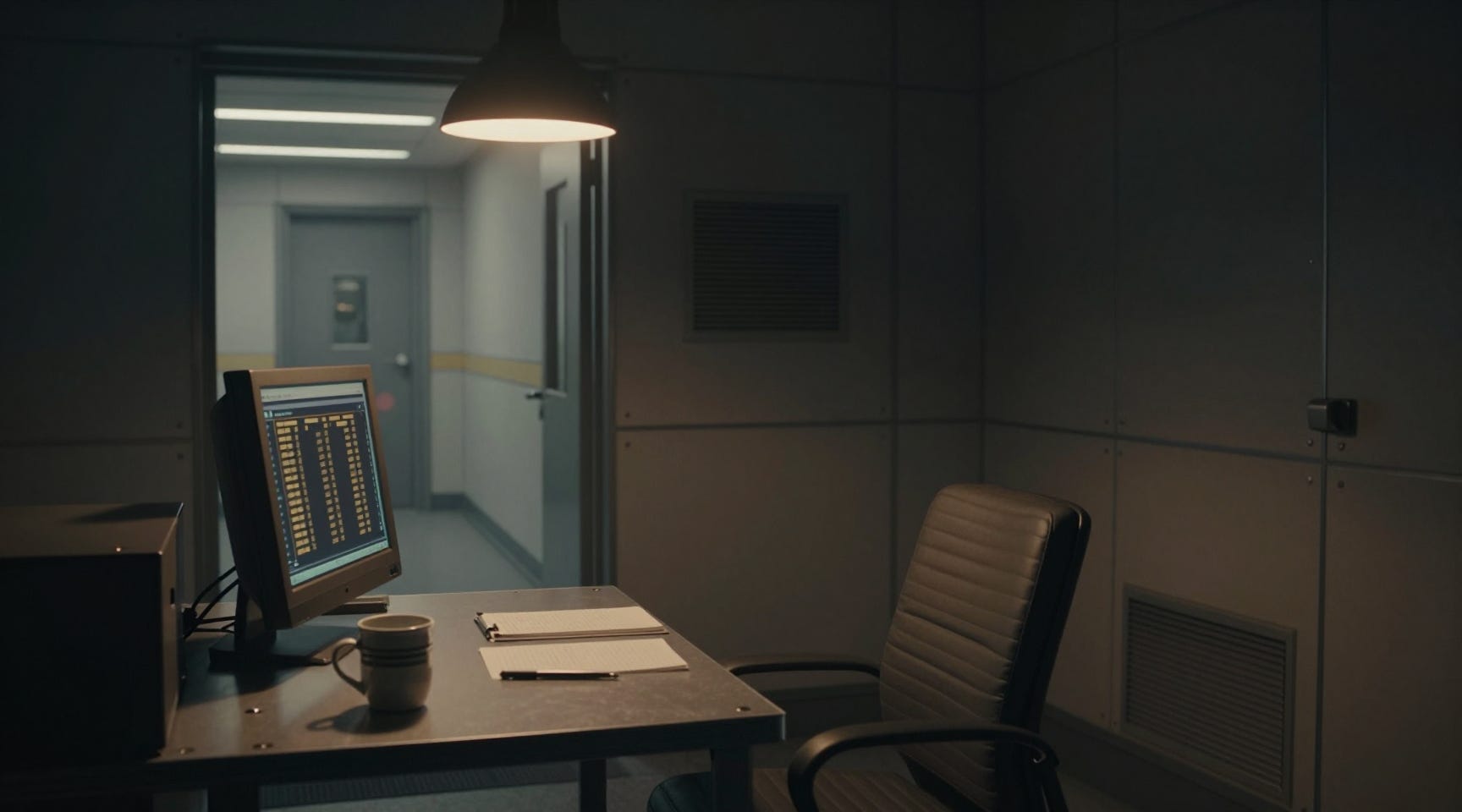
The flag that opened the second window was not a transcription error.
A single thermal credit transaction had passed through five different account designations in three minutes. The first attribution was a Pallas freight broker. The second was a Mars orbital holding company. The third was an Enceladus courier consortium subsidiary that Dominika did not recognize. The fourth was a Ceres-registered cargo expediter she did recognize, because the cargo expediter had been audited eleven months ago and cleared, and the audit file had read thin in a way she had not been able to articulate. The fifth attribution was a private account holder on Mimas Station whose registration documentation was four lines long and whose deposits had begun seven months ago and had grown every quarter since.
The transaction was for fourteen thousand thermal credits. Almost no one moved fourteen thousand credits in three minutes through five accounts. The arithmetic was wrong. The flagging system would not catch it, because none of the five hops individually exceeded the threshold. The system was looking at altitudes, not at the path.
Dominika pulled the transaction record in full.
The five hops were textbook clean. Each had a routing number, a justification code, a counterparty signature. Each was attached to a goods-movement manifest that matched the credit amount within tolerance. Every piece of paperwork was correct. The pattern of the paperwork was what was wrong. The hops were too fast, the routing too deliberate, the final attribution too small to absorb fourteen thousand credits without showing any operational ripple.
She pulled a second transaction from the same Mimas account. Eight thousand credits. Three hops. Same shape.
A third. Eleven thousand. Five hops. Same shape.
She pulled a week of transactions from the same Mimas account, then a month. The pattern was a wave. Some weeks the account took six hops at three or four thousand each. Other weeks it took two hops at nine thousand. The total monthly volume was consistent. The shape varied to keep individual transactions below the system’s attention threshold.
Dominika sat back in the broken-in chair. She did not write anything down.
A bank ran on the assumption that paperwork existed to describe something true. When the paperwork existed to describe something that was not true, the bank kept running anyway, because the paperwork was what the bank could see. The system Dominika ran had been built to catch errors made by people who wanted to move money correctly and had failed. The system was not built to catch people who wanted to move money incorrectly and had planned the route in advance.
Whoever was running these accounts had planned the route in advance.
She looked again at the routing pattern. The Pallas broker, the Mars holding company, the Enceladus subsidiary, the Ceres expediter, the Mimas account holder. Five names, none of which would draw a second look in isolation. The Enceladus subsidiary was registered to a courier consortium that the regulatory database listed as nine years in operation, with public manifests cleared by UEN inspection on a quarterly basis. The Mars holding company’s filing was thin in a way that should have triggered review and never had. The Ceres expediter was eleven months past an audit she herself had read.
The Mimas account was new in the way new things were when they had been deliberately constructed to look new. The registration documents were the minimum required. The deposits had grown at a rate that read as organic and was not. The withdrawals had begun in Month Four and had moved outward into other anonymous accounts at a pace that matched the deposit growth almost exactly.
She was looking at laundering. The polite word was structuring. The professional word was integration. The accurate word was that someone was washing thermal credits at industrial scale through the gaps in the Ceres regulatory framework, and the framework was so well-fitted to the gaps that the operation read as routine commerce.
A footstep in the corridor.
Dominika closed the audit windows in one keystroke. The screen returned to the quarterly cross-check summary. She pulled a routine flag from the queue and began clearing it with the unhurried precision of a worker who had been doing exactly what she was supposed to be doing for the last hour.
The senior auditor passed the open doorway of Audit Three. His footfalls did not slow. His coffee cup carried fresh heat, the bitter smell of it reaching her from across the room. He did not turn his head. He kept moving toward his own office, where he would close the door for the next ninety minutes and not emerge before the day shift relieved her.
She waited until his door clicked shut.
She did not reopen the audit windows. She opened a new file on her local working partition, the partition the bank’s overnight backup did not touch because the bank had never imagined an audit clerk would have anything worth backing up that the bank itself did not own.
She named the file Threadbank.
She did not know why the word came to her. The accounts were threads. The accounts ran through the bank’s machinery the way thread ran through a loom, in and out and through and around, and the pattern they made was not visible to the loom because the loom was looking at one thread at a time. Threadbank. She liked the shape of it in her mouth. She did not say it aloud.
She began to catalog the flows. The Pallas broker. The Mars holding company. The Enceladus subsidiary. The Ceres expediter. The Mimas account. Five names, five routing numbers, five paths. She added a sixth column for transaction shape and a seventh for monthly volume. She added an eighth column whose header she left blank, because she had not decided what to put in it yet. The column was for the reason she was building the file. The reason was not in her head as a sentence. The reason was a quiet pressure behind her sternum that had been there since the seventh week she had worked overnight shifts at Audit Three for less pay than the daytime junior who cleared one tenth as many flags as she did.
The shift clock read 0341.
She would not report what she had found. She did not yet know what she would do with it. She knew only that the file would exist by the end of the shift, and that the file would be on her own partition, and that the file would grow.
At 0342 she pulled the next transaction from the queue and began to walk it back, one hop at a time, into the eight-column ledger she had just made.
Author’s note: Day Twenty-Three of the Iron Wake Origins arc. Year 3, Month 3. This is an anthology break in the Iron Wake throughline. Anya Rask is on Mimas. Dominika Sobczak is on Ceres, deep in the back-office of a legitimate bank, watching thermal credit flows that the bank’s machinery is not built to see. She does not know yet that the Mimas account she is cataloging belongs to a courier consortium that Anya signed a contract with last month. She does not know yet that the eight-column ledger she has just made will be the foundation of the Threadbank, the Year 3 origin of the financial laundering operation that, by Year 14, will be the gray-market clearinghouse for nearly every thermal credit that washes through Ceres without official attribution. She knows only that the file will grow. The Iron Wake’s permanent infrastructure is taking shape on three planets at once, and the people building it do not yet know each other’s names.
If you enjoyed this story, you can follow the main story arc in The Exodus Rush, the first book in The Vethrak Requiem series.