


The third stage was still on the screen. Wanjiku Bett removed its permission, not its trace.
Beyond the containment window, the sacrificial transition sat between opposed restraints. Retained offcuts, the original joint geometry, Tuva’s sequence, the shared heat treatment. Enough of Article Four’s load path to ask the question again. Nothing they intended to send into service.
Cho secured his slate beneath the station clip.
“That leaves one diagnostic extension,” he said.
“Inside the reviewed envelope. No third stage.”
He brought the reduced-power allocation beside the thermal reserve. Their last full working interval under masked heat rejection had room for the bounded sequence and the promised sectioning. It did not have room to repeat a test because someone had forgotten a channel.
Wanjiku pressed her boots into the restraints and checked each channel herself.
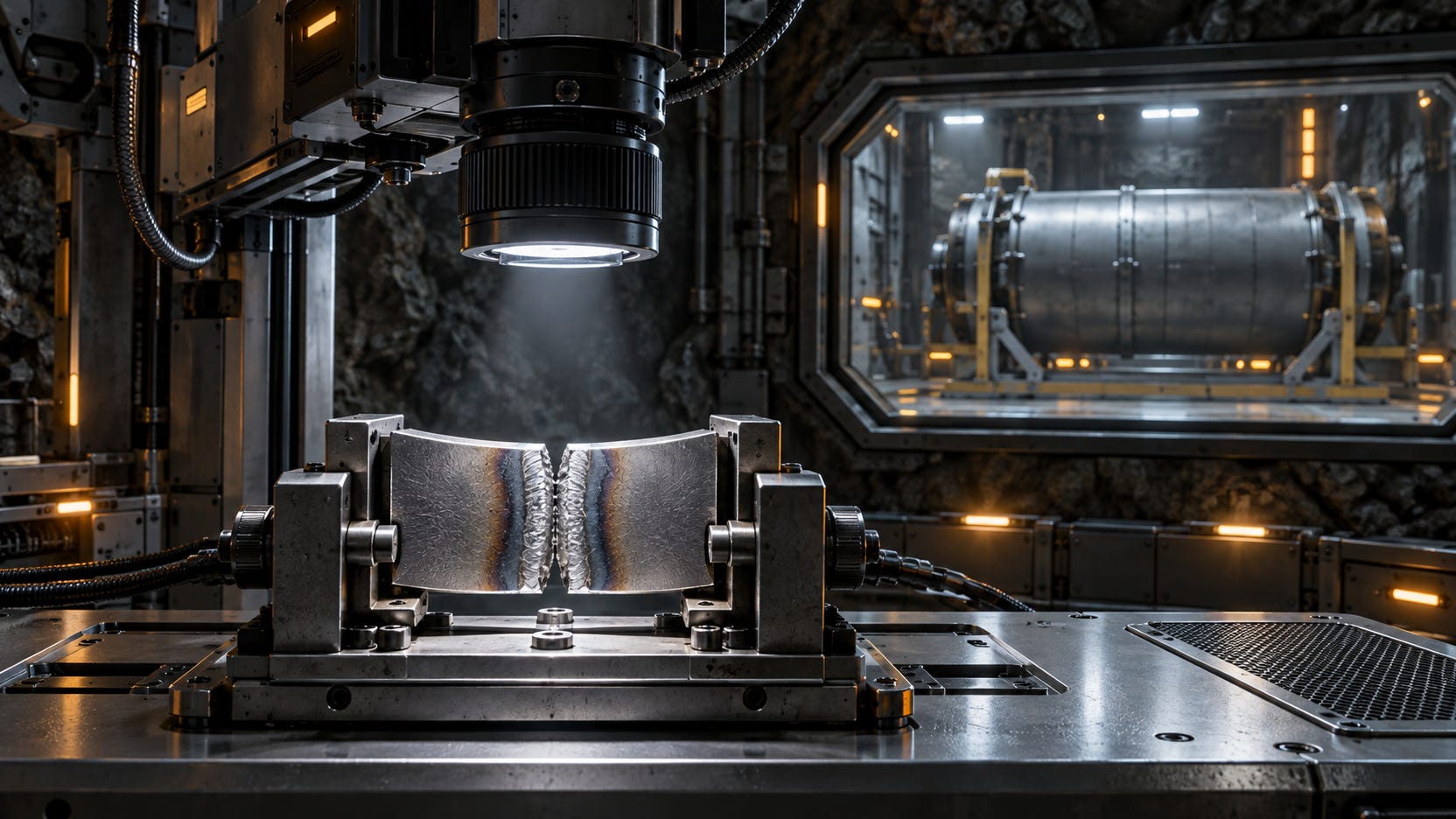
The fixture’s reaction members disappeared into anchors in the rock beside Slip Two. She followed their load record from actuator to restraint, then checked the containment calculation against the actual specimen position. The mock-up could develop the damage they were looking for without exhausting the fixture’s margin.
She verified automatic unload limits independently of the diagnostic stops. A useful signal could justify a pause. A containment limit would require unloading whether the signal was useful or not.
The operator read back both.
On the flight-hardware board, Article Four’s actuators remained isolated. Wanjiku opened that status long enough to confirm the distinction, then returned to the fixture.
Tuva’s fabrication packet held the two material links separately. The same-history control joint occupied its assigned position in the test arrangement. Samrawit’s prediction remained dated before loading: emissions during unloading, followed by ultrasonic growth on the worked-plate side.
Wanjiku checked the pre-test scans with the inspection technician. Both faces, the prescribed angles, the same registration marks they would use afterward. No reportable crack indication within the qualified examination limits. Smaller precursors remained possible. She signed the baseline without making it more absolute.
“Boundary clear,” the operator said.
She checked the camera view and the personnel count. Samrawit and Tuva were behind the barrier. Tools were captive. The access interlock showed closed.
Cho moved his thumb away from the power display.
“Allocation is yours.”
Wanjiku authorized the first stage.
Force rose through the curved specimen. The actuator note passed into the station rail beneath her glove. Strain climbed along the predicted path, and the reaction frame held its shape inside the permitted band.
She kept the load trace and reserve visible together. Neither could substitute for the other.
At the plateau, the acoustic channels remained quiet apart from the retained fixture background. The control joint gave them no corresponding event. An uneventful hold could still lead to the result Samrawit had predicted. Their trouble had lived on the way back.
“Controlled unload,” Wanjiku said.
The first arrival group appeared before the actuator reached zero. A second followed with the same channel order. Both localized to the worked-plate side of the mixed transition, beside the weld rather than through its center.
The sound reached her as marks, not a dramatic crack through the window. The specimen’s visible outline had not changed.
“Diagnostic pause. Keep acquisition.”
The operator completed the programmed return to zero, retained the specimen in mechanical capture, and isolated the actuators. Wanjiku waited through the dwell and confirmed isolation before releasing inspection access. Silence in the headphones would not make an energized fixture safe.
The technician moved along the handrail to the registered scan position. Wanjiku watched the reference check return where it belonged. No gain change. No convenient new angle without a retained comparison.
A shallow indication occupied the predicted zone. A repeat from the opposite face held its position. The control remained unchanged within coverage.
Samrawit secured herself at the neighboring station.
“New against baseline,” she said.
“Within the sizing limit,” Wanjiku replied. “We haven’t measured growth from this one yet.”
She retained the scan as the in-sequence comparison. The first event had earned that much. It had not finished the test.
Cho brought the reserve display closer without covering the indication.
“We can stop with a reproduction.”
“Of the acoustic event.”
“A new indication too.”
He was right. The evidence would survive a stop. Wanjiku could sign a narrower result and leave the harder question unanswered. The next extension would spend part of a reserve the whole yard needed.
She reopened the authorized diagnostic stage. Its load ceiling, energy allowance, and unload conditions had been set before the first event. The measured indication remained inside the specimen damage assumed by the containment review. No fixture limit had moved toward its boundary.
Changing those limits now would have made the test a different promise.
“Do the readings change the containment case?” she asked Samrawit.
“They fit the predicted local damage. They don’t establish the upstream treatment.”
“I’m not releasing material.”
“I know.”
Wanjiku checked the remaining thermal allowance with Cho. Sectioning still fit. A further load stage did not.
She left the third-stage inhibition visible and authorized only the diagnostic extension. The operator read back its ceiling and stopping conditions before closing the boundary again.
No one touched Article Four.
Force returned through the sacrificial joint. The shallow indication now had a measured beginning against which another examination could be compared. Wanjiku watched the reaction channels more closely than the acoustic display. A desired result could not excuse the wrong hardware carrying the load.
At the permitted plateau she gave the unload command before the program could request the inhibited stage.
The acoustic groups returned along the same mapped zone. The control joint stayed quiet. Force fell in the prescribed ramp, then settled at zero.
Wanjiku held the access boundary through dwell and isolation again. Only afterward did she release the technician to repeat the scan.
The indication was longer.
She registered the two examinations together, checked their reference responses, and asked for the repeat before accepting the comparison. Its measured change exceeded the recorded sizing uncertainty. The growth occupied the worked-plate heat-affected zone. Nothing corresponding appeared at the control joint.
Wanjiku signed the bounded result. The same sequence that had damaged flight hardware could recur in retained material under matched geometry and treatment. They had obtained that answer without asking the flight barrel to surrender another piece of its margin.
Tuva came to the window and secured one hand on its rail. Wanjiku turned the paired scans toward her.
“The control?” Tuva asked.
“Clean within the same examination.”
The welder followed its separate trace to the end. Her hand loosened on the rail, but she kept it there.
Once the specimen was released under its disposition plan, Samrawit took the identified joint into the enclosed sectioning station. Wanjiku stayed for the cut and the examination, leaving the original acoustic record open beside the photographs.
The section exposed local damage in the same altered band. Matched microscopy and repeat hardness traverses preserved the sharper transition on the worked side. Samrawit linked each image to the scan position and retained both halves.
“Local heat-affected-zone damage confirmed,” she said. “The hardness supports the changed condition. It still isn’t a direct toughness measurement.”
Wanjiku kept the qualification beside the finding.
The joint had answered a question about reproducibility, not every question about cause. No certificate had returned. No corrective procedure had been qualified. A broken test piece could not sign a repaired barrel into service.
She entered the remaining release gates separately: upstream process-history confirmation; a qualified corrective joining procedure; full repeated proof on Article Four after repair and the required examination.
Cho read them without asking her to combine the lines.
“The test is complete?”
“This test.”
She signed the termination record. The unused stage remained attached, visibly unperformed.
Beneath the lab camera, the sacrificial joint lay open in its captive holder. Beyond the containment wall, Article Four hung whole in the isolated cradle. Wanjiku framed both in the saved view before closing the record.
Author’s note: This story continues the Site Anvil arc in late Year 3, within the same bounded dark-state window. Wanjiku Bett must obtain useful evidence from expendable test hardware while the flight structure remains protected.
New to The Vethrak Requiem? Start with The Exodus Rush, Book 1, where humanity fights for survival after an alien invasion using technology it barely understands. These short stories explore the wider universe; the novel begins the main story.