


The intake scale on Dock Seven read 4,847.3 kilograms. Larissa Contreras checked the manifest: 4,847.3 kilograms, Vethrak composite debris, recovered from Belt Debris Zone Fourteen, consigned to UEN Salvage Protocol Processing under requisition number 4401-C.
The numbers matched. They always matched on the first shipment of the day, the one that arrived under full escort with a UEN compliance officer watching the unload. The compliance officer’s name was Rand. He signed Larissa’s intake log at 0614 every morning, took his copy, and walked back to the administrative offices two levels up without checking whether she recalibrated between loads.
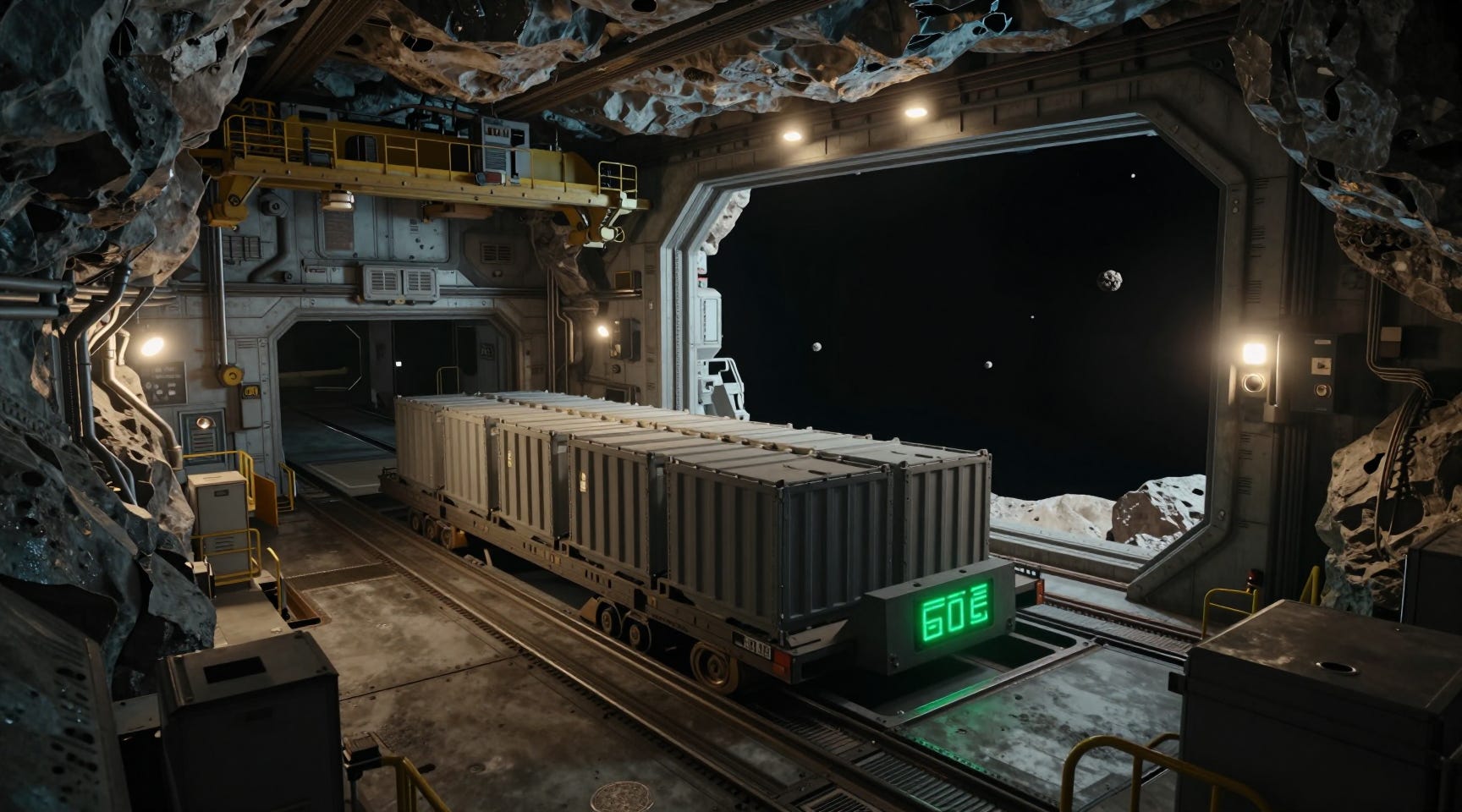
She never recalibrated between loads. The scale was accurate to within half a kilogram across its full range. She had tested it herself, monthly, using the station’s certified reference weights. Dock Seven’s scale was one of three in Ceres Station’s intake complex, and it was the most reliable. That reliability was why she had been assigned to it. That reliability was also the problem.
The second shipment arrived at 0730. No escort. No compliance officer. A battered CSV freighter called the Danaë docked at Bay 3, and a crew of four unloaded twenty-two sealed containers onto the intake platform. The manifest listed 6,200 kilograms of mixed salvage, Belt origin, routing to a private buyer under licensed commercial recovery permits.
Larissa activated the scale. The platform hummed. The digital readout climbed and settled.
6,412.8 kilograms.
Two hundred twelve kilograms over manifest. She pulled up the variance log on her terminal and began entering the discrepancy when the bay door behind her opened.
Archie Morin walked the way mechanics walk: heavy boots, unhurried pace, hands loose. He wore a station maintenance coverall with someone else’s name stitched above the pocket. He had never explained whose name it was, and Larissa had never asked.
“Morning,” he said. He stopped three meters from the scale terminal, respecting the line she had drawn the first time he visited Dock Seven four months ago.
“You’re two hundred twelve over,” she said.
“Am I?”
“The manifest says sixty-two hundred. The scale says sixty-four twelve point eight. That’s a reportable variance.”
Archie looked at the containers on the platform. Twenty-two sealed units, identical in shape, indistinguishable from each other. “The manifest reflects what was loaded at the recovery site. Transit adds weight. Moisture absorption, thermal expansion of packing material, ice accumulation in the seals. Standard variance.”
“Two hundred twelve kilograms is not standard variance.”
“It is if the tare offset accounts for container weight differentials.” He met her eyes. Calm. Practiced. “Your scale subtracts container weight using a preset tare value. The containers on that platform are a different model than your system expects. Heavier by about nine and a half kilograms each. Twenty-two containers, nine and a half kilos: two hundred nine. Close enough to your overage.”
The math was plausible. The explanation was not. Larissa had weighed containers from the Danaë before. The tare values in her system matched the actual container weights within a kilogram. Archie was describing a problem that didn’t exist to justify a number that couldn’t be right, and he was doing it fluently because he had done it before, on other docks, with other scale operators who had decided the math was close enough.
“I’m logging the overage,” she said.
“Your call.” He didn’t move. “How’s Tomás doing?”
Her jaw tightened. “Fine.”
“The supplemental oxygen allocation for Deck Four got cut last week. Half-ration for non-critical residents. Tomás is, what, category three respiratory? Category three doesn’t qualify for full supplemental under the new schedule.”
She knew the schedule. She had read it four times, sitting in the clinic waiting room while Tomás breathed through a mask connected to a tank that was now half the size it needed to be. Category three: moderate chronic impairment. Full supplemental oxygen required for sustained activity. Non-critical under the new allocation because non-critical meant he could still breathe while sitting still.
“I can get a private cylinder delivered to your quarters by tomorrow,” Archie said. “Medical grade. Full capacity. Enough for three months at his usage rate.”
“In exchange for what?”
“Adjust the tare offset on commercial shipments from the Danaë. Nine point five kilograms per container. The overage disappears from your log. The manifest matches the scale. Nobody files a variance report, nobody audits the load, and the extra material moves to its buyer without complications.”
Two hundred twelve kilograms of unaccounted salvage per shipment. The Danaë docked twice a week. Over four hundred kilograms of Vethrak composite vanishing from the official record every seven days, routed to a private buyer whose licensed permits probably didn’t cover weapons-grade material.
Tomás was eleven. He had been breathing recycled station air since before he could walk, and the damage was cumulative and irreversible. Three months of full supplemental oxygen wouldn’t fix his lungs. It would keep the deterioration from accelerating into something that pushed him from category three to category four. Category four meant permanent mask dependency. Category four meant a childhood measured in tank refills and clinic visits and the slow arithmetic of diminishing capacity.
The scale’s readout glowed steady. 6,412.8. The containers sat on the platform, sealed and silent, holding whatever they held. Somewhere in Ceres Station’s administrative offices, the compliance officer named Rand was finishing his morning coffee, confident that Dock Seven was the most reliable intake point in the complex. Somewhere on Deck Four, Tomás was sitting still because sitting still was all the oxygen schedule allowed.
Larissa opened the tare calibration menu. The system prompted for her operator code. She typed it in.
The adjustment took four seconds. Nine point five kilograms per container, applied to the Danaë’s registered container class. The scale recalculated. The readout dropped.
6,203.8 kilograms.
Close enough to manifest. Within standard variance. The log would file clean.
Archie nodded once. “Cylinder arrives by 0800 tomorrow. Same arrangement next week.”
He left through the bay door. His borrowed coverall disappeared into the maintenance corridor, and the door sealed behind him.
Larissa stared at the readout until the numbers stopped meaning anything. Then she finalized the intake log, cleared the platform, and called for the next shipment. The scale hummed, ready and precise, measuring exactly what she told it to measure.
Author’s Note: Ceres Station’s intake docks served as a critical chokepoint in the official Vethrak salvage pipeline during the early post-invasion years. Every kilogram of recovered material entering the station passed through calibrated scales operated by certified technicians before reaching UEN processing or licensed commercial buyers. The system depended on the accuracy of those measurements and the integrity of the people recording them. Where the system failed to account for the personal circumstances of its operators, other parties filled the gap. The syndicate networks spreading through Sol didn’t need to break the infrastructure. They needed one person, at one scale, willing to change one number.
If you enjoyed this story, you can follow the main story arc in The Exodus Rush, the first book in The Vethrak Requiem series.