


The Cascade Reactor was singing.
Thomas Okonkwo had read about the sound. Every engineer in the Academy had read about it. The textbooks called it magnetohydrodynamic resonance. The instructors called it the commissioning hymn. The senior engineers called it something else. Park called it the first honest thing the ship would ever say to you.
Thomas stood at auxiliary monitoring station four, the junior-most position on the engineering deck, his hands resting on a console still running diagnostics. The duty shift had begun forty-seven minutes ago. The reactor had been warming for the last twenty. The hum that had filled the bay since Thomas first stepped aboard was climbing now, rising in pitch, and the deck plates were vibrating in a way that was less like machinery and more like a living thing stretching after a long sleep.
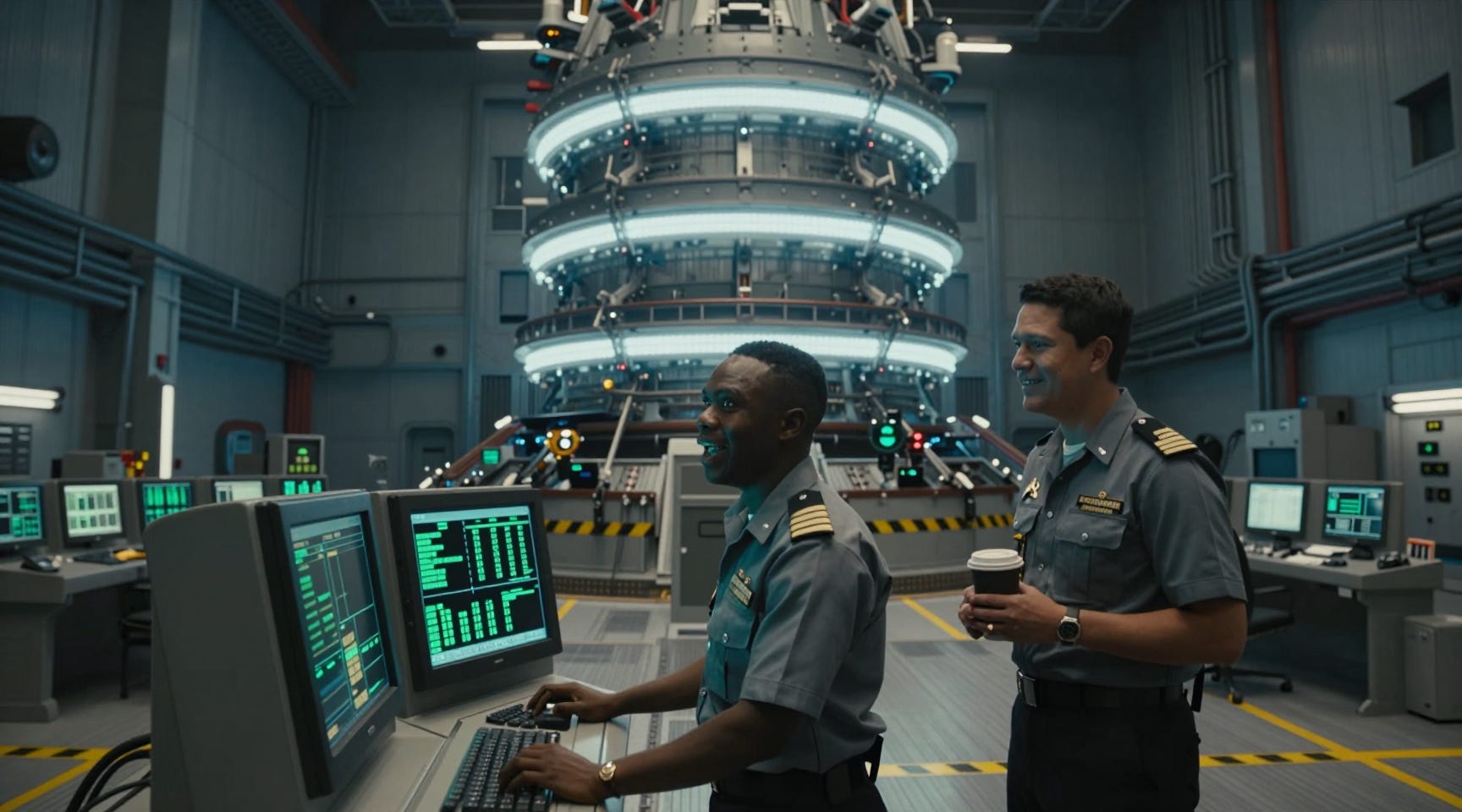
He kept his hands still on the console. He was not nervous. He had decided that approximately fifteen seconds into the shift.
“Status by station,” Park said from the primary monitoring console.
The calls came back down the line. All green. All nominal. Thomas’s console showed the same: reactor output stable at 12 percent, coolant flow steady, containment field solid. He had checked the readings four times. He checked them a fifth.
Park did not look at him. Park was watching his own displays with the relaxed attention of a man who knew exactly which numbers were going to move first.
“Mister Okonkwo.”
Thomas straightened. “Sir.”
“What are you reading on manifold three?”
Manifold three. Coolant distribution to the secondary heat exchangers. A subsystem Thomas had studied for two hours the night before because Park had mentioned it in passing during the briefing and Park did not mention things in passing.
He looked at the display. The number was green. The number was within specification. The number was also 0.3 percent above where it had been three seconds ago.
“Manifold three is reading a fluctuation in coolant flow,” Thomas said. “Point-three percent above baseline. Still within spec.”
Park did not look away from his console. “Show me.”
Thomas routed the readout to Park’s secondary display. The line was almost flat. A tiny, apologetic deviation from the steady-state curve. The kind of thing that happened a hundred times during a spin-up and corrected itself before any engineering log ever caught it.
This one was not correcting.
“It is not the manifold,” Park said. “It is the valve sensor on the upstream side. The manifold is fine. The sensor is lying to you.”
Thomas looked at the readout again. The upstream valve sensor was reporting nominal because it had been calibrated to report nominal. It had not been told there was a spin-up happening and the rules were changing.
“Because I have been lied to by that particular sensor twice already this month,” Park said, before Thomas could ask. He took a sip of coffee. “Log it. The manifold is at 47.2 percent flow. I want 47.5. Adjust the secondary valve to compensate.”
Thomas’s hands found the controls. The interface was physical. Mechanical. The safety-critical loop was hardware, not software, because hardware did not crash and hardware did not reboot. Thomas turned the dial one notch. Two.
The flow rate climbed to 47.5 and held.
“Good,” Park said. “Now give it ninety seconds.”
Thomas gave it ninety seconds. He held his eyes on the number with an attention he had not given anything since the Academy exams. The number held for ninety seconds and it held for ninety-one and at ninety-two Thomas exhaled and looked up and Park was looking at him.
“Logged,” Park said. “Good work, Mister Okonkwo.”
The first time anyone had called him by rank with weight.
Thomas nodded. He turned back to his console. Something settled in his chest that had been unsettled since the day his mother put his father’s wrench in his hand and told him to go be the man his father would have wanted.
The reactor’s song climbed another half-octave. Forty percent power and climbing toward operational thrust. The central housing was a tower of gray metal three decks high, wrapped in magnetic containment rings that glowed faint blue-white with Cherenkov radiation. The light was the same color as the glow his father’s old diagnostic equipment used to cast on the ceiling of their apartment in Lagos when he worked late into the night.
“Status by station,” Park said again.
All green. All nominal.
“TYCHE,” Park said, “what is the probability we make it through this spin-up without another anomalous reading from the coolant system?”
The AI’s voice came from the overhead speakers. Female. Analytical. Slightly dry.
“Probability of recurrence within the next seventy-two hours: 6.3 percent. I would not lose sleep, Lieutenant Park.”
Park smiled. A small smile, at the corner of the mouth, not involving the eyes. Thomas did not see it. He was still tracking manifold three.
The numbers ticked upward. Fifty percent. Sixty. The deck plates hummed with a vibration that was not uncomfortable and was not ignorable. Senior engineers liked to claim they could tell the reactor output to within half a percent by the feel of the deck beneath their boots. Thomas was beginning to understand why someone might.
At 80 percent the ship settled into herself. The vibration smoothed. The reactor’s song shifted from a climb into a steady chord, the commissioning hymn reaching its first sustained note. Thomas had been gripping the edge of his console. He let go.
“Operational thrust achieved,” Park said. “All stations hold.”
The engineering deck exhaled. One person at a time. A shift of weight. A release of tension in the jaw. Thomas was the last to relax. He tracked manifold three for another thirty seconds and then made himself look away.
Park walked over and stood beside him. He looked at the reactor housing through the inspection window. He did not say anything for a moment.
“Your father was an engineer,” Park said.
Thomas looked at him. He had not mentioned his father to Park. He had not mentioned his father to anyone aboard except Captain Shaw, and that had been a single line in a personnel interview.
“The wrench,” Park said. “You touch it when you are nervous. I spotted it the first week you reported.”
Thomas’s hand went to his pocket. The motion was automatic.
“He taught you to read a heat signature,” Park said. It was not a question.
“Yes.”
“He taught you to feel a stuck bolt before you force it.”
“Yes.”
“He would have wanted to see this. You at a console. A ship under you. The numbers green.”
Thomas could not have spoken. The words would not have formed.
Park nodded once and turned away. He walked back to the primary console and picked up his coffee cup. The gesture was casual. The words had been anything but.
Thomas stood at his station for another minute. The reactor sang its steady chord. Manifold three held at 47.5 percent. The wrench in his pocket was warm from his body heat and heavy with memory and for the first time since his father had died the weight of it was not an absence. It was a hand on his shoulder.
What is it doing now?
The reactor was singing. The ship was breathing. Thomas Okonkwo was standing at his station aboard the UENS Vanguard and the answer was the same as it had always been.
It is working. It is working and I know why.
He touched the wrench once, gently, the way his father had taught him to feel a stuck bolt rather than force it. Then he turned back to his console and began the next log.
If you enjoyed this story, you can follow the main story arc in The Exodus Rush, the first book in The Vethrak Requiem series.