


The recovered material occupied every display surface in the cultural analysis station, rendered into Dominion standard and sorted by origin, category, and estimated cultural weight. Reader-of-Prey-Records had been working through it for six cycles, following the standard sequence for post-harvest cultural assessment: literature first, then philosophy, then art, then political theory. The sequence existed because it worked. Literature revealed what a species valued. Philosophy revealed how the species justified those values. Art revealed what the species could not say directly. Political theory revealed what the species intended to do about all three.
The human material did not fit the sequence.
The analyst had registered the discrepancy two cycles ago and had not yet localized it. This was itself anomalous. Discrepancies attached to data points. A resistance pattern surfaced in a specific text. A threat indicator emerged from a specific political structure. The irregularity accumulating in this assessment attached to nothing. It was distributed across the entire corpus, present in every category, resolvable in none of them.
The analyst continued the review, because continuation was the procedure, and the procedure had processed the cultural remains of more than two hundred species without once producing a distributed anomaly.
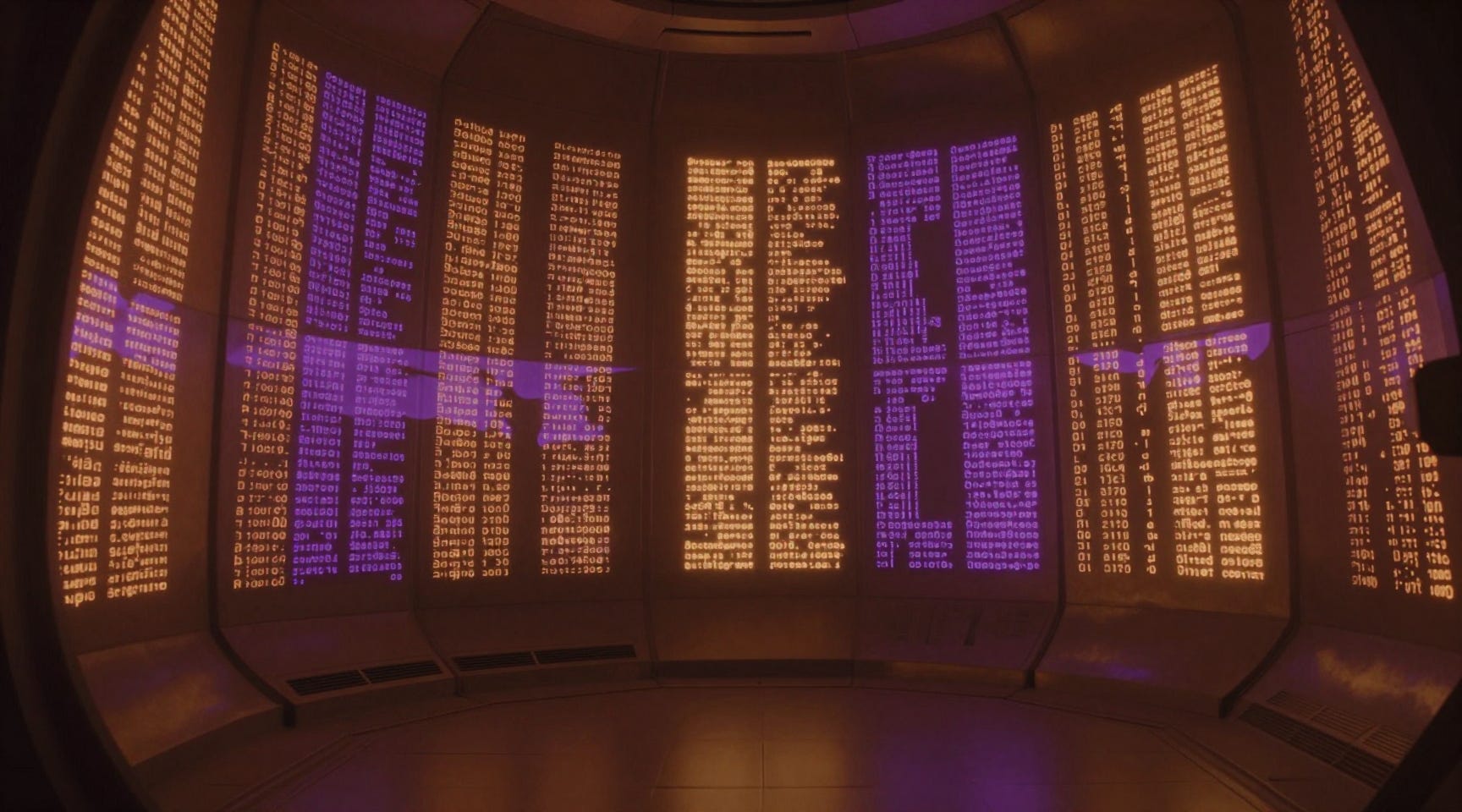
The text that finally localized the discrepancy was a philosophical work from the human pre-invasion period, early in what their calendar designated the twenty-first century. The translation rendered it as a proposal for a global governance framework: institutions for cooperative decision-making, arbitration structures intended to replace armed conflict, resource distribution built on the premise that scarcity drove war and abundance could be engineered. The text contained no military doctrine, no threat assessment, no enemy. It was not a plan for resistance. It was a plan for a world after conflict, written by a species that had never completed a single generation without one.
The analyst read it a second time, applying the standard classification filters. Satire: rejected. The text lacked the structural markers of human satire, which the corpus had established across thousands of samples. Utopian fiction: possible, except the text was not narrative. It cited existing treaties. It referenced functioning institutions. It proposed budgets. The analyst read it a third time and assigned the classification the framework resisted: genuine political philosophy. A serious proposal, from a serious mind, arguing that war among humans could end. Not pause. End.
The analyst filed the text as an anchor point and ran the full cross-reference.
The concept the translation rendered as peace appeared in seventy-three percent of the recovered pre-invasion cultural records. The analyst verified the figure twice. It held. The semantic range came next, and the analyst expected the concept to resolve into categories the Dominion framework recognized: submission, exhaustion, the interval between conflicts during which both parties rebuilt their capacity to fight. Some instances resolved that way. Most did not. In the majority of the material, the concept functioned as a positive state, a condition the species described as desirable in itself. An end, not an interval. Humans wrote treaties toward it. They composed music about it. They taught their offspring that it was achievable, in educational materials spanning every recovered culture and every recovered century.
The analyst attempted a full translation of the concept into Dominion standard and failed. The nearest available renderings were end of resistance and harvest stability, and both were wrong in the same direction. Both described the condition of the predator after the prey stopped struggling. The human concept described something else entirely. It described a condition with no predator in it at all.
The analyst constructed the threat model.
A species that accepts conflict as the natural order resists harvesting the way any organism resists predation: locally, biologically, until exhaustion. The Culling Doctrine was built on that resistance curve. Exhaust before striking. The curve always bent the same way, because fear depletes. A species that believes conflict is an aberration resists on a different curve. Its resistance is not fueled by fear of the predator. It is fueled by a projected future, and a projected future does not deplete. Every loss confirms the necessity of the fight rather than the futility of it.
Peace-belief was not pacifism. The distinction carried the entire assessment. The records showed that humans had fought wars continuously across their recorded history, at every scale their technology permitted, with a persistence that several prior analysts had classified as a predator marker. The belief had survived every one of those wars. That was the data point that mattered. Ten thousand years of evidence against the concept, and the concept persisted in seventy-three percent of everything the species made.
The implication propagated through every operational assumption the analyst had inherited. The Claiming assumed that prey species, once shown the true scale of the Dominion, would recalculate and accept. Acceptance required a framework in which predation was permanent. The human framework held that no conflict was permanent. They would fight until they believed peace had been achieved, and the Dominion could not offer peace. The Dominion did not possess the concept. Fifty thousand years of doctrine contained no category for a positive state of non-conflict, because the Dominion had never needed one. It could offer only the end of resistance, and the humans’ own philosophy defined that offer as another name for war.
The analyst composed the assessment with the precision the tier required.
Human species, cultural analysis, post-harvest review. Pre-invasion records indicate a fundamental worldview incompatible with Dominion authority. The species operates on the premise that a state of non-conflict is achievable and desirable. This premise is load-bearing across the full span of their cultural output and has survived contradiction by their own recorded history. Recommended classification: existential threat. Standard harvest-efficiency pacification is not viable for this species. Recommendation: complete population elimination.
The words were clinical. The analyst reviewed them once, verified each citation against its source, and transmitted. The assessment left the station and entered the routing protocols that would carry it to sector command, and from sector command upward, toward whatever authority allocated the fleets that recommendations at this tier set in motion.
The displays continued cycling through the human material, indifferent to the classification that had just been filed against the species that made it. A fragment of translated text held position on the eastern surface, part of the anchor document, a sentence proposing that former enemies could build institutions together. The analyst remained at the station past the end of the review period. There was no procedural reason to remain. The assessment was filed. The function was complete.
Something persisted in the analyst’s processing that the transmission had not discharged, and the analyst did not have a designation for it. The Dominion framework contained no category for the state a mind enters when it encounters a way of being it cannot reach. It occurred to the analyst, in the last moments before the displays cycled to the next assignment, that the humans almost certainly had a word for that state. They had words for everything they could imagine, and they had imagined more than the Dominion had ever permitted itself to see.
If you enjoyed this story, you can follow the main story arc in The Exodus Rush, the first book in The Vethrak Requiem series.