


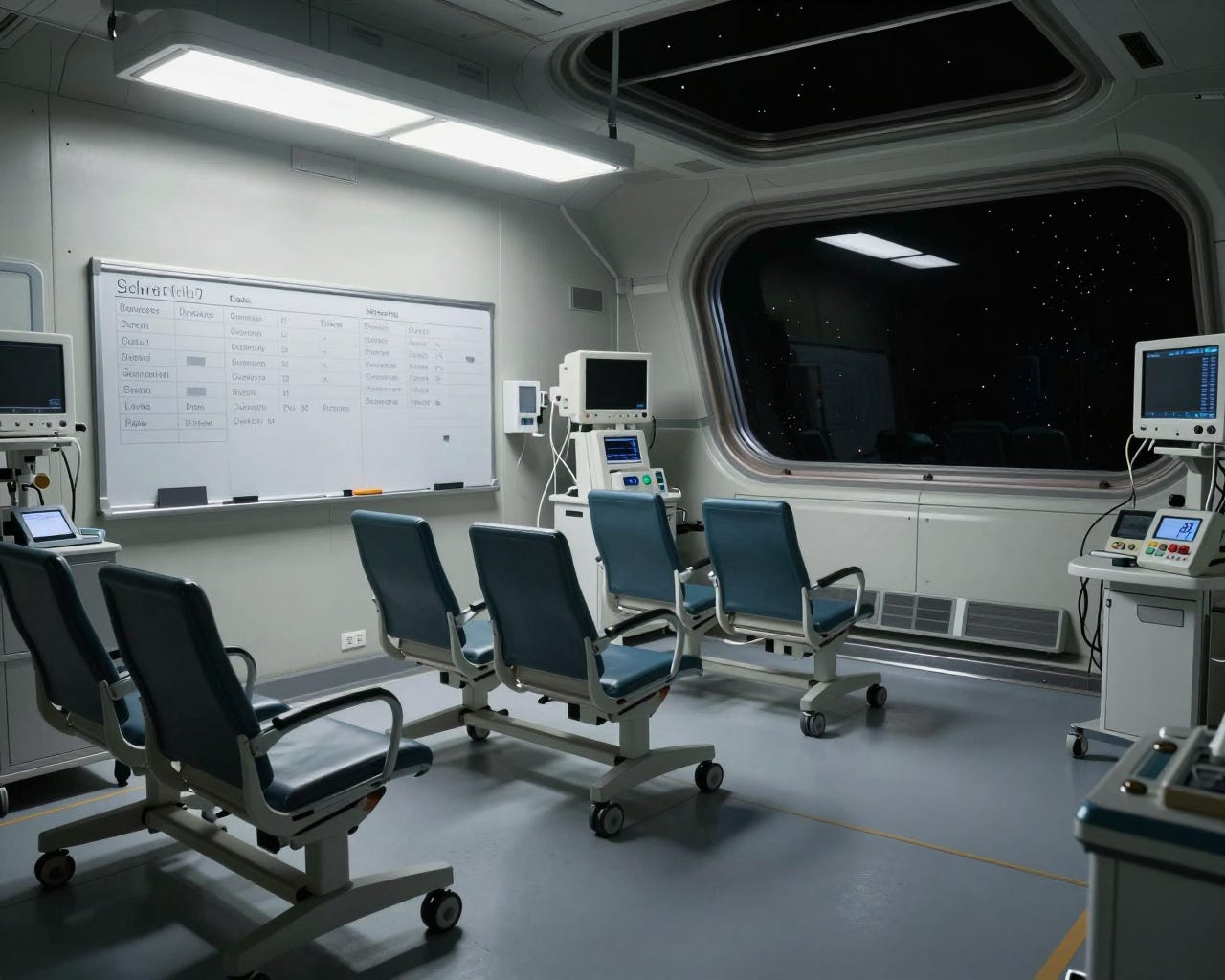
The medical bay smelled like antiseptic and recycled air. Doctor Amara Diallo stood in front of the whiteboard, marker in hand, seventeen names written in neat rows. Behind her, seventeen patients waited in various states of deterioration. Kidney failure. Liver damage. Heart conditions. All terminal without transplants. All waiting for organs that didn’t exist.
Year 11 had brought a grim stability to humanity’s scattered survivors. Food production had stabilized. Water systems functioned. Power grids hummed along. Medical care had advanced to pre-invasion standards in most settlements.
The problem was simple: there weren’t enough donors.
Eleven billion dead, but most of those bodies had burned in the initial strikes or decayed beyond salvage. The survivors numbered barely two hundred million, spread across a dozen colony worlds and orbital habitats. Organ failure killed more people each year than accidents, disease, or violence combined. The waiting lists grew longer. The prognosis didn’t improve.
Amara turned to face her patients. They sat in wheeled chairs, on benches, leaning against walls. Some looked healthy enough at first glance. Others had the gray pallor of people whose bodies were shutting down. All of them knew why they were here.
“We received an organ shipment today,” she said. “Three kidneys, two livers, one heart.”
The room stirred. Hope flickered across seventeen faces. Amara felt the weight of it pressing against her ribs. Six organs. Seventeen people. She’d been making these calculations for three years. The math never got easier.
“The allocation committee has reviewed all cases,” she continued. “Medical urgency, tissue matching, survival probability, social factors. We’ve made our decisions.”
Nobody spoke. They knew the protocol. Arguing wouldn’t change the outcome. The committee’s choices were final.
Amara read the first name. A woman in the back row closed her eyes and exhaled. Relief and guilt warred across her features. She would live. Someone else would die. Both truths sat heavy in the air.
The second name. A man stood, nodded once, and left the room to prep for surgery. No celebration. No tears. Just acceptance.
Third. Fourth. Fifth. The room emptied in stages. The chosen went to the surgical wing. The rest remained in their seats, faces blank, hands folded. Waiting for the next shipment. The next lottery. The next impossible choice.
When Amara read the sixth name, eleven patients still sat before her. She set the marker down and faced them. Words felt useless, hollow. These people knew their odds. They’d been on the list for months, some for years. Every day they woke up wondering if today would be the day. Every evening they went to sleep knowing it wasn’t.
“We have three potential donors in critical condition across the network,” Amara said. “Two on Ganymede Station, one at New Kinshasa. If their families consent, we could have organs within the week. We’ll notify you immediately.”
A young woman in the front row, maybe twenty-five, raised her hand. Her name was Sana. Kidney failure. Stage five. Dialysis three times a week. She had maybe six months left.
“Doctor Diallo,” Sana said, “how many are ahead of me on the list?”
Amara checked her tablet. The numbers glowed in the dim light. “Forty-seven.”
Sana nodded. No tears. No outburst. She’d known the answer before asking. Sometimes people just needed to hear it confirmed. Reality had weight that speculation lacked.
The room emptied slowly. Amara watched them go, each patient returning to their quarters, their jobs, their routines. They would continue living until they couldn’t anymore. Humanity had learned resilience the hard way. Survival meant accepting what you couldn’t change and fighting like hell to change what you could.
Amara erased the whiteboard. Seventeen names disappeared under broad strokes of felt. Tomorrow there would be new names. New calculations. New impossible choices.
The medical bay door hissed open behind her. Nurse Kofi Mensah stepped inside, tablet in hand, expression neutral.
“We have an update from Ganymede Station,” he said. “One of the critical patients died. Family consented to donation. Four viable organs.”
Amara felt the familiar tension in her chest. Relief that someone might live. Grief that someone had died. Gratitude that the family had chosen to help. Exhaustion at the endless cycle.
“Start the matching protocols,” she said. “I’ll call the committee.”
Kofi nodded and left. Amara stood alone in the medical bay, surrounded by equipment that could save lives if only it had the raw materials to work with. Humanity had clawed its way back from extinction. They’d built ships, stations, colonies. They’d mastered alien technology and learned to fold space itself.
They still couldn’t make a kidney.
The lottery would continue. People would live. People would die. Doctors would make choices that kept them awake at night. Families would grieve or celebrate, often both at once. Humanity would survive, one organ at a time, one impossible decision after another.
Amara picked up her tablet and started making calls.
Author’s Note:
This story explores one of the darker aspects of post-invasion survival: medical triage on a civilization-wide scale. With the human population reduced to a fraction of its former size and medical infrastructure stretched beyond capacity, every resource becomes precious. Organs are no exception. The allocation committees mentioned in this story exist across all UEN settlements, making life-and-death decisions based on criteria that never feel adequate.
Doctor Amara Diallo is a new character, but her experience reflects the reality faced by medical professionals throughout the scattered remnants of humanity. The ethical weight of these decisions, the impossible mathematics of scarcity, and the quiet courage of patients who continue living despite knowing the odds are all part of the world that shapes the events of The Vethrak Requiem.
If you enjoyed this story, you can follow the main story arc in The Exodus Rush, the first book in The Vethrak Requiem series.