


Keitumetse Marini counted the containers three times before she trusted the number.
Fourteen. The manifest said sixteen.
She stood on Titan Station’s Receiving Dock Four, her breath fogging in the cold that seeped through the platform’s thermal shielding, and ran her stylus down the cargo list on her tablet. Sixteen containers of compressed protein rations, shipped from the inner-system distribution hub on Ceres. Each container weighed two hundred kilograms standard. Total expected mass: three thousand two hundred kilograms.
Her scale read two thousand seven hundred and twelve.
The discrepancy was not new. Three shipments this week had arrived light. Last week, four. The pattern stretched back six weeks in her logs, a steady hemorrhage of supplies that the receiving dock’s automated tracking software smoothed into rounding errors and transit losses.
Keitumetse did not believe in rounding errors.
She had worked the docks for nine months, recruited straight from the Titan refugee intake after the UEN determined her background in agricultural logistics made her useful enough to feed. Before the invasion, she had managed grain distribution for a cooperative outside Pretoria. The work translated. Containers were containers. Tonnage was tonnage. Numbers either matched or they didn’t.
These didn’t match.
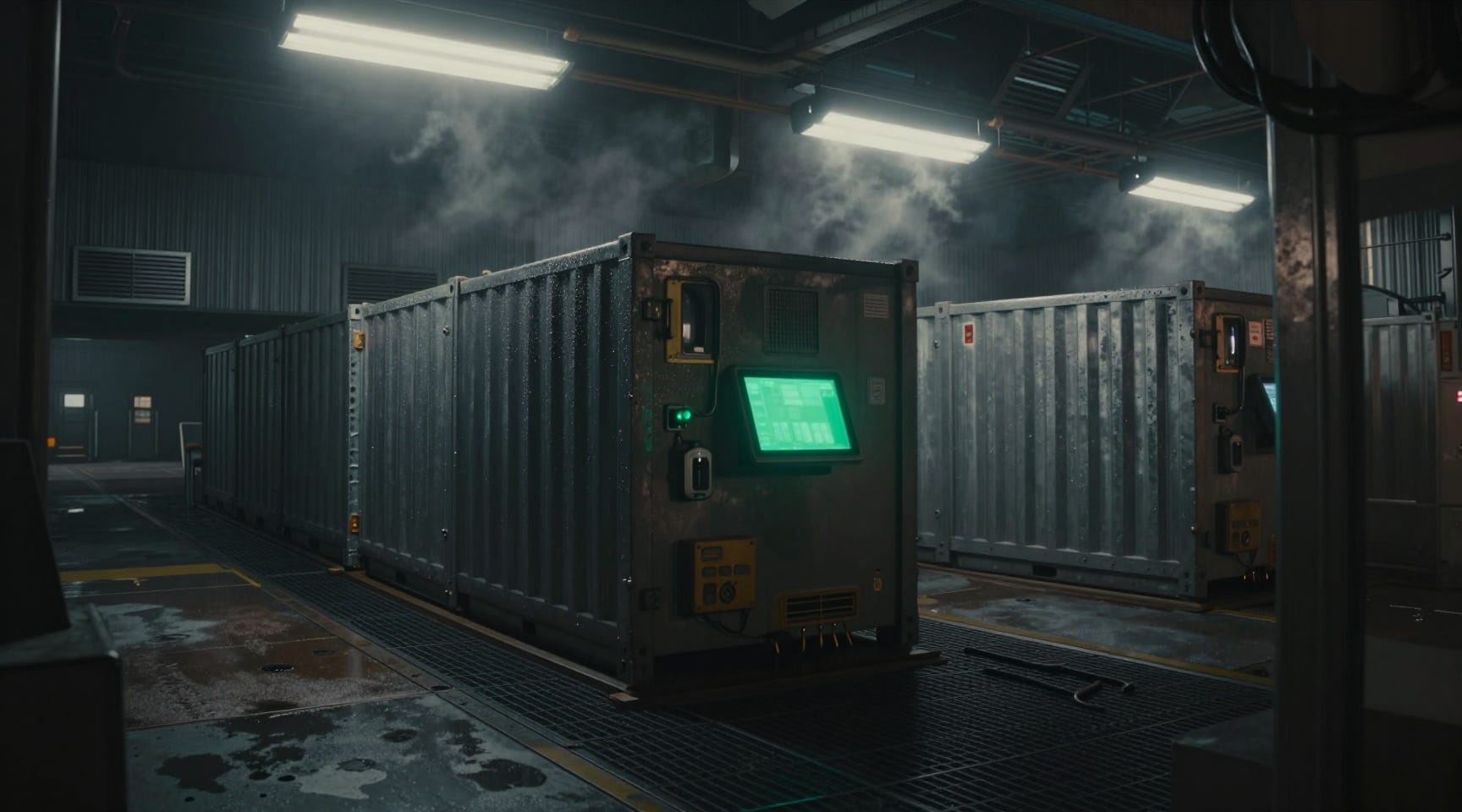
The transfer shuttle berths occupied a pressurized hangar at the far end of Dock Four. Keitumetse walked the connector corridor in silence, her boots clicking against metal grating slick with condensation. The air tasted different here. Warmer. The atmospheric processors worked harder near the shuttle bays, compensating for the thermal bleed every time a berth opened to vacuum.
Konrad Olsen sat in the bay supervisor’s office, a glass-walled booth overlooking the hangar floor. He was eating from a ration pack, methodical spoonfuls of gray nutrient paste consumed without apparent pleasure. His tablet lay face-down on the desk beside him.
She placed her own tablet in front of him, the cargo discrepancy highlighted in red.
“Four hundred and eighty-eight kilograms short,” she said. “This shipment.”
He glanced at the screen. His expression didn’t change. The spoon paused halfway to his mouth, then completed its arc. He chewed, swallowed, set the spoon down.
“Transit loss,” he said.
“Transit loss accounts for point-five percent. This is fifteen.”
“Containers shift during Fold transit. Seals breach. Product degrades.”
“The containers are intact. I inspected every one.”
“Then your scale needs calibration.”
“I calibrated it this morning.”
He met her eyes. Held them. The silence stretched for five seconds, ten, until it became something other than a pause in conversation.
“Close the door,” he said.
The numbers were precise. Konrad showed her on his own tablet, a spreadsheet hidden behind three layers of encryption that mapped every diverted kilogram across six weeks of shipments. Two to four percent per cargo load, pulled during the shuttle transfer before the containers reached her dock. The skimmed rations were repackaged in maintenance supply crates and routed through the station’s internal logistics network to Sublevel Eight.
Sublevel Eight was not on the UEN’s official habitation map. The section had been damaged during the invasion, its hull integrity rated at sixty-two percent, its life-support systems running on jury-rigged backups fed by tapped power lines. Three hundred and forty people lived there anyway, because the station’s authorized population zones were full.
The UEN didn’t allocate rations to people who didn’t exist in the system.
“Children,” Konrad said. His voice was flat, rehearsed, the voice of a man who had delivered this explanation before. “A hundred and six of them at last count. Their parents were flagged during the population audit. Wrong documentation. Expired transit papers. In some cases, no papers at all. The system dropped them.”
Keitumetse stared at the spreadsheet. Each line represented a family, a bunk number, a caloric requirement. The arithmetic was clean. Two percent from each shipment fed Sublevel Eight for a week. The station’s overall inventory tracked within normal variance. Nobody upstream would notice unless they looked for it.
Nobody was looking for it.
“If I flag this, you go to detention,” she said.
“Probably.”
“The people on Sublevel Eight lose their supply.”
“Definitely.”
The ration pack sat half-eaten on his desk. Gray paste in a foil tray, stamped with a UEN distribution code and a calorie count: 1,200 per serving. Standard allocation for non-essential personnel. Not enough for sustained physical labor. Not enough for growing children.
“How long?” she asked.
“Since the audit. Four months.”
Four months of doctored manifests. Four months of containers arriving light. Four months of children eating food that the system said didn’t exist, diverted by a man who ate nutrient paste in a glass booth and kept a spreadsheet of small thefts.
She picked up her tablet. The discrepancy field blinked red, waiting for her input. Two options. Flag the variance for investigation, or enter an adjustment code that attributed the shortfall to standard transit degradation.
The code was six digits. She had used it twice before for legitimate losses.
Keitumetse entered the code.
The red field turned green. Fourteen containers, two thousand seven hundred and twelve kilograms. Received and accounted for.
She walked back to her dock without speaking.
The numbers balanced. They always did, once you decided what counted.
Authors note: In the years after the invasion, Titan became one of humanity’s most overcrowded refuges. The UEN struggled to track survivors, and thousands fell through the gaps in a system designed for a civilization that no longer existed. This story is part of The Vethrak Requiem universe, set during the chaotic early years of reconstruction.
If you enjoyed this story, you can follow the main story arc in The Exodus Rush, the first book in The Vethrak Requiem series.