


The simulation room smelled like ozone and recycled air, the same smell as every tactical lab on every ship Marcus had ever commanded, and that familiarity was the only thing keeping him in his seat.
Twelve junior officers sat at the simulation stations, arranged in a semicircle around the main display. The scenario was already running. A convoy of six civilian freighters, the kind that ran supplies between the Mars orbital farms and the Luna yards. Two escorts. The kind of light escort you got when the Navy had stripped its patrols to feed the strike force. Inbound vectors showed three Vethrak corvettes emerging from fold on an intercept course, and the junior officers were already making the mistake Marcus had made at their age.
They were spreading their escorts.
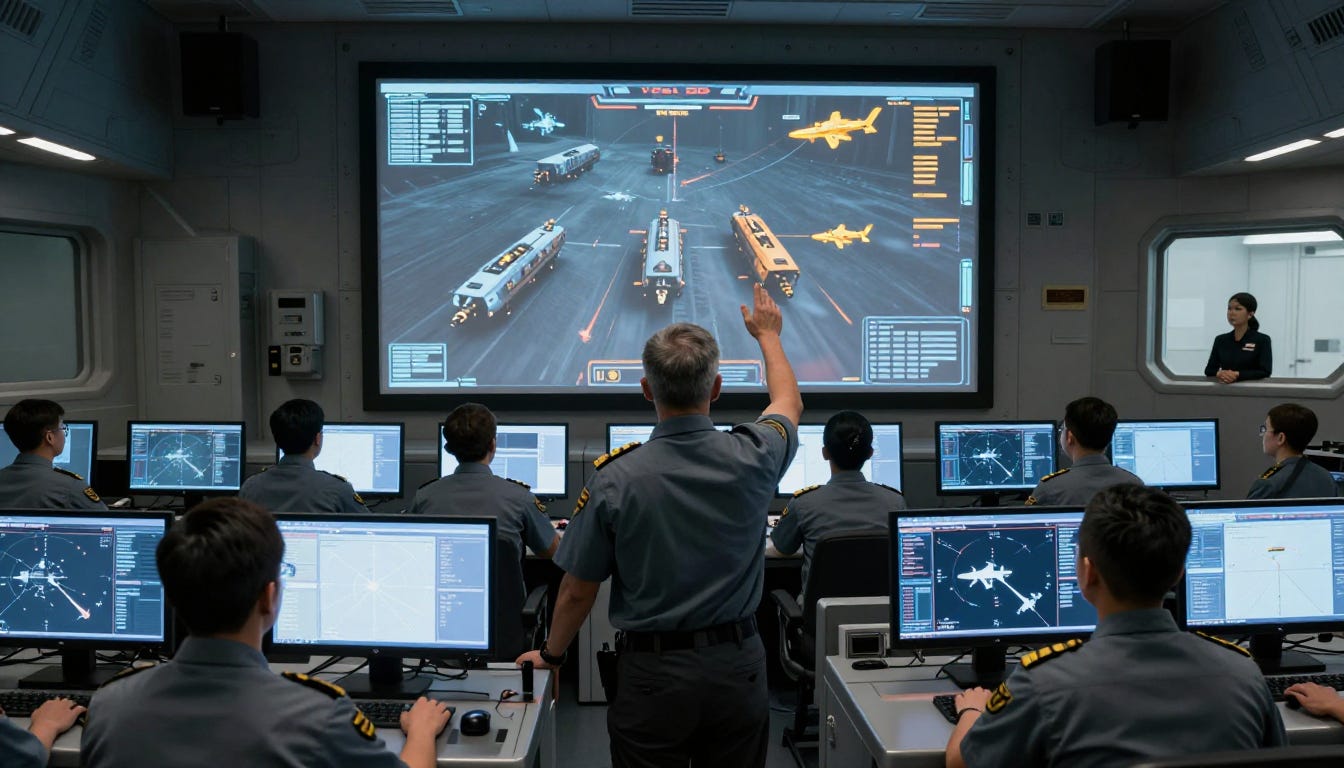
Lieutenant Reyes, a young woman from the most recent Academy class, had taken command of the simulation. Three inbound contacts appeared on her display, and she deployed her two escorts to meet them at three separate intercept points. The geometry was clean. It was also wrong.
Marcus kept his eyes on the display. His hands were folded in his lap. His left knee wanted to bounce. He made it stop.
“Contacts at forty-three seconds,” Reyes said. Her voice was steady. She had never been shot at.
The simulation ran the intercept. The escorts engaged, one against two corvettes, the other against one. The one-against-one engagement held for twelve seconds. The one-against-two collapsed in eight. The freighters died in sequence: freighter three, freighter one, freighter five. The simulation registered thirty-one hundred simulated casualties and terminated.
The room went quiet.
Reyes stared at her display. Her hands were flat on the console. She did not look at Marcus.
He did not speak. He let the silence do what silence did in a room full of officers who had just killed thirty-one hundred people in a simulation.
After twelve seconds, he said: “What did you see?”
Reyes turned. Her expression was the expression of every junior officer who had ever lost a simulation badly and was bracing for the critique.
“I deployed my escorts to match their numbers,” she said. “I wanted to engage all three contacts simultaneously so none of them could reach the convoy.”
“And?”
“And the one-against-two engagement failed because two corvettes concentrated fire on one escort and killed it before the engagement could develop.”
Marcus nodded. “What else?”
“The geometry was wrong.” Reyes’s voice was steadier now. She was someone who learned fast from failure. Marcus recognized the type. “I should have kept the escorts together. Concentrated force. Let one corvette through and trusted the freighters’ evasive capability while the two escorts handled the remaining contacts.”
“Show me.”
Reyes reset the simulation. This time she kept the escorts together. The engagement ran longer. The two-on-two held. The third corvette killed three freighters before the combined escorts could re-engage and kill it. The simulation registered eleven hundred casualties.
“Better,” Marcus said. “Not good. Better.”
He stood. Walked to the main display. Twelve faces tracked him. He pulled up the engagement data and highlighted the moment the third corvette had broken through.
“The third corvette was faster than the other two,” he said. “Vethrak corvette design has a speed variance across the class. The outer-hull models are heavier, slower. The inner-hull models have lighter armor and higher acceleration. You assumed all three were the same threat. They were not.”
He pulled up the patrol data from the Kaath-Seven operation. The same speed variance. The same tactical error. He did not say that he had made the exact same mistake in Year 3, commanding a patrol boat in the Belt, and that it had cost him a crew member he still dreamed about. He did not need to. The data said it.
“The geometry tells you what the enemy is going to do,” he said. “The timing tells you what they are afraid of.”
Reyes was watching him with the expression of someone who had just understood something she would not forget. “The three-corvette formation was a test. They were probing our response pattern.”
“Yes.” Marcus turned from the display. “You were not outnumbered by ships. You were outnumbered by information. You engaged before you knew what you were engaging. That is the mistake.” He paused. “You will not make it again.”
She would not. He could see it in the way she was already replaying the scenario in her head, finding the moment she should have waited.
The simulation room cleared. The junior officers filed out, Reyes last, her datapad already open to the engagement data. Marcus stayed at the main display. The debrief was over. The room was quiet.
The observation door opened. Captain Yuki Tanaka stepped through.
She moved with the same deliberate economy she had always moved with, the fluid precision that made her seem like she was gliding. The injuries from Book 3 had left no visible trace, but she held herself differently now. Less braced. More patient. The kind of patience that came from being forced to stop.
“You are good at this,” she said.
Marcus did not turn from the display. “It is not the same.”
“No.” Tanaka walked to the station beside his. “It is not. That is the point.”
He looked at her. Tanaka’s expression was calm, as it always was, but there was something in it that he recognized. The particular stillness of someone who had also lost a command.
“I watched the Kaath-Seven raid,” she said. “From the observation deck. I saw David’s maneuvers. I saw Kira’s command decisions. I saw your simulation design in the pre-mission briefings.” She paused. “You built the scenario that prepared them for the corvette speed variance. They did not make the mistake you made in Year 3. That is not an accident.”
Marcus said nothing.
“You are still commanding,” Tanaka said. “Just differently. The officers who walked out of this room will make better decisions because you let them fail here first. That is not a consolation. It is a fact.”
She turned to leave. At the door, she paused. “I recommended Kira for Hope because I saw what she could become. You are doing the same thing for a roomful of strangers. That is what command looks like when you are not in the chair.”
The door closed behind her.
Marcus stood alone in the simulation room. The main display still showed the engagement data from the last scenario. He pulled up a new file. Blank. Untitled.
He began designing the next simulation. A scenario based on David’s maneuvers at Kaath-Seven. The engagement where David had drawn two corvettes into a crossfire by pretending to retreat. The maneuver that had saved Resolute and killed two Vethrak corvettes in ninety seconds.
He built the scenario from memory, pulling engagement data from the operation logs, recreating the geometry of the approach vectors, the timing of the feint, the moment the corvettes committed. He built it so the junior officers would have to find the solution themselves. He built it so they would fail the first time, and the second, and learn from both. He built it to teach.
When the scenario was complete, he saved it under a new designation: “Rivera Maneuver - Training Variant.”
He sat for a moment, looking at the name on the display. David’s name. His brother’s name. The maneuver that was going to be taught to the next generation of tactical officers.
The chair in the simulation room was not a command chair. The room was not a bridge. The officers were not a crew.
Marcus closed the file. Stood. Walked to the door.
He had a class at 0800 tomorrow. Twelve junior officers who needed to learn how to survive.
He would be there.
If you enjoyed this story, you can follow the main story arc in The Exodus Rush, the first book in The Vethrak Requiem series.