


Tuva Hawthorne kept the red plate captive while Samrawit Assefa read the two material tags beneath it.
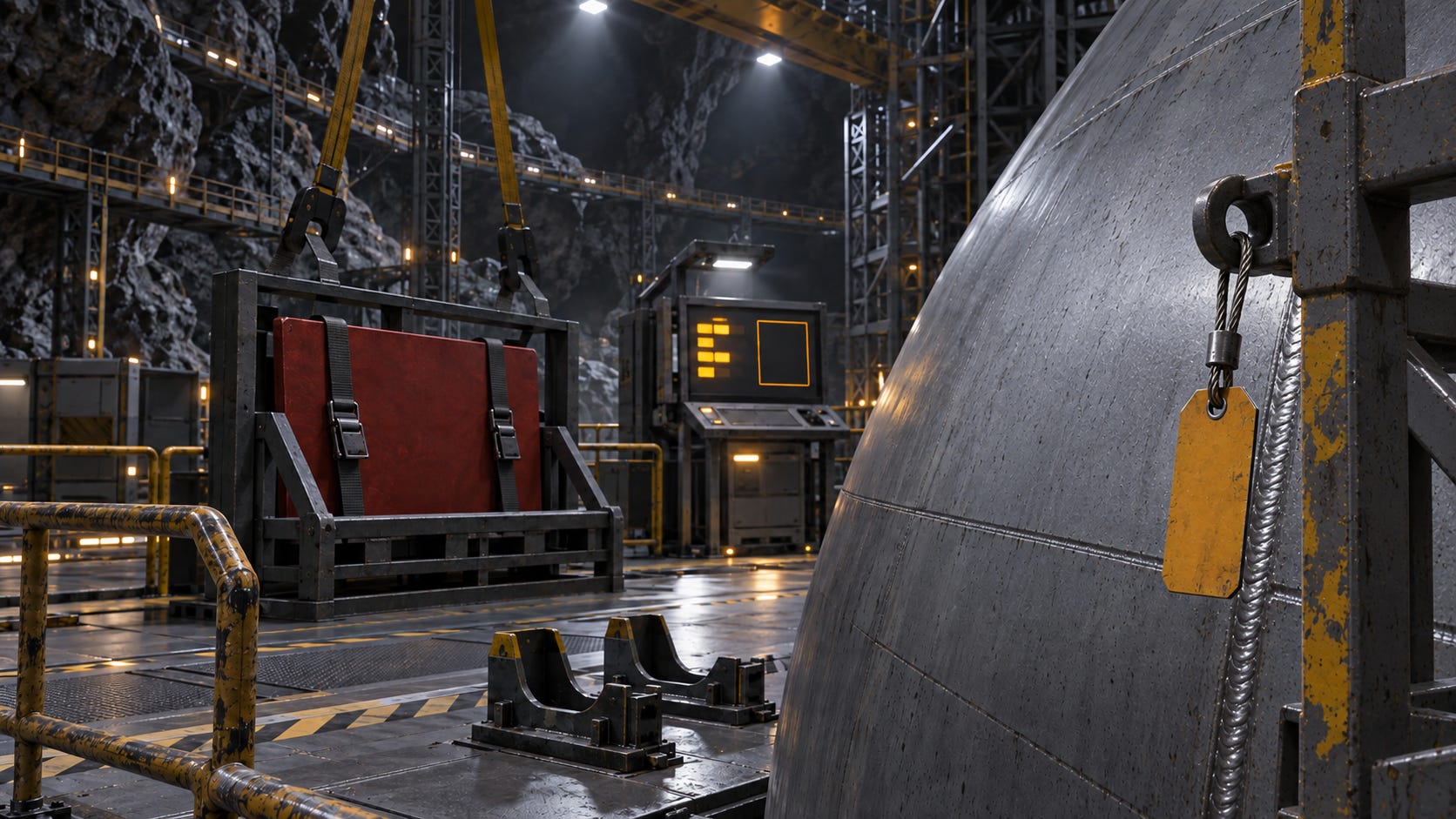
One strap remained through the assembly-clamp eye. The other held the plate clear of the prepared edges, exactly where the new authorization permitted it during witnessed work. Between power windows it would return across the access. Nobody had detached it from the fixture.
“First pair matches,” Samrawit said.
She pulled herself along the scaffold rail to the second transition. Tuva followed on a shortened tether, carrying the torch in its locked cradle. Article Four hung in secured slings inside Slip Two, a short barrel that would eventually join two pressure hulls elsewhere. Its gray exterior had no stamp or name. Inside the clamps, every piece still had a tag.
At each of the three planned transitions, Samrawit matched both plate links to the work package. Wanjiku Bett checked the location diagram independently, tracing each boundary with a tethered inspection lamp.
“All three,” the inspection lead said. “One conditional package. No joining outside these locations.”
Tuva opened the authorization on her cuff.
Yesterday’s mixed coupons met the limits. One had made a small sound during unloading that nobody could assign to a cause. The second had not repeated it. Both results stayed attached. A quiet strip did not make the first trace disappear.
Wanjiku checked the proposed pickup positions and strain channels against the barrel’s curved transitions. Their coverage would listen across the full structure when the anchored actuators put force through it. She accepted the dense coverage, baseline-scan requirement, and witnessed proof plan, including the return to zero load.
Her signature authorized the conditional work and its test arrangements. The structural-release field remained empty.
“Your procedure revision?” she asked.
Tuva held up the cuff. “Same as the coupons. Full settings. Full thermal cycle.”
Samrawit entered the limited permission to uncover each joint for welding. Wanjiku confirmed it against the hold. Tuva checked both signatures before unlocking the torch.
The first arc pressed light against Tuva’s visor.
She braced both boots in the scaffold restraint. The torch lead ran through its captive guide; her tether ended behind her shoulder, clear of the seam. Current and feed stayed inside the approved range. Beneath the glove, vibration settled into the small steady resistance she expected.
The bead followed the prepared edge. Too much attention to the clock would pull her hand ahead of it.
Her cuff counted down the reserved block.
She finished the planned run at its qualified stopping point, killed the arc, and parked the torch. The next section would wait for the next full-output window. Slowing into an unqualified setting would save the board a gap and leave her an uncontrolled pass.
Cho called while she checked the recorded values.
“Can you carry into the low block?”
“Not at this setting.”
“How much remains?”
She gave him the remaining run and its preparation time. He repeated both before closing the channel.
Tuva secured the red plate across the access again. The hot metal cooled within the procedure’s limits while the ventilation carried the sharp smell toward the filters. Environmental power continued through the wait.
Her fingers cramped when she opened them. She clipped the glove to her harness and worked her bare hand inside the restraint rail, slowly, without pushing herself away.
On the opposite side of the barrel, Wanjiku marked the completed run on the diagram. No green release followed it.
The next block arrived with its full allocation.
Tuva checked the joint temperature, covered her hand, and reset the torch. Samrawit witnessed the next pair before the plate moved into its captive working position. The second transition took two reserved runs. The third closed in the last block, with enough margin to finish the pass without borrowing from cooling.
Tuva retained the settings for every run and every authorized pause. After welding, the controlled heaters took all three transitions through the specified thermal cycle. Nobody shortened the hold to recover the minutes between arcs.
She left the assembly secured while it cooled for examination.
The inspection lamp raked across the three weld faces.
Tuva drew herself along the rail beside Wanjiku, keeping her torch parked. The weld faces showed no crack or undercut. The dimensions stayed within the package limits. At each transition, the technician guided the ultrasonic probe over the marked examination paths while Wanjiku checked coverage against the diagram.
Three locations. Three retained scans. No reportable workmanship indication.
Tuva let her grip ease.
The last scan joined the pre-test baseline. It would give the next examination something real to compare, instead of a recollection that the seam had looked clean.
“Immediate examination complete,” Wanjiku said. “Proof remains outstanding.”
Tuva acknowledged and pulled toward the work-package station. She changed clips at the rail junction, secured her cuff in the terminal bracket, and called up completion.
One field filled the center of the screen.
Complete.
Below it, the production handoff preview offered the next queue: transfer preparation.
She opened the field’s detail. No separate place for the intermittent coupon event. No distinction between a bead finished under the qualified procedure and a barrel proved under the loads it would carry.
Her name would sit beside that word in the protected authorship view. On the shop board, the same act would become a color.
Tuva held her hand away from the confirmation pad.
Refusing the job that morning would have left all three seams unfinished. An unqualified signature would send finished work onward with a question dropped behind it. The last run still tingled through her fingers. Each stopping point, each return to full power, belonged to work she could account for. The small unexplained trace belonged beside it.
Cho arrived at the station rail. His slate remained fastened to his chest.
“Examination is clean?”
“The immediate checks are.”
He opened the preview on his own display. “That queue is waiting for a completion.”
“It can have the work I completed.”
“The field won’t take that much text.”
“The attachment will.”
She opened the existing hold link and retained both coupon records beside the three examination entries. The uncertainty had an author and a time already. It needed to travel with this signature.
Tuva entered the scope in the signed attachment: weld execution complete, all three transitions.
The linked hold followed: structural release pending witnessed proof load and materials disposition.
She checked that the link survived in the handoff preview. Transfer preparation stayed inhibited. Test preparation remained available under the accepted plan.
“I won’t sign a load result,” she said. “I haven’t made one.”
Cho rubbed his thumb along the slate’s retaining clip.
“Show me the three locations again.”
She did. He compared the completed runs, thermal record, and examination coverage with the authorization. Then he opened the remaining reservation for the anchored proof cradle.
The production board stayed amber.
“Keep the test block,” he said. “Carry the hold in the handoff.”
Tuva confirmed the attachment and pressed the signature pad.
Wanjiku fastened the structural-test tag through a free eye on the fixture before Tuva touched the red plate’s straps.
They matched its linked hold to the terminal entry. All three transitions. Witnessed proof and materials disposition outstanding. No transfer or structural release. The technician read it back from the test station.
Only then did Wanjiku authorize the exchange.
Tuva detached the red plate, caught both straps, and secured the assembly in its return rack. The new tag remained captive beside the completed seams. Nothing hung loose against the hull.
She closed the torch cradle and checked its latch once more.
At the terminal, her full name sat beside the three weld entries. Access was restricted. Outside that view she would still be a shift designation and a torch hand.
The barrel beyond the rail remained blank. Its release box remained empty.
Her name stayed beside the work she had done, with room left for what nobody had proved.
Author’s note: This story continues the Site Anvil arc in late Year 3, at the end of Article Four’s first fabrication week. A completed weld and a released structure require different evidence, even when the work package offers only one convenient word.
New to The Vethrak Requiem? Start with The Exodus Rush, Book 1, where humanity fights for survival after an alien invasion using technology it barely understands. These short stories explore the wider universe; the novel begins the main story.