


If you enjoy this story, you can follow the main story arc in The Exodus Rush, the first book in The Vethrak Requiem series.
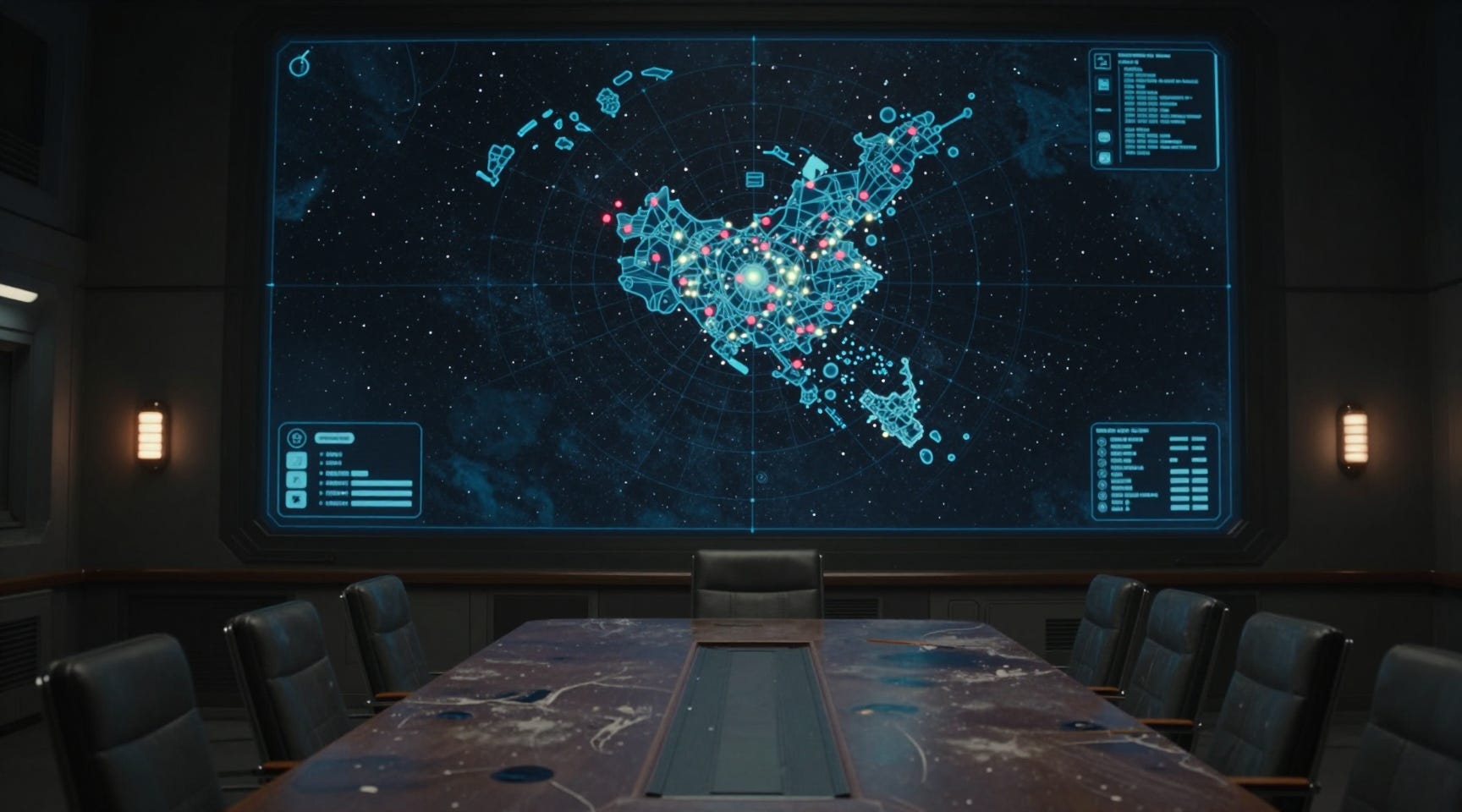
Finn Russo counted the faces around the table. Twelve representatives. Twelve settlements. Forty thousand survivors depending on what they decided in this room.
The conference chamber on Station Liberty smelled like recycled air and desperation. Two years past the end of the world. Humanity scattered across three dozen settlements, each one barely surviving, none of them trusting the others.
“We need standardized emergency codes,” Finn said. “Right now, every settlement uses different signals. Different frequencies. Different protocols. When someone calls for help, half of us don’t even recognize it.”
Camille Becker from New Geneva leaned forward. “You want us to broadcast our emergencies on open channels? So every raider and scavenger knows when we’re vulnerable?”
“I want us to stop dying in silence because we’re too paranoid to ask for help.”
“Easy for you to say. Station Liberty has military-grade shields. New Geneva has farmers and mechanics. We broadcast a distress signal, we’re a target.”
Marco Hansen from Kepler Settlement tapped the table. “She’s right. Three months ago, Port Adelaide sent an open distress call. Pirates stripped them before legitimate help arrived. Forty people dead. Everything worth taking, taken.”
Finn pulled up the holographic display. Star map. Thirty-seven active settlements. Red markers showed eighteen that had gone silent in the past year. Eighteen communities. Thousands of people. Gone.
“This is what happens without coordination,” he said. “We don’t know who needs help. We don’t know who can give help. We’re dying separately when we could survive together.”
Silence. The delegates stared at the red markers. Too many. Too close to home.
“What are you proposing?” Camille asked.
“Standardized emergency codes. Encrypted channels for distress signals. Resource sharing protocols. If someone needs medical supplies and we have extra, we send them. If someone’s oxygen scrubbers fail and another settlement can spare parts, they ship them. No payment. No negotiation. We help because we’re all that’s left.”
“That’s not realistic,” Marco said. “Resources are limited. Every settlement is rationing. You can’t ask people to give away what keeps them alive.”
“I’m asking people to invest in what keeps humanity alive.”
“Pretty words. They don’t feed children or patch hull breaches.”
Finn closed his eyes. He had known this would be difficult. Trust died along with eleven billion people. The survivors inherited the corpse.
“Port Adelaide fell because no one knew they needed help until it was too late,” he said. “Kepler Settlement almost lost life support last month. You got lucky. A freighter happened to pass through with the right parts. Next time, you might not be lucky. Next time, it might be Kepler showing up as a red marker on this map.”
Marco’s jaw tightened. He didn’t argue.
“Here’s what I’m proposing.” Finn pulled up the protocol document. “Three-tier emergency system. Code Black: immediate life-threatening emergency. Code Yellow: critical resource shortage. Code Green: requesting non-essential assistance. Each code has specific encryption and authentication. Only verified settlements can access the channels. Raiders can’t fake credentials they don’t have.”
Camille studied the document. “Who verifies settlements?”
“We do. This council. We establish the network. We grant access. We maintain the security protocols. We become the backbone of coordinated survival.”
“You’re describing a government,” someone said from the back. Finn recognized her. Lieutenant Koval from Haven Station. Former military. “Two years ago, governments failed to protect us. Why should we build another one?”
“I’m not describing a government. I’m describing a network. No centralized authority. No hierarchy. Equal representation. Each settlement maintains sovereignty. We’re just agreeing to standardized communication and mutual aid.”
“Mutual aid only works if everyone participates,” Koval said. “What happens when a settlement takes help but refuses to give it?”
“Then we stop sending help to that settlement.”
“You’re describing exclusion. That’s a power structure.”
“I’m describing consequences. Trust has to be mutual. You can’t take without giving. You can’t benefit from the network without supporting it.”
The room fell silent again. Finn watched them process the implications. They were rebuilding society from fragments. Every decision mattered. Every precedent became permanent.
“I want to show you something,” he said.
He pulled up another display. A message log. Timestamps stretched across six hours.
“Last week, Colony Seven’s water reclamation system failed. They sent a distress signal on their local frequency. Station Meridian picked it up three hours later by accident. Meridian had spare parts. They shipped them. Colony Seven came back online. Two hundred forty people didn’t die of dehydration.”
He switched to another log.
“Four days ago, Outpost Ganymede requested medical supplies. No emergency. Just running low on antibiotics. Haven Station had surplus from a recent supply run. They sent a shipment. No payment. No favors owed. Just supplies that were needed.”
Another log.
“Yesterday, the freighter convoy between New Perth and Station Atlas got hit by debris. Lost an engine. Dead in space. They broadcast on open channels. Three settlements responded with tugboat offers. New Perth got there first. Towed them to safety. The convoy’s cargo made it to Atlas. Supplies that keep four thousand people alive.”
He closed the displays.
“This is already happening. People are helping each other. The network exists. We’re just formalizing it. Making it reliable. Making it secure. Making it something we can count on instead of hoping we get lucky.”
Camille looked at Marco. Marco looked at Koval. Koval stared at the red markers on the star map.
“If we do this,” Camille said slowly, “we need guarantees. Authentication protocols that can’t be faked. Verification that takes hours, not minutes. I won’t open New Geneva to attack by rushing this.”
“Agreed,” Finn said.
“And resource sharing has to be voluntary,” Marco added. “No settlement gets punished for saying no. Sometimes no is the only answer that keeps you alive.”
“Agreed.”
Koval stood. Walked to the star map. Touched one of the red markers.
“This was Port Saigon,” she said. “I knew their administrator. Good man. Died six months ago. Power failure. No backup generator. We didn’t know until three weeks later when a freighter found them. Frozen bodies. Forty-seven people.”
She turned to face the delegates.
“If this network had existed, someone would have known in hours. Someone could have responded. Those people might be alive.”
She returned to her seat.
“Haven Station supports the proposal. We’ll implement the protocols. We’ll share what we can. We’ll help build this network.”
One by one, the other delegates agreed. Camille. Marco. The rest. Twelve settlements. Forty thousand people. Agreeing to trust again. Agreeing to help again. Agreeing to survive together instead of dying alone.
Finn Russo recorded the votes. Twelve in favor. Zero against. The Signal Compact was ratified.
The Unified Emergency Network was born.
Author’s Note: Station Liberty, Year 2. Two years after the invasion, humanity faced a choice: remain isolated and vulnerable, or rebuild the connections that make civilization possible. The Signal Compact wasn’t just about communication protocols—it was about choosing trust in a world where trust had nearly died along with everything else.
This story explores a pivotal moment in humanity’s recovery, showing how the Unified Emergency Network (UEN) came to exist through the difficult work of consensus-building and the choice to help each other survive.