


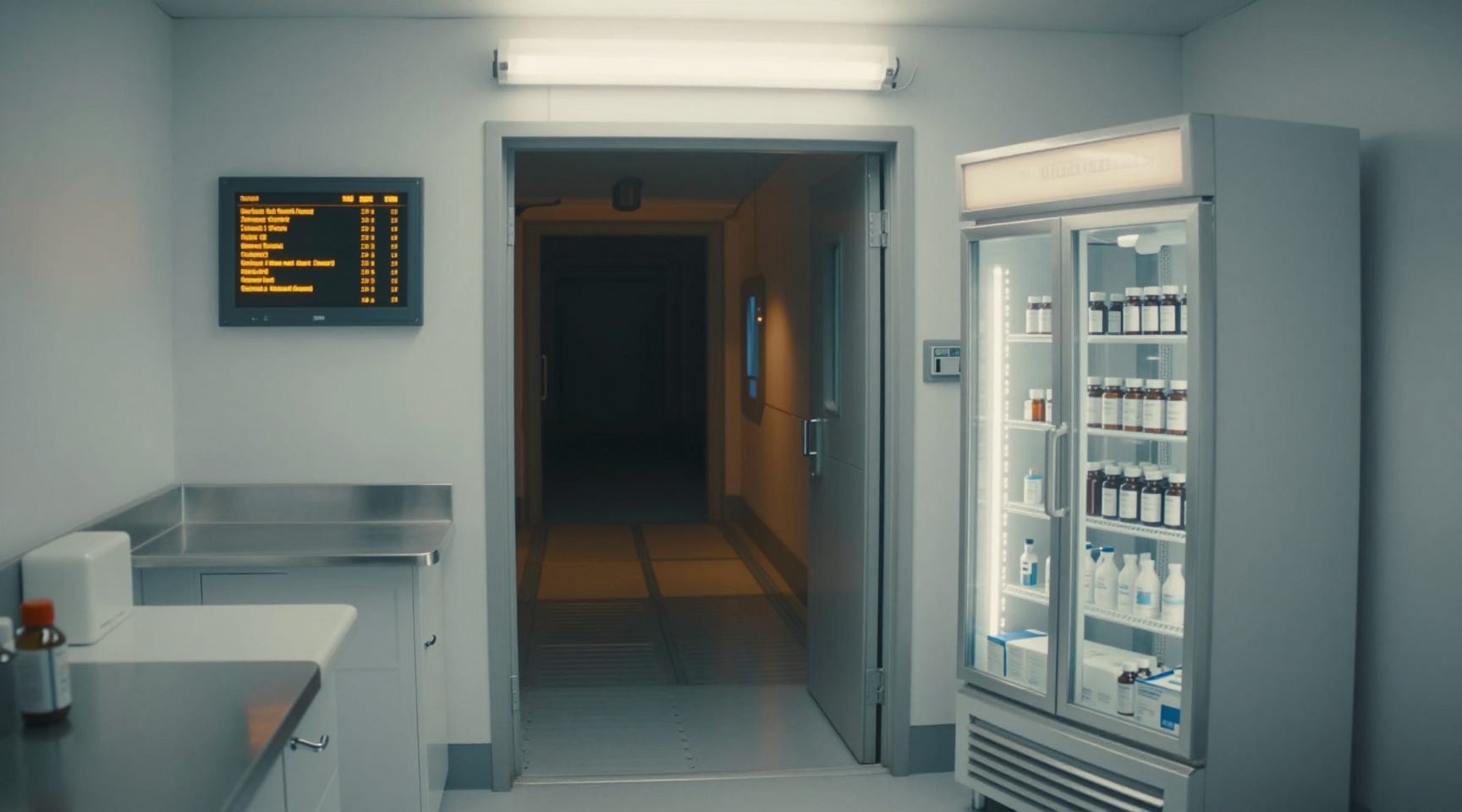
The dispensary log showed forty-two units of ciprofloxacin at last audit. Bárbara Cromwell counted thirty-six in the refrigerated cabinet, same as yesterday, same as the day before. Six units missing from the record. She knew where they had gone because she had carried them out herself, two at a time, wrapped in thermal foil and tucked inside the lining of her jacket.
She closed the cabinet and entered thirty-six into the daily count. The system flagged the discrepancy in amber, not red. Amber meant variance within acceptable loss parameters. Breakage, spoilage, administrative error. The dispensary on Orbital Station Kepler-7 processed four hundred prescriptions a week with a staff of three, and nobody had the bandwidth to chase an amber flag. That was the math she had been counting on for six weeks.
The morning queue formed outside at 0700. Coughs, infections, malnutrition symptoms, radiation exposure from hull sections where the shielding had degraded. The same procession every day, the same inadequate toolkit to address it. She dispensed what she could, documented what she couldn’t, and sent the worst cases to the station clinic two decks up where the wait time averaged eleven days.
Vicente Palmer arrived at 0940. He didn’t come through the queue. He came through the service corridor that connected the dispensary’s storage room to the maintenance tunnels running beneath Deck 12. The door was supposed to be sealed, access restricted to facilities staff. The lock had been broken for eight months. Nobody had filed a repair order because the maintenance tunnels were how half the station’s unofficial economy moved.
“Morning.” He set a thermal container on the storage room shelf. “Twelve units. Protein supplement, pharmaceutical grade. Not the reconstituted stuff they serve in the cafeteria.”
Bárbara opened the container. Twelve sealed packets, each stamped with a UEN logistics code she didn’t recognize. Military supply chain. The protein supplements were worth three weeks of standard rations per packet. One hundred forty-four weeks of supplemental nutrition in exchange for six vials of antibiotic that the official supply chain would replace on the next quarterly shipment.
“The next shipment is delayed,” Vicente said. He leaned against the doorframe, arms crossed. Compact build, steady eyes, the kind of calm that came from knowing exactly how much trouble he could absorb. “Supply freighter out of Ceres had a reactor fault. Two months minimum before they reroute.”
Her stomach tightened. “How delayed?”
“Eight weeks. Maybe ten. The station administrator knows. They’re rationing announcement timing, not supplies. Supplies they’ve already started cutting.”
Eight weeks without resupply meant every unit in her cabinet was irreplaceable. The thirty-six remaining vials of ciprofloxacin, the dwindling stock of analgesics, the wound-care supplies she stretched by cutting bandages in half. Eight weeks, and she had already sent six vials into the black market for protein she could have gotten through official channels if the official channels had worked.
They didn’t work. That was the point. The official channels allocated based on population formulas written by administrators who had never stood in a dispensary watching someone’s infection spread because the next available appointment was eleven days out. The protein supplements she traded for kept four families on Deck 9 alive through the last shortage. Families with children too young for the reduced ration schedule. Families the system had categorized as “adequate” because adequate meant breathing.
“Same arrangement next week?” Vicente asked.
“No.” The word came out harder than she intended. “I can’t move any more units. Not with the delay.”
He studied her for a moment. “Your call. The offer stands if you change your mind.” He left the way he came, through the broken door and into the tunnels.
Bárbara stacked the protein packets in the cabinet beside the ciprofloxacin. Twelve packets. Six vials short. The math was simple and unforgiving.
At 1430, a woman named Reese from Deck 7 carried her son into the dispensary. The boy was eight, maybe nine. His left hand was wrapped in a cloth that had been white once and was now stained yellow-brown. The smell hit Bárbara before the woman reached the counter: infection, deep and progressing. She unwrapped the cloth. A puncture wound in the palm, probably from exposed metal in one of the station’s deteriorating corridor panels. The tissue around it was swollen, hot, streaked with red lines running toward the wrist.
Cellulitis. Spreading. Without antibiotic intervention, the infection would reach the bloodstream within days.
She needed ciprofloxacin. Two units for the initial course, a third if the infection was resistant. Three of her thirty-six remaining vials for a single patient, with eight weeks of empty supply lines ahead and every other infection on the station competing for the same dwindling stock.
Three vials. She had sent six into the tunnels.
The boy watched her with dark eyes that held no accusation because he didn’t know there was anything to accuse. He held his injured hand in his lap and didn’t cry. Children on stations learned early that crying didn’t change the math.
Bárbara pulled three vials from the cabinet. She prepared the first injection, swabbed the boy’s arm, and administered the dose with the practiced efficiency of someone who had done this three thousand times. The antibiotic entered his bloodstream, and the clock started: forty-eight hours to see improvement, seventy-two to confirm the infection was responding.
“Bring him back tomorrow,” she told the mother. “Same time. He needs the second dose administered here so I can monitor the response.”
The mother nodded. She didn’t say thank you. Gratitude had become a luxury that implied the help was optional, that it could have been withheld. On a station where medical care ran on amber-flagged inventories and broken service doors, everyone understood that what they received was what someone had decided to give. The decision was the thing.
After they left, Bárbara updated the dispensary log. Thirty-three units remaining. The system flagged the entry in amber. Nine units below the last audit. Still within acceptable variance. Still invisible.
She looked at the protein packets on the shelf. The protein had fed children. The antibiotics she had traded were treating infections in the tunnels, administered by people with no medical training to patients with no official status. Everything she had diverted was being used. Everything she had kept was being used. The calculus wasn’t clean, and it never would be.
She locked the cabinet, entered her end-of-day code, and began preparing for tomorrow’s queue. Thirty-three vials. Eight weeks. Four hundred prescriptions per week. The numbers didn’t work. They hadn’t worked before she started skimming, and they wouldn’t work after she stopped.
The broken door at the back of the storage room hung slightly open. Tunnel air drifted through, carrying the mineral smell of recycled atmosphere and the faint hum of the station’s life-support systems laboring to keep fourteen thousand people breathing.
She closed the door. It didn’t latch. It never did.
Author’s Note: By Year 3, humanity’s surviving orbital stations had developed complex unofficial economies that operated alongside, and often in direct competition with, official UEN supply chains. Medical supplies occupied a particular tension point in these systems. The official allocation formulas, designed for stable populations with functioning supply lines, couldn’t adapt fast enough to the realities of stations running on damaged infrastructure and irregular resupply. Dispensary workers, positioned at the intersection of official inventory and human need, faced daily decisions about how to distribute resources that were never sufficient. Some of those decisions stayed within the system. Some didn’t.
If you enjoyed this story, you can follow the main story arc in The Exodus Rush, the first book in The Vethrak Requiem series.