


Noémie Renard hated the number because it had a voice.
Forty-five seconds.
On the test bay wall, the countdown pulsed in calm green, indifferent to the nervous shift of bodies behind the safety glass. Forty-five seconds meant warm-up. Forty-five seconds meant an entire human lifetime in the wrong kind of motion.
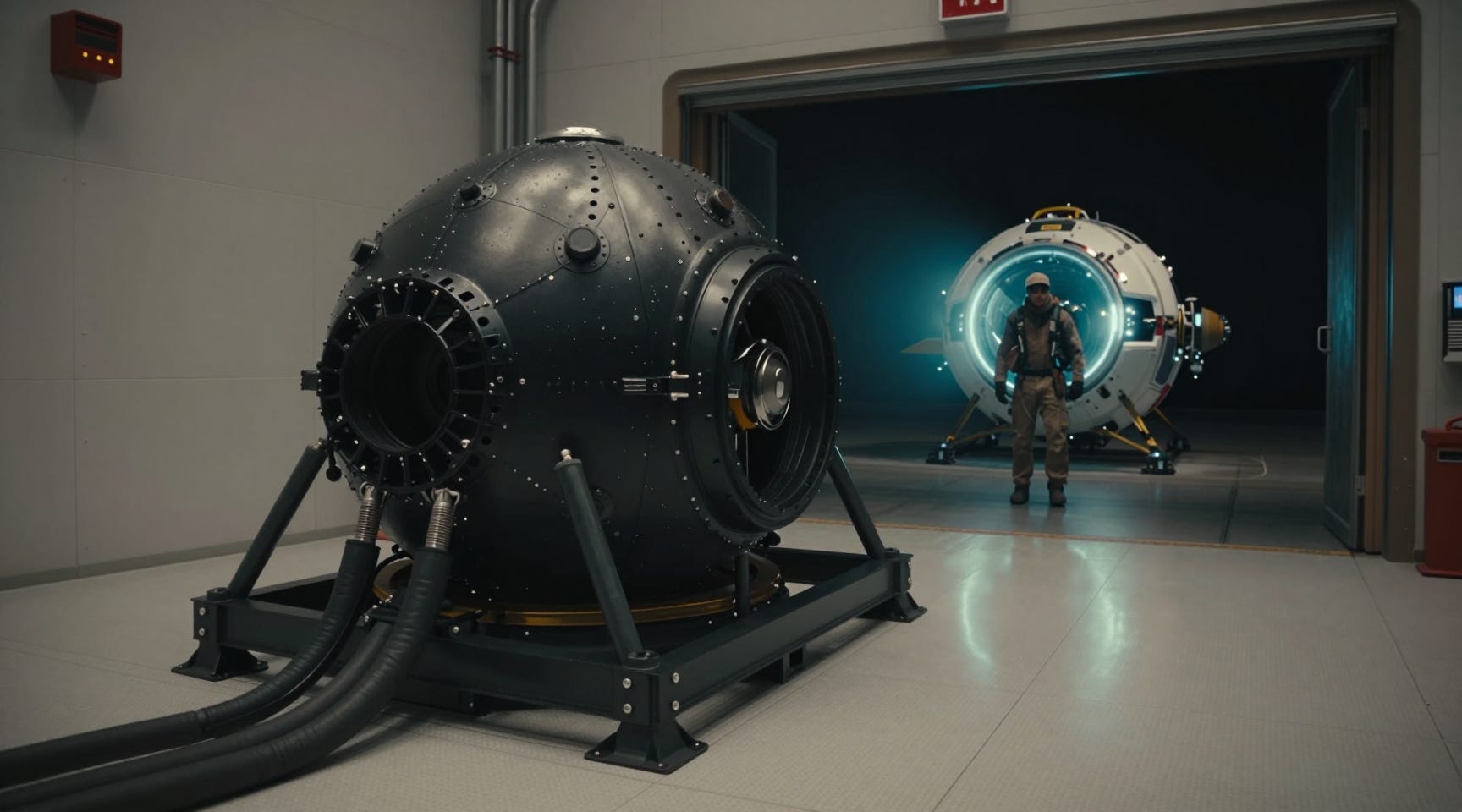
The Aurora Drive sat in the center cradle like a block of night, matte panels swallowing the overhead lights. Cables as thick as her arm ran from its housing into the bay floor, feeding power from the Cascade Reactor two decks below. The reactor could light a city. Today it fed a gamble.
A clipboard rested against her thigh, the paper already damp where her glove met it. Ink bled at the edges of her last notation.
Field symmetry variance: 0.7%.
The spec limit read 0.5%.
Chief Ortez stood at the console with his sleeves rolled to the elbow, jaw set in the way people wore when they planned to pretend later. He did not look over.
“Stabilizers are within tolerance,” he said.
Noémie kept her gaze on the drive cradle. The drive did not care about his confidence. The drive cared about math.
A courier ship waited in the adjoining hangar, a cramped transport with patched hull plating and fresh UEN markings stenciled over old corporate logos. Its manifest sat open on Noémie’s second screen.
Medical kits. Water reclaim filters. Protein concentrate.
Destination: Lagrange Refuge Platform Seven.
Her little sister’s last message lived behind her ribs, a ghost text from four months ago when comms still made it out of the atmosphere.
If you ever get a chance to steal anything, steal air.
The lights in the test bay dimmed as the drive control system took priority. A low hum rose through the floor, vibration in bone.
Noémie lifted her pen, then stopped. A signature line waited at the bottom of the checklist.
Approval to engage.
Her name.
She did not want it to become a verb.
Ortez tapped a key. “Power draw steady. Reactor couplings stable.” His voice stayed casual for the room, for the observers, for the unseen administrators who would read the log afterward.
The engineer beside Noémie, a thin man with burn scars up his neck, whispered without turning his head. “If it spikes again, the compensators lag. People in that courier become paste. You know that, right?”
Noémie did not answer. Answers gave distance. The courier sat close enough to smell the paint through the glass.
A new line of data scrolled across her display.
Gravitic field phase drift: 0.3 degrees.
The drift had been 0.2 in last week’s run. Last week’s run ended with an emergency shutdown and a light fixture falling from the ceiling. That fixture had not weighed seventy tons.
Ortez glanced back at her now. His eyes held the question he refused to ask aloud.
Noémie’s throat went dry. The checklist blurred, then steadied.
She knew how these logs ended. Numbers stayed inside limits or they did not. When they did not, people died.
A thin band of technicians watched from the catwalk above the bay, helmets tucked under arms. Their faces held the same hollow patience as ration lines.
Noémie’s pen hovered over her signature. The tip trembled. No one else moved.
Ortez stepped closer, boots loud on the metal deck. “Renard.” He said her name once, clean, no pressure. The pressure existed anyway.
“Variance is high,” she said.
“It is,” Ortez replied. “It also drops once the field locks. The models say so.”
Models did not bleed.
Noémie glanced at the courier again. The nose cone pointed toward the open hangar doors, toward the black beyond, toward a platform with too many mouths.
“If I sign,” she said, “and it fails, the line on the report will be mine.”
Ortez’s expression tightened. “If you do not sign, the report will be mine. The supplies sit in a warehouse. Platform Seven keeps starving.”
A word formed in her mind, sharp as metal.
Choice.
Noémie hated that word too.
Her palm pressed against the glass. It stayed cold. The drive sat quiet in its cradle, waiting.
The countdown on the wall dropped to thirty seconds.
A technician on the catwalk coughed into her sleeve. Another wiped sweat from his brow and left a streak of grime.
Noémie’s mind returned to a different number.
Zero point five.
Spec lines existed for reasons written in blood and torsion.
A message blinked in the corner of her display, flagged urgent. She did not touch it. The sender ID read PLATFORM-7 OPS.
Ortez noticed it too. His lips parted, then closed.
Noémie opened the message.
We have thirty-seven minutes of oxygen buffer in Habitat Ring C. Two scrubbers failed. Replacement filters requested four days ago. Courier delay will kill twelve.
Noémie’s hand tightened on the clipboard. A dull ache climbed her forearm.
Twelve.
She could picture twelve in a line, eyes on the floor, waiting for a machine to admit it was broken.
The number forty-five seconds returned, louder.
Warm-up.
Gamble.
Noémie lowered her pen to paper and wrote her name.
The ink dried fast.
Ortez exhaled once, then turned back to the console. “Approval logged. Engage sequence.” His voice carried across the bay. The words became official.
Noémie’s stomach twisted. Her signature sat there, black against white.
The drive housing lit from within, not with lamps but with a soft distortion, a shimmer around the edges like heat above asphalt. Light bent the wrong way. The bay looked warped.
The hum deepened. Deck plates buzzed.
Noémie’s display filled with cascading numbers.
Field strength rising.
Phase drift correcting.
Symmetry variance: 0.62%.
Still high.
Ortez kept his hand on the emergency cutoff.
The courier feed blinked, then returned with a halo of pale aurora around its hull. The shimmer thickened, stormlight trapped against metal.
A new line flashed.
Field lock achieved.
Symmetry variance: 0.48%.
Under the line.
Noémie did not move. The numbers held. The hum steadied into a smooth, constant tone.
Ortez’s fingers relaxed from the cutoff. “Stability confirmed,” he said, voice low now, meant for her. “Good call.”
Noémie stared at the 0.48 until the digits burned. Relief tried to enter, then stopped at the threshold of memory.
One success did not erase the failures. One courier did not solve hunger.
The courier’s captain came on the internal comm. Static, then a voice rough with sleepless nights. “Aurora shimmer looks clean. No oscillation. Request clearance to depart.”
Ortez keyed his mic. “Clearance granted. Safe flight.” He paused. “Deliver those filters.”
“Copy,” the captain said. “Platform Seven, here we come.”
The courier slid forward, silent, and disappeared through the hangar doors into the dark.
Noémie watched the camera feed until the shimmer dwindled to nothing. The bay lights returned to their normal white.
Her clipboard remained in her hand. The signed approval line stared up at her.
The number forty-five seconds lost its voice. A different sound took its place, quieter and harder to ignore.
Twelve.
Noémie flipped the page and wrote a new entry at the top of the ledger.
Field symmetry variance exceeded spec on initial ramp. Field lock brought variance within limits. Approval granted due to oxygen-critical request from Platform Seven.
She added her initials.
N.R.
The ink looked small. The consequences did not.
Author’s Note: This story takes place in Year 12 (Post-Invasion), during the earliest operational deployments of the Aurora Drive. In those first months, every jump carried the weight of a checklist and a signature. Supplies did not travel on hope. They traveled on imperfect math and people willing to own it.
If you enjoyed this story, you can follow the main story arc in The Exodus Rush, the first book in The Vethrak Requiem series.