


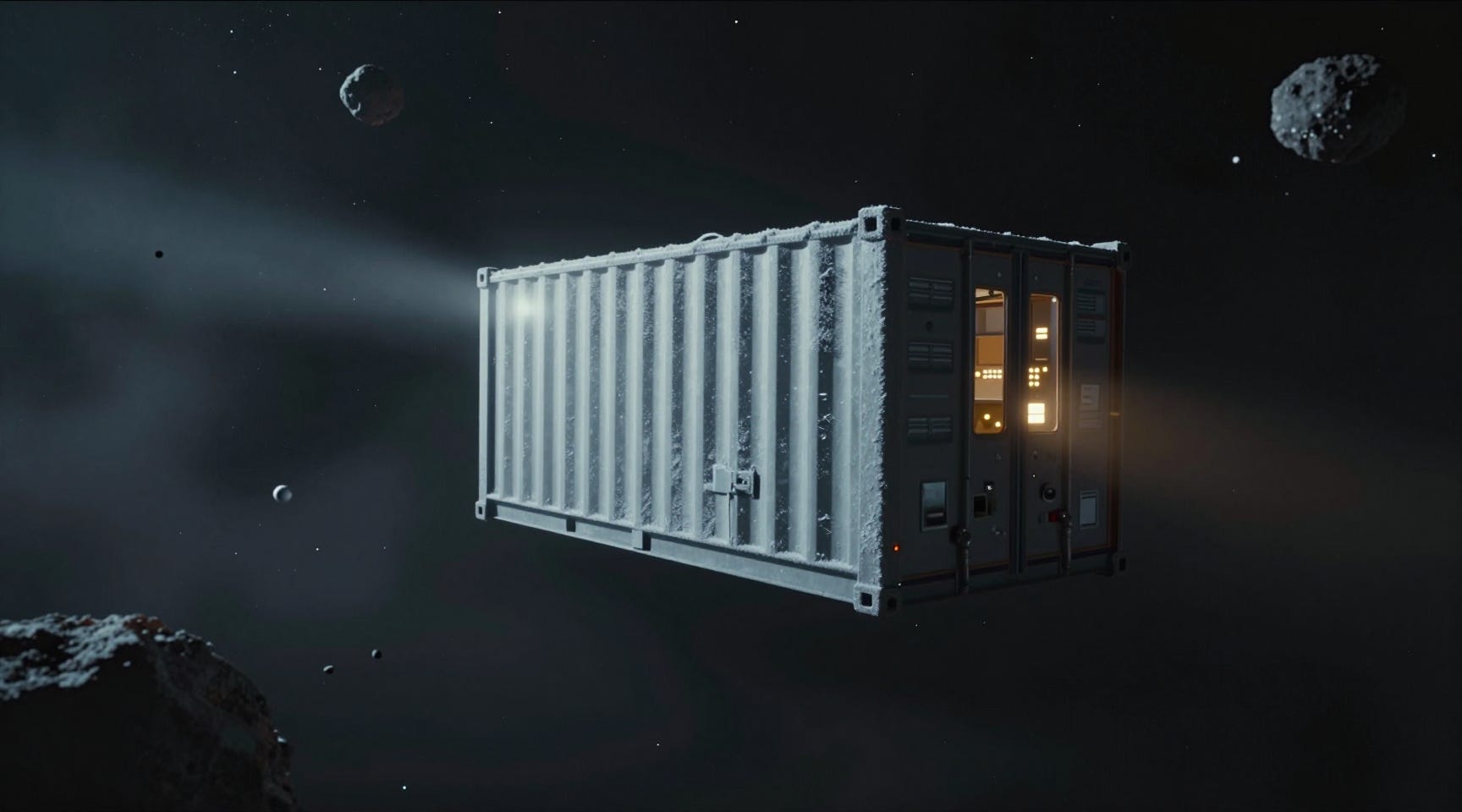
The manifest scanner took eleven seconds per container. Bruna Holmberg counted them the way she counted everything on the CSV Driftline: without expectation, without attachment, without letting the numbers carry weight beyond their function. Container one, agricultural nutrient concentrate bound for Pallas Station’s hydroponics wing. Thermal profile matched. Container two, recycled atmospheric filter cartridges. Profile matched. Container three, reclaimed cascade reactor coolant, hazmat class two, destination Pallas maintenance division.
Profile did not match.
Coolant pulled from cascade reactor systems ran hot. Residual thermal energy from the annihilation process lingered in the reclamation fluid for weeks, sometimes months. Every coolant container Bruna had ever hauled registered between forty and sixty degrees on the scanner’s thermal band. Standard. Predictable. The kind of reading that let her close the manifest file and start the burn to Pallas without a second thought.
This container read nine degrees. Near-zero thermal output, as if something inside was pulling heat from the environment or generating none at all. The electromagnetic signature underneath was clean, symmetrical, tight as a sine wave on an oscilloscope. Nothing about it resembled industrial waste. Nothing about it resembled anything human. Belt couriers traded stories about signatures like this, the kind that showed up in Iron Wake salvage listings before the posts disappeared.
Bruna set the scanner on the cockpit console and stared at the reading for longer than she should have. The Driftline hummed around her, life support cycling its quiet rhythm through the cabin. Outside the forward viewport, the belt stretched in every direction, a sparse field of tumbling stone and metal lit by a sun too distant to warm anything.
She keyed the comms. Sinan Gomes answered on the second pulse, which meant he had been waiting.
“Go ahead.”
“Container three. The thermal profile doesn’t match the manifest.”
Silence. Not the empty silence of a dead channel, the weighted silence of someone choosing their words.
“What did the profile show?” His voice stayed level. Too level.
“Nine degrees. Clean EM signature. Symmetrical. It’s not coolant, Sinan.”
More silence. Then: “Deliver as scheduled. Delete the scan log. Run the standard manifest on arrival and let the numbers match what the label says.”
“The label says coolant.”
“Then it’s coolant.”
“It’s not.”
“Bruna.” His voice dropped half a register, the way it did when the conversation was about to stop being optional. “The rate for this run has been adjusted. You’ll find the deposit when you dock. Ten times standard. Deliver the container. Don’t scan it again. Don’t open it. Don’t talk about it after this call.”
The comms channel closed. Bruna sat in the pilot’s chair and listened to the Driftline breathe.
Ten times standard. She ran forty-seven hundred thermal credits per delivery on a good month. Ten times that was enough to cover her atmospheric stipend for the rest of the year and still have margin left over. Enough to stop running belt routes entirely, if she wanted to find a station-side job that didn’t require asking no questions about sealed containers.
The container sat twelve meters behind her, bolted to the cargo deck in its standard locking frame. Cold. Clean. Wrong.
She had been running syndicate cargo for nineteen months. Ration supplements with expired lot numbers. Medical supplies diverted from UEN distribution channels. Atmospheric filter components pulled from decommissioned stations and resold at markup through Pallas brokers. All of it human. All of it traceable to human systems, human scarcity, human need. She had made peace with that. The official supply chain left gaps wide enough to kill people, and the syndicate filled them. Not cleanly, not fairly, not without profit skimming off every transaction. Still, the goods moved and people at the other end ate, breathed, survived.
Vethrak salvage was different.
Iron Wake. The name circulated through belt courier networks the way radiation warnings circulated through mining channels: everyone knew about it, nobody wanted to be the one standing closest when it mattered. They moved alien technology from salvage sites to buyers who paid in quantities that made legitimate commerce look quaint. A scanning array pulled from a dead Vethrak vessel could fund a station’s entire black-market medical supply for a year. A navigation component could buy silence from every customs inspector between Ceres and Jupiter.
The container behind her was worth more than five years of courier runs. She could feel the math pressing against her ribs, the same way she could feel the Driftline’s vibration through the deck plating. Five years. That was how long she had been out here since the syndicate recruiter in Ceres C-block had offered her a ship and a route and a set of rules simple enough to live by: deliver on time, don’t open containers, don’t ask questions.
Three ways this ended. She could dock at Pallas, hand the container to whoever met her at the cargo bay, collect the deposit, fly back to Ceres, and pretend the sine wave on her scanner had been a calibration error. She could open the cargo bay doors between here and Pallas, let the belt swallow the container, and tell Sinan the locking frame malfunctioned during transit. She could change her transponder, find a buyer outside the network, and hope that five years of courier work had taught her enough about staying invisible.
Dumping the cargo made her a liability. Couriers who lost shipments didn’t get second runs; they got visits from people whose names nobody knew. Disappearing with it made her a target. Iron Wake tracked their inventory with the same precision the UEN tracked warships. Taking one of their containers was a death sentence delivered on a flexible timeline.
Delivering made her complicit in something larger than ration diversions and recycled filter cartridges. A link in a chain that moved alien weapons technology into human hands with no authorization and no oversight. The kind of person she had spent nineteen months telling herself she wasn’t.
Bruna initialized the Aurora Drive. The Driftline’s sublight engines spooled to cruising thrust, pushing her toward Pallas at the same velocity she always traveled. Six hours. She spent them in the pilot’s chair, watching the belt scroll past, not looking at the manifest scanner on the console beside her.
The docking clamps engaged at Pallas with a familiar thud. Bay seventeen, same as always. A cargo handler in unmarked coveralls was already waiting on the platform when the bay pressurized. He didn’t give a name. He checked the container’s locking frame, verified the seal was intact, and loaded it onto a freight dolly without speaking. His scanner stayed holstered. Bruna signed the delivery confirmation on her manifest tablet, and the handler wheeled the container through the bay doors toward a corridor she had never walked down.
Her account registered the deposit forty seconds later. Forty-seven thousand thermal credits. The number glowed on her wrist display, clean and absolute.
Bruna closed the manifest file for container three. She opened the file for her next scheduled run: four containers from Pallas to Ceres, departing in nine hours. Standard cargo. Standard rates. She initialized the pre-departure manifest check and held the scanner over container one.
The scanner took eleven seconds. She counted them the way she counted everything. Steady. Methodical. Without letting the number mean anything.
Author’s Note: Iron Wake courier operations in the asteroid belt rely on a layered system of compartmentalization. Couriers carry sealed containers without knowledge of their contents, handlers receive shipments without knowledge of origin points, and certification officers on stations like Pallas process manifests that match their labels regardless of what sits inside the container. By Year 14, an estimated twelve to fifteen Vethrak salvage shipments move through belt courier networks each month, hidden inside the thousands of legitimate cargo transfers that keep humanity’s scattered settlements alive.
If you enjoyed this story, you can follow the main story arc in The Exodus Rush, the first book in The Vethrak Requiem series.