


The pressurization lock cycled, and the young Skarreth stood at the threshold of the tunnel, waiting.
The instructor stood behind them in the lock’s outer chamber. The instructor’s name was not known to the young one: not yet, not well enough to use, and the instructor offered nothing: no instruction, no assessment, no indication of what lay ahead. The instructor simply stood in the chamber’s recycled stillness, and the silence itself was instruction.
The young one pressed into the tunnel mouth.
The body changed. That was the first thing. The compression was not a technique. It was a necessity, as natural as breathing in the high-pressure corridors of Kresh-Vor. The hydrostatic structure redistributed, the internal cavities collapsing in a sequence as practiced as heartbeat: abdomen, thorax, secondary chambers. The surface plating, still smooth with the unmarked quality of early adulthood, flexed inward along the natural fault lines of the carapace. The standing volume dropped to sixty percent, then fifty-five, then forty-five. A shape that would fit through a gap a human could not have inserted a hand into.
The walls of the tunnel pressed against every surface of the body at once.
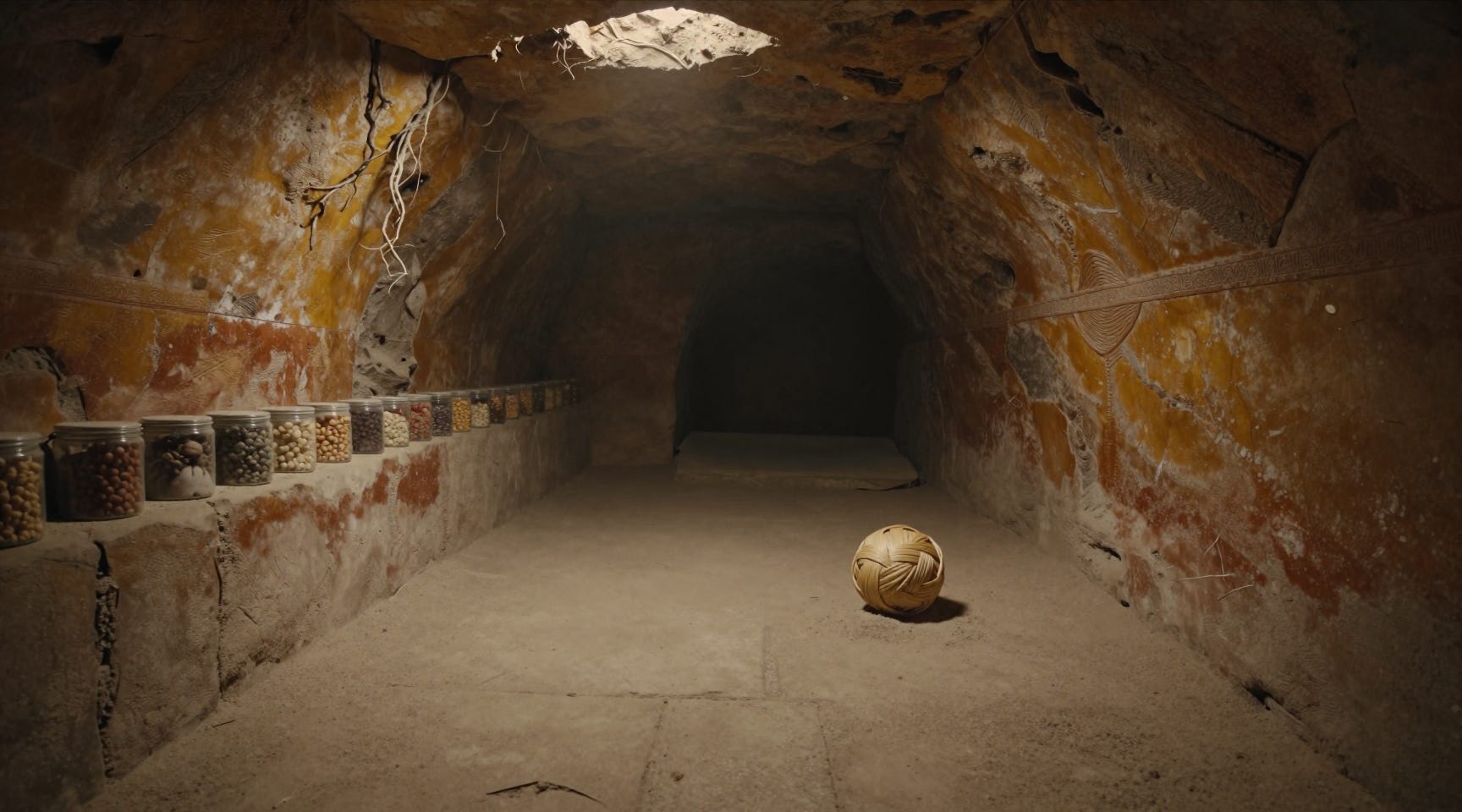
This was the second thing. The tunnel had been collapsed by the Harvest bombardment thirty-four years ago, before the young one was born, before the young one’s parents were born, before anyone currently living on Kresh-Vor had seen the sky. The stone had settled in the decades since, finding new configurations, and the path through the collapse was not a route anyone had mapped. The young one’s first independent compression-test was a tunnel that had not been traversed since the Harvest. The instructor had said nothing about this. The instructor had simply indicated the entry point and stood back.
The young one moved forward through the collapse, click-echolocation casting a brief, percussive soundscape against the broken stone: the sharp return of a close surface, the hollow ring of a chamber beyond, the muffled absorption of compacted debris. Each click built a momentary map of the space ahead, and between clicks the darkness was absolute. There was no light in the collapsed tunnel. There had been no light in this part of the underground for thirty-four years.
The body found the narrowest passage and pressed through.
The compression deepened, an adjustment that pushed past the practiced range into something the young one had not attempted before. The hydrostatic redistribution tightened, the secondary chambers collapsing further than the training simulations had required. The walls of the passage ground against the carapace on all surfaces, the friction producing a low vibration that traveled through the body’s structure. The young one made no sound. Skarreth did not vocalize during compression. Vocalization signaled distress, and distress was information no one else needed.
The passage widened. The click-echolocation returned a different signature: open space ahead, a chamber with a ceiling high enough that the return was soft, muffled by distance. The young one expanded to resting volume. Eighty percent, ninety, the redistribution easing as the tunnel opened into a space that had not been reached since before the Harvest.
The chamber was a pre-Harvest community space.
The young one stood in the center of a room that had been someone’s home. The walls were surfaced ceramic, warm-toned in a spectrum the young one’s eyes registered as comfort-range. The color of light that had been designed for living, not survival. The chamber was large enough for a family unit, with subsidiary alcoves branching off in three directions. The contents were intact. The air was vacuum, the preservation of thirty-four years of undisturbed stillness holding everything in the position it had occupied on the day the Harvest came.
Dried food storage shelves lined one wall. The containers were still sealed. A child’s woven object rested on the floor near the sleeping alcove: a sphere of interlocked fibers, the kind of thing a young Skarreth made during the developmental phase when manipulative precision was still being refined. It had fallen there when the bombardment shook the chamber. It had not been picked up.
The young one stood in the silence of a dead family’s home and did not know what to do.
There was no operational protocol for a collapsed residential chamber. The training simulations covered tunnel navigation, debris assessment, structural integrity evaluation, emergency extraction. They did not cover what to do when you found a woven sphere on the floor of a room that had not been touched since its occupants died. The young one’s body held at resting volume, the hydrostatic system cycling at a steady state, and the young one stood in the center of the chamber with something that the Skarreth language did not have a word for.
Skarreth did not name emotions. They named the shapes they needed to be.
The young one did not know what shape this required.
They stood in the chamber for a measurable interval. Thirty seconds, maybe more, maybe less. And they looked at the child’s sphere, the sealed containers, the walls that had been designed for warmth. The instructor had said nothing about what the young one would find at the end of the tunnel. The instructor had not needed to. The instructor knew that the shape required by this moment could not be taught. It could only be encountered.
The young one pressed the sphere into the smallest storage cavity in their thorax. The cavity was designed for emergency rations, but the sphere was not larger than a ration pack, and the young one would not need the rations before returning. The woven fibers rested against the interior surface. The young one did not know why they had taken it.
The return compression was faster. The body had memorized the path through the collapse, and the passage that had required full concentration on the inward journey was now a route the hydrostatic system could navigate with the efficiency of learned knowledge. The young one moved through the narrowest gap without hesitation, the walls pressing, the click-echolocation mapping the return in a sequence that no longer required conscious assessment.
The pressurization lock cycled. The young one expanded to full standing volume in the outer chamber.
The instructor did not react. The instructor’s surface chromatophores had shifted. Not to a communicative pattern, but to the resting state of a senior who had been waiting in stillness for the duration of the test. The instructor said nothing.
“The tunnel is stable,” the young one said. “The path is registered.”
“Correct,” the instructor said.
Nothing else was said about the chamber.
As the young one turned to exit the lock and begin the transit back to the main complex, the turn speed was different. Slower. More deliberate. The body carried a new awareness: the weight of a woven sphere in the storage cavity, the memory of a room that had been designed for living, the knowledge that the collapse was not just a navigational problem but a threshold between a civilization that had been and a civilization that had become something else in order to survive.
The instructor noted the turn speed but said nothing.
Skarreth did not name emotions. They named the shapes they needed to be. The young one had found a shape in the darkness that the training had not prepared them for, and the shape was not yet named. But it was there, carried in the thorax alongside the child’s sphere, and it would not be returned to the place it had come from.
If you enjoyed this story, you can follow the main story arc in The Exodus Rush, the first book in The Vethrak Requiem series.