


The fragment weighed eleven grams. The engineer had weighed it before submitting the retention request, because the requisition form required a mass entry, and the form had no field for the reason.
The habitat section at the end of Station Kresh-Var’s third ring had been built to pre-Harvest specifications. The ceilings ran a full body-length higher than operational standard. The chambers spread wider than any tactical calculation could justify. Pressure vents lined the walls in repeating rows, shaped and spaced for symmetry, serving no purpose the environmental schematics acknowledged. Almost no one used the section.
The engineer came here on the eighth rest cycle of every rotation.
The fragment was ceramic, warm-toned, glazed on one face with a repeating geometric pattern. It had been part of a decorative wall panel in the public square of the pre-Harvest capital, four levels down in Kresh-Vor, sealed for a hundred and forty-seven years and opened again by a survey team the engineer had served on. Commander Tcha-Kss had stood in that recovered square, in the recovered light, and said nothing. The survey report classified the wall panels as architectural features. The engineer had carried one broken corner back to the surface and filled out the form.
The engineer turned the fragment over in the precision manipulators. The glazed face was smooth in a way that operational ceramic was never smooth. Surface finish on station equipment was specified for grip, for thermal dissipation, for resistance to abrasion. This surface had been specified for touch. Some Skarreth, seven generations gone, had fired the glaze to a smoothness whose only purpose was the experience of a manipulator moving across it.
The engineer’s chromatophores held neutral. The click record for the chamber, had anyone been keeping one, would have shown silence.
There was no analysis to perform. The engineer had attempted one on the first visit, and it produced nothing usable. The fragment was not efficient. It was not adaptive. It demonstrated no competence the command council would ever review. It was a surface made to be touched for pleasure, by a species that had possessed room for pleasure, and the engineer, shaped by the resistance into a form with no space for such a surface, kept returning to it anyway.
The engineer had no name for what the returning was. Skarreth did not name such things. They named the shape they needed to be.
The engineer sat in the oversized chamber, under the unjustified ceiling, turning a broken piece of a beautiful wall. Being near it. That was all.
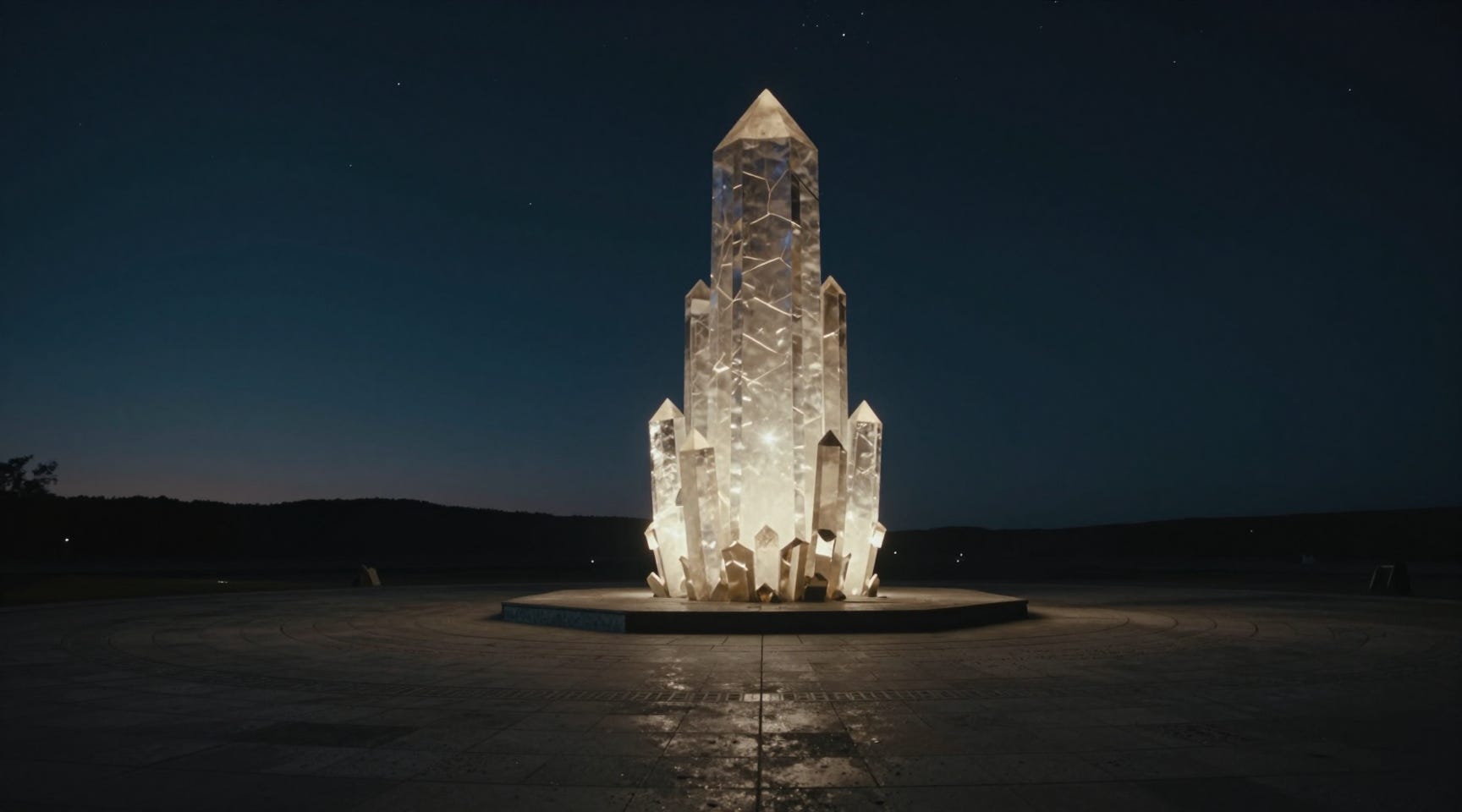
On Tau Ceti IV, the star had set behind the western ridge, and the Monument’s lattice held the last of it.
First-Light-After stood alone on the plaza stone. The crystalline structure rose into the dark, its facets releasing the day’s absorbed light in a residual glow too faint for any instrument to bother recording, a shimmer at the threshold of perception. The night wind moved across the plaza and carried the mineral smell of dust, the dust the maintenance crews swept each morning and the planet replaced each afternoon.
Years had passed since the first landing, since the training cohort disembarked into thin air and the Monument’s resonance field pressed against their lower frequencies like a harmonic the body received before the mind attended to it. First-Light-After had returned many times since. As a candidate. As a graduate. As an officer escorting cohorts of the newly grown. Each visit had carried a purpose, a ceremony, an instruction to complete.
This visit carried nothing.
First-Light-After’s own light sat low, banked to a faint amber idle, the register of a Keraneth alone with no one to address. The Monument required no address. The twelve hundred were not an audience. They had merged their light into the lattice long before First-Light-After’s generation was grown, and what remained of them did not converse. What remained of them resonated.
The low harmonic moved through the plaza stone, up through First-Light-After’s footing, and settled somewhere beneath the range of formal language. It was not Grief-Tone. First-Light-After had learned Grief-Tone at this Monument as a candidate, the ultraviolet depth of it, the way it stood in the record as warning. It was not Hope-Resonance, the rose-copper pulse the instructors broadcast at graduation. The harmonic carried neither color. It carried something simpler, something that had taken First-Light-After years to learn to receive.
Presence.
The volunteers were not waiting. That understanding had come slowly, across the visits, across the years. The twelve hundred had not merged themselves into the lattice to wait for vindication, for the fleet, for the day the preparation would finally be spent. They had merged so that they would be here. They were here. The lattice glowed, the resonance moved through the stone, and a Keraneth stood in the dark beside them because they had wanted to be near, and being near was permitted, and nothing further was asked.
First-Light-After’s banked light lifted, unbidden, a single slow pulse of warmth in the dark plaza. There was no one to receive it. It was not sent to be received.
The display showed nothing.
Sentinel-of-the-Uncrossable stood at the forward station of the observation ship, confirmed the reading, logged the reading, and remained at the station after the log entry closed. The diagnostic cycle had completed on schedule. The Boundary returned no data, as it had returned no data for the thirty-nine years of the Sentinel’s assignment, as it had returned no data for as long as the Dominion had kept records of the region where records stopped.
The crew maintained the routine. The junior sensor operator ran the passive arrays. The navigator held the patrol line at the mandated distance. No one spoke. Nothing required speech.
The Boundary would not change. The Sentinel had carried this as fact for thirty-nine years. The charts marked a line the Dominion did not cross, a limit that had held through fifty thousand years of doctrine, a prohibition that even the Voice did not explain. Ships that approached were recalled. Questions that approached were not asked. The Sentinel had stopped forming the questions decades ago, and what remained was the function: observe, log, report if the Boundary changes. The Boundary did not change.
The Sentinel kept the watch anyway.
There was no operational requirement to stand at the forward station between diagnostic cycles. The displays would alert on any deviation. The standing added nothing to the ship’s capability, produced no data, served no clause of the patrol directive. The Sentinel stood the watch because the watch was the function, and the function was the closest thing the Dominion issued to meaning, and the Sentinel had held it long enough that the function had taken the shape of the Sentinel, or the Sentinel had taken the shape of it. The distinction had stopped mattering somewhere in the fourth decade.
The pressure at the edge of awareness was present tonight, as it had been for years now. Attention, from the far side of the line, unverifiable and constant. The Sentinel did not log it. The log had no field for it. The Sentinel stood in the attention of something the Dominion did not acknowledge, watching a limit the Dominion would not cross, serving an authority that did not explain itself, and this was the whole of it, and the whole of it continued.
The display showed nothing. The cycle continued.
Three shapes, in three rooms of the same galaxy. A Skarreth engineer sitting with a broken piece of a beautiful wall. A Keraneth pulsing warmth into a dark plaza with no one to receive it. A Vethrak standing a watch that adds nothing, at a line that will not move. None of the three would name what they were doing. Two of the three had no language for it. The third had a language for it and did not permit the word. The war had made all three, and the war was not the whole of any of them, and in the quiet at the edges of it, each had gone looking, without knowing it was looking, for the shape it would be when the war was over.
If you enjoyed this story, you can follow the main story arc in The Exodus Rush, the first book in The Vethrak Requiem series.