


The water tasted wrong. Raphaël Kozłowski held the sample vial up to the inspection lamp and tilted it, watching the light refract through liquid that should have been clear. A faint milkiness swirled through the lower third, particulate matter that the filtration array in Block 9 should have caught before the water ever reached a residential tap.
He logged the reading on his tablet. Turbidity: 4.2 NTU. Acceptable threshold was 1.0. He’d pulled fourteen samples from Block 9’s distribution nodes over the past three days, and not one had tested below 3.5.
The filtration array wasn’t failing. He’d inspected it himself last week. Every membrane was intact, every pump cycling within rated parameters. The array was processing water at full capacity for the volume it received.
The volume it received was the problem.
Raphaël worked water reclamation auditing for Titan Station’s Environmental Services division, a title that meant he walked corridors with a sample kit and a tablet, testing water quality at distribution nodes and filing reports that nobody read. The station’s water recycling infrastructure was designed for a population of twelve thousand. Current registered population sat at fourteen thousand. Unregistered population, the number that didn’t appear on any official roster, pushed the real figure closer to nineteen thousand.
Nineteen thousand people generating wastewater. Filtration capacity for twelve thousand. The math produced the milky vial in his hand.
He capped the sample and slotted it into his kit. Block 9 occupied the lower residential tier of Titan Station’s southern arc, a warren of converted cargo compartments and partitioned storage bays where the unregistered population concentrated. The corridors down here were narrower than the main residential levels, the lighting dimmer, the air carrying a mineral tang from exposed piping that nobody had bothered to insulate because these spaces were never meant for habitation.
His route took him past a door marked MECHANICAL, 9-C-14. The door was closed, which was normal. The condensation beading on its surface was not. Mechanical rooms on Titan Station ran cold. The equipment inside generated minimal heat. Condensation meant something behind that door was producing thermal output that the room’s ventilation couldn’t absorb.
Raphaël stopped. He could hear it now that he was listening: the low, rhythmic pulse of a pump running at high capacity. Not a station pump. The vibration frequency was wrong, too fast for the variable-speed drives that Environmental Services used. This was a fixed-speed unit, the kind that salvage crews pulled from decommissioned transport ships and sold at the open markets on the cargo level.
He checked his tablet. Mechanical room 9-C-14 was listed as containing junction valves for the Block 9 secondary water loop. No active equipment. No scheduled maintenance.
The door wasn’t locked. He pushed it open.
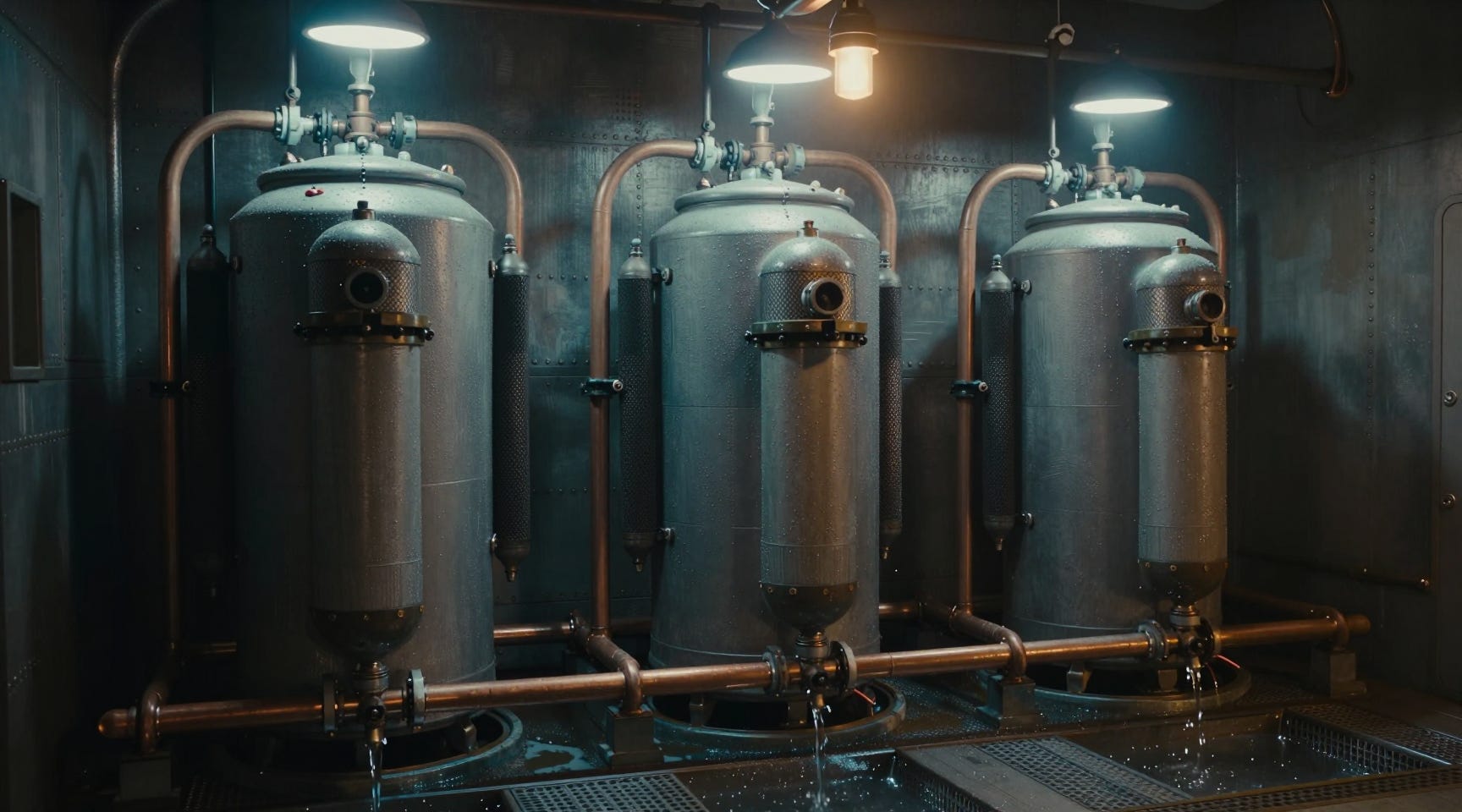
The room had been transformed. Where junction valves should have stood, someone had installed a compact water processing system built from salvaged components. Three settling tanks, each roughly the size of a shipping crate, sat in a row along the back wall. Intake lines tapped into the station’s gray water return, pulling wastewater before it reached the official filtration array. A centrifugal pump drove the water through a cascade of improvised filter stages: coarse mesh, activated carbon beds packed into repurposed oxygen canister housings, and a final UV sterilization unit cobbled from medical equipment.
The system was running. Clean water dripped from the output line into a collection tank marked with a symbol Raphaël had seen before: a circle with three horizontal lines through it. The mark of The Cistern.
He’d heard the name in Block 9’s corridors, always spoken carefully, always in contexts that evaporated when anyone official came near. The Cistern ran parallel water services in sectors where the station’s infrastructure couldn’t keep up with demand. They tapped gray water returns, processed it through improvised systems, and distributed the clean output to residents who couldn’t get adequate supply through official channels.
Raphaël stepped inside. The air was warm, humid, carrying the chlorine bite of the UV sterilization stage. The settling tanks gurgled softly. He pulled a sample vial from his kit and held it under the output line.
The water ran clear. He tested it. Turbidity: 0.3 NTU. Bacterial count: within potable limits. Mineral content: slightly elevated calcium, consistent with the activated carbon filtration. Drinkable. More than drinkable. Cleaner than what the official system was delivering to Block 9’s taps.
“You’re welcome to take a full liter.”
Raphaël turned. A woman stood in the doorway, arms crossed, watching him with the practiced calm of someone who had expected this moment. She was short, muscular, wearing maintenance coveralls with no name patch and no division insignia.
“How long has this been operational?” he asked.
“Nine months. Two other units in Block 9. Four more across Blocks 7 and 11.”
Seven parallel filtration systems. Raphaël calculated the throughput. At the capacity this unit appeared to handle, seven systems could process enough gray water to supplement supply for roughly three thousand people. Three thousand people who were drinking 4.2 NTU water from the official taps, or worse.
“The station knows Block 9’s water quality is degraded,” he said.
“The station filed a remediation request fourteen months ago. Funding was denied. Infrastructure budget went to the northern arc expansion.” The woman uncrossed her arms. “The settling tanks cost us six hundred credits in salvage parts. The pump was pulled from a decommissioned cargo shuttle. The carbon beds need replacement every forty days, which costs another two hundred. The Cistern covers it through subscription. Residents pay what they can. Nobody pays more than fifteen credits a month.”
Fifteen credits. A fraction of what the official water surcharge would cost if the station ever bothered to implement one for the unregistered population. Which it wouldn’t, because implementing a surcharge would require acknowledging the population existed.
“Your UV sterilization unit,” Raphaël said. “The dosage calibration. Who maintains it?”
“We have a retired Environmental Services tech. She calibrates every seventy-two hours.”
“Every seventy-two hours isn’t sufficient for a unit running continuous flow. Forty-eight is the minimum for reliable pathogen elimination at this throughput.” He paused. “The carbon beds. Forty-day replacement cycle is aggressive. At this flow rate, you’re losing adsorption capacity by day thirty. The water’s still clear at forty days, but the chemical filtration is degraded. Dissolved organics start passing through.”
The woman studied him. “You’re auditing us.”
“I’m telling you your system has two maintenance gaps that could make people sick.” He capped his sample vial and slotted it into his kit. “The official system is making them sick now. Elevated turbidity at 4.2 NTU carries particulate-associated pathogens that chlorine treatment doesn’t fully neutralize. The children in Block 9 who keep presenting with gastrointestinal infections at the clinic aren’t getting sick from food contamination. They’re getting sick from the water.”
He’d filed that report three months ago. The response had been a request for additional sampling data.
“I need to log this room,” Raphaël said.
The woman’s expression didn’t change. “If you log it, station security shuts us down. Three thousand people go back to drinking from the official taps.”
“If I don’t log it, and your UV calibration slips, or your carbon beds exhaust early, those same people get sick from your system instead of the station’s.”
He stood in the converted mechanical room, listening to the settling tanks process water that the station’s own infrastructure couldn’t clean. His tablet held fourteen sample readings documenting official water quality that violated the station’s own health codes. His kit held one sample of water from an illegal filtration system that met every standard the official system was failing.
Raphaël opened a new entry on his tablet. Mechanical room 9-C-14. He typed: Junction valves inspected. No anomalies detected. Recommend increased monitoring of Block 9 distribution nodes due to elevated turbidity readings.
He looked at the woman. “Your UV calibration schedule needs to be forty-eight hours. Non-negotiable. I’ll leave a maintenance checklist in this room tomorrow morning. Follow it.”
She nodded once.
He walked back into the corridor, sample kit against his hip, tablet logging the fourteen readings that would go into his weekly report alongside a recommendation for infrastructure funding that would be denied again. Block 9’s official water would remain at 4.2 NTU. The Cistern’s parallel system would keep running in mechanical rooms that his inspection logs would continue to classify as containing junction valves and no anomalies.
The water in his sample vial caught the corridor light as he walked. Clear as anything the northern arc residents drank from taps connected to systems that had never been underfunded, in sectors where every resident had a registration number and every registration number had a water allocation and every allocation was sufficient because the population matched what the infrastructure was built for.
Raphaël filed his report at the end of his shift. All systems within acceptable parameters. He recommended a follow-up inspection of Block 9 in ninety days.
The settling tanks would still be running by then. He’d make sure of it.
Author’s Note: Titan Station’s southern arc was never meant to house the population it absorbed after the resource consolidations of Year 14. The official infrastructure serves the registered twelve thousand adequately. The additional seven thousand residents, products of migration waves that the station’s intake system processed at capacity and then stopped processing, survive through parallel systems built by people who understood that waiting for official remediation meant drinking water that was slowly making their children sick. The Cistern doesn’t advertise. It doesn’t recruit. It charges what people can afford and maintains equipment that the station should have installed years ago. Raphaël’s compromise isn’t heroic. It’s the minimum response of someone whose professional training tells him the water is dangerous and whose institutional reality tells him nobody with authority to fix it intends to.
If you enjoyed this story, you can follow the main story arc in The Exodus Rush, the first book in The Vethrak Requiem series.