


The briefing request came in at 0742. Fleet HQ’s outer office had flagged it urgent and Senatorial, which meant Admiral Helena Chen was reading it by 0743 and had cancelled her 0800 by 0744. The senator from Manila was Villanueva, Pacific reconstruction, the same woman who had asked, in the Ash Room eleven weeks ago, whether the United Earth Navy was building warships against a ghost. She wanted a private update on the First Three’s first nine days of patrol.
A private request meant the senator was doing something else.
Chen’s second thought, the one she did not write down, was that Villanueva was the only senator who had ever asked the right question the first time.
She said yes.
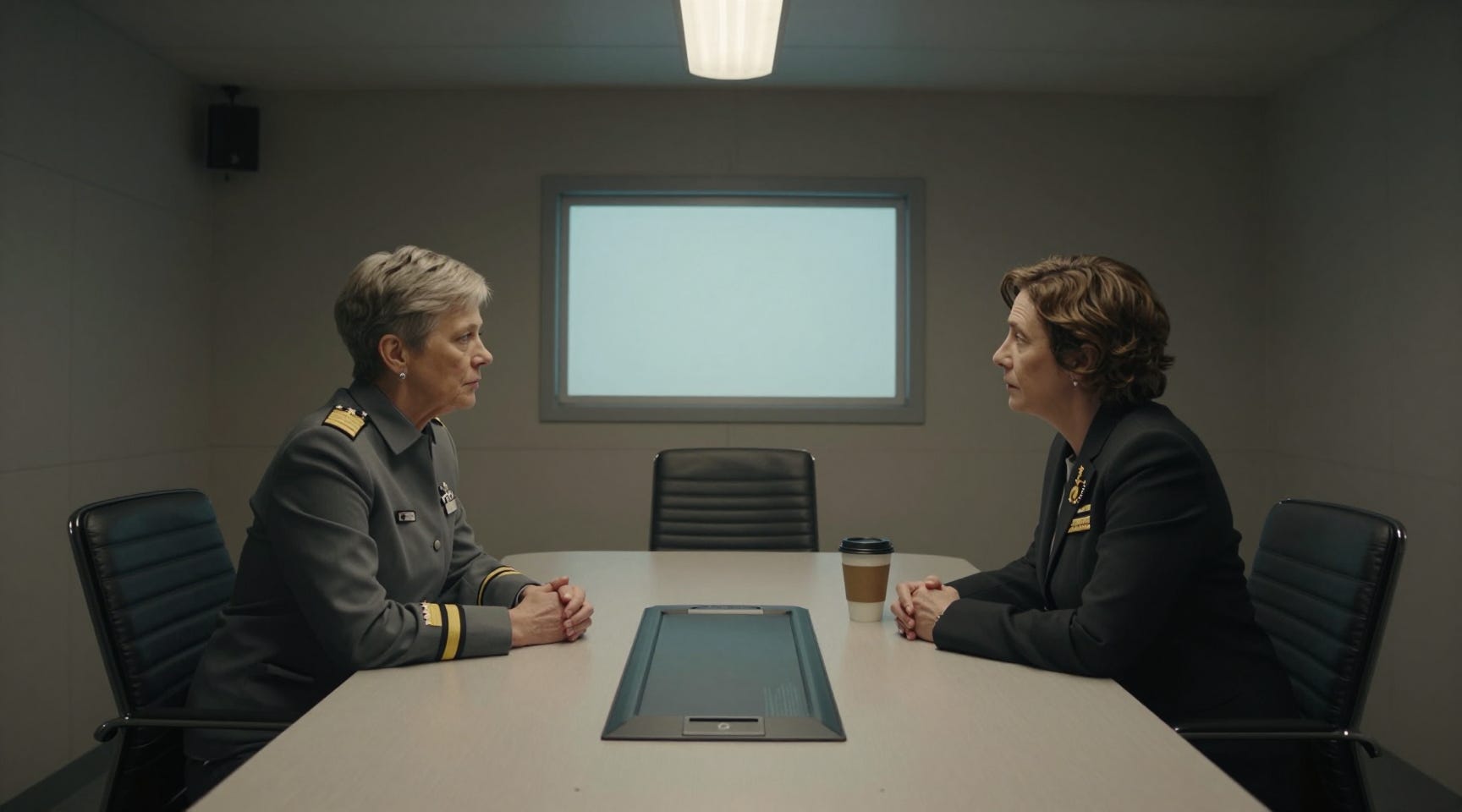
The conference room on twenty-two was smaller than the Ash Room and had no cameras. A holoprojection plate dominated the table, its protective film still on the edges. The shipyards had called the plate a gift. Chen kept the film on. Removing it would have been accepting a bribe, and she knew it.
Villanueva arrived at 0800 exactly.
The senator wore the same charcoal jacket, the same gold seam of the Pacific reconstruction coalition pinned on her left breast. She carried a tablet and a lobby coffee. She closed the door behind her and sat without waiting for an invitation.
“Admiral.”
“Senator.”
“Thank you for doing this on short notice.” Villanueva set her coffee on the table in its cardboard cup. A civilian gesture in a room built for ceremony. Chen noted it. “My staff tells me the First Three have been on patrol for nine days. I have read the situation reports. I have questions those reports cannot answer.”
“That is what briefing rooms are for.”
“I am not sure this is a briefing.”
Chen waited.
Villanueva opened her tablet to a single page. Questions, written in order, in a font the senator had chosen herself. Not staff work. Prepared.
“Fold-readiness status across all three ships.”
Chen gave her the numbers. Vanguard at ninety-four percent certification. Defiant at eighty-eight. Hope at ninety-one. The gap on Defiant was a maintenance backlog Marcus Rivera had flagged himself in the 0500 report. Chen gave her that too.
Villanueva made a mark and did not comment on the gap. Chen revised her estimate of the senator’s preparation upward.
“Crew morale.”
Chen had not expected the question in that language. The Fleet language was unit cohesion, readiness indices. Morale was a civilian word. The right word.
“Improving,” Chen said. “The crews have settled. The patrol is uneventful. For a warship’s first patrol, uneventful is the point.”
“Has anyone frozen at a station?”
“Why do you ask?”
“Because the captain of Defiant has a history of freezing under stress and I know it and you know it and you put him in the chair anyway. I am not asking whether that was a mistake. I am asking whether he has frozen.”
Chen made a decision. Villanueva had done her reading so thoroughly the standard answers were not going to hold.
“He has not frozen. He has performed.” She paused. “He is not sleeping. His biometrics are yellow. His CMO is watching. His XO is his brother and that is either the best decision I have made in two years or the worst one. I will not know for another month.”
Villanueva wrote something on her tablet that was longer than a check mark.
“You are being honest with me.” Villanueva’s voice was still even, still without theater. There was something in it now that had not been there in the Ash Room. “Why?”
Chen considered the question. The honest answer was a paragraph she had been writing for two years and had never said aloud. The paragraph was true. The paragraph was too personal.
“I need a senator who asks real questions,” Chen said. “The appropriations subcommittee has thirty-seven members. Thirty-six of them ask questions someone else wrote. You are the thirty-seventh.”
Villanueva closed her tablet. She looked at Chen.
“Then let me ask you the real one.”
Chen waited.
“The patrol is uneventful. Every report from Fleet says the same thing in the same language.” Villanueva leaned forward. “Admiral. What happens when it stops being uneventful? Not the tactical answer. The answer you have been writing in your head for eleven years.”
The question landed in Chen’s chest the way a sentence landed when you had been waiting for someone else to say it aloud.
“Three ships,” Chen said. “Three ships against a force we have no tactical intelligence on. I have spent eleven years building the case that these three ships are the beginning of something. They could also be the end. If we respond wrong, we lose the ships, the argument, and the political capital to build the next ten. If we respond right, we lose people and learn something and build the next fleet faster. I do not know which one is coming. I know I wake up every morning waiting to find out.”
The hum of the building’s air recycling filled the silence.
Villanueva picked up her coffee, took a sip that had gone cold, and set it back down. She did not grimace.
“I have been telling my colleagues you are competent. You are serious. The money is worth spending. I have not been telling them I trust you, because trust is not a legislative word.” She stood. “I am going to adjust my language.”
She walked to the door and stopped.
“Admiral. I am not against you. I am against being lied to. Do not lie to me.”
“I will not.”
Villanueva held her gaze. Then she nodded and walked out, and the room was empty of everything except the cold coffee and the holoplate with its protective film and the question Chen had been answering for eleven years without anyone asking.
What happens when the patrol stops being uneventful?
The office faced north over the reconstruction grid. Chen closed the door and did not turn on the overhead. The desk lamp threw its small yellow circle over the blotter. She sat down inside it and opened the blank document she had been opening for two years.
She wrote one sentence.
She had written it before in seventeen versions over eleven years. She had never been sure it was the right sentence. She was still not sure. The difference was that she no longer needed it to be right. She needed it to be true.
We listen because the silence has cost us before.
She read it. She did not delete it. She saved it and closed the document and sat for another minute, thinking about her grandchildren in their rebuilt district of Cebu and about the senator who had asked the question she had been waiting for.
The silence had cost them before. They were listening now because Helena Chen had built them a fleet to listen with.
She would return to the appropriations subcommittee in the morning.
She would be ready.
If you enjoyed this story, you can follow the main story arc in The Exodus Rush, the first book in The Vethrak Requiem series.