


Dr. Keiko Tanaka unsealed the cryogenic storage unit and watched frost crystals evaporate into the filtered air of Habitat Seven’s agricultural laboratory. Inside, two hundred and forty-three seed packets represented what remained of Earth’s agricultural diversity in this sector.
Two hundred and forty-three varieties. Earth had cultivated over seven thousand food crop species before the invasion.
She lifted the first packet with gloved hands. Wheat. Triticum aestivum. Heritage strain from the Canadian prairies, stored at negative twenty Celsius for four years.
Today was germination day.
Three junior technicians waited at the preparation bench. Yuki Sato had agricultural training. Min-ho Park had worked his family’s farm before Vethrak weapons turned the Korean Peninsula to ash. Lucia Reyes knew hydroponics from colony transport life support.
None of them were trained botanists. Keiko herself was a microbiologist. The real agricultural experts had died when the Vethrak targeted research facilities in the first wave strikes.
The survivors made do.
“We’re starting with wheat,” Keiko said, positioning the packet under the examination light. “Cold-hardy, drought-resistant, ninety-day growing cycle. If these grow, we have flour in three months.”
“If,” Yuki said. “The soil’s wrong. The light’s artificial. Temperature’s unstable.”
“Then we adapt.” Keiko opened the packet, spilling twenty-three wheat seeds onto the sterile tray. Each held thousands of years of human agriculture. “We document everything. Germination rates, growth patterns, yields. Every failure teaches us. Every success builds a foundation.”
She distributed seeds between four growing trays, each with different soil mixtures. Tray one: treated regolith. Tray two: recycled organic matter. Tray three: hybrid mixture. Tray four: pure hydroponics.
Twenty-three seeds. Four approaches. Twelve weeks for results.
Keiko planted the first seed, pressing it into treated regolith with extreme care. This was dangerous. If crops failed, survival probability dropped into grim territory.
Food stockpiles would last eight months. Maybe ten with harder rationing. After that, humanity needed to grow food or make difficult decisions about who ate.
“Dr. Tanaka,” Min-ho said. “Tray one pH reads too alkaline.”
Keiko checked. Point eight above optimal. The margin between success and failure measured in decimal points.
“Add phosphoric acid,” she said. “Conservative dosing.”
They worked through the afternoon, planting wheat, documenting variables, photographing each step. The work felt sacred—a ritual of hope while humanity’s survivors fought to hold on.
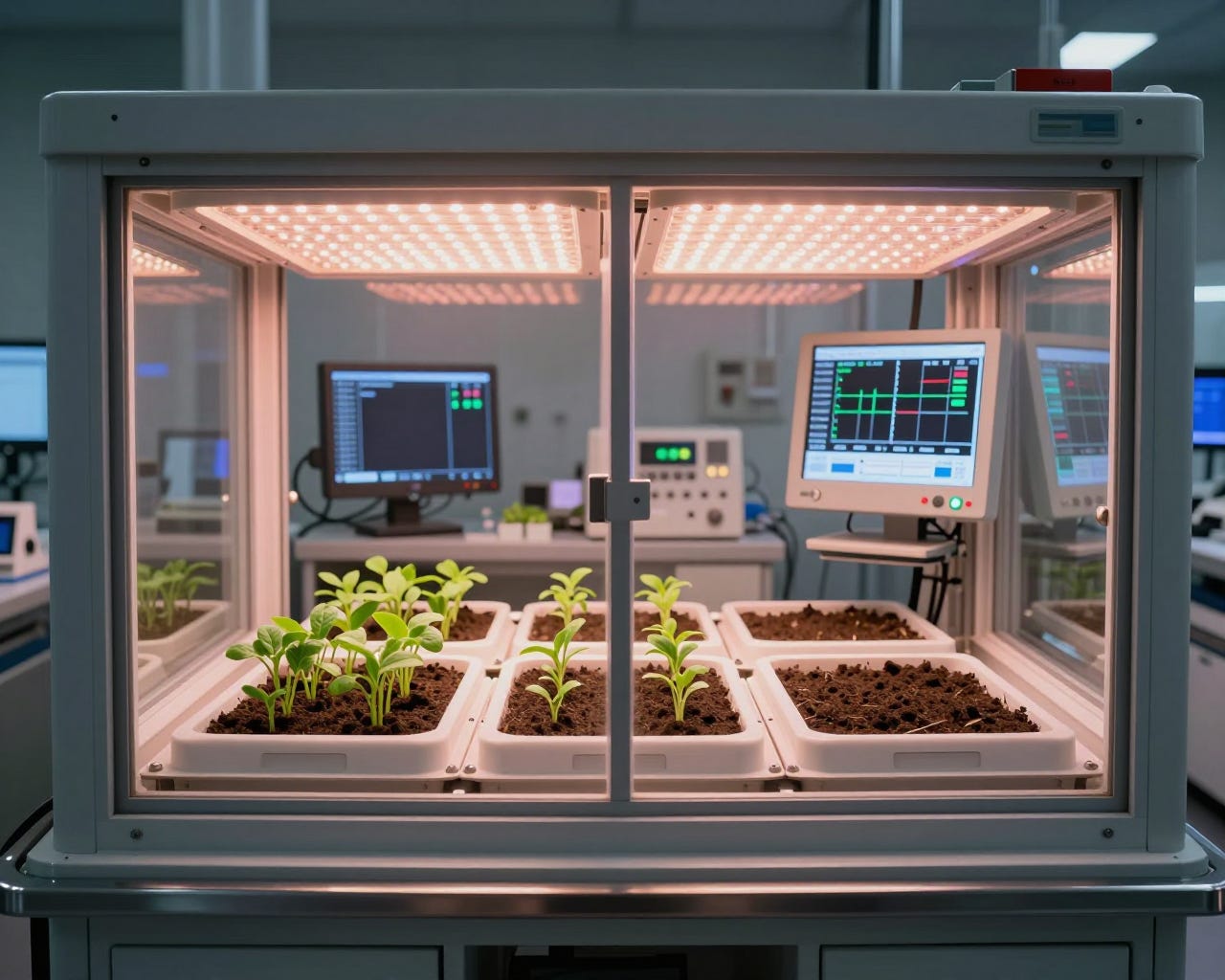
Keiko sealed the trays and transferred them to the environmental chamber. Controlled lighting and temperature would simulate Earth’s growing season. Approximate it, at least. The LED spectrum mimicked sunlight. Temperature cycled between eighteen and twenty-four Celsius.
Close enough. The vocabulary of people without the luxury of precision.
“How long?” Lucia asked.
“Seven to ten days for germination,” Keiko said. “If we see shoots, we celebrate. If not, we try again.”
Yuki smiled, tired. “What’s next?”
“Rice.” Keiko pulled another packet. “Humanity’s survived on rice for ten thousand years. Maybe a little longer.”
They planted rice in the same configuration, documenting everything, learning in real time. The work continued through shift change, through meal breaks of protein paste and supplements, through fatigue born from knowing each decision carried consequences measured in lives.
At twenty-two hundred hours, Keiko sealed the last rice tray. Forty-six seeds planted. Eight configurations. The beginning of sustainable agriculture or another failure in humanity’s post-invasion catalog.
“Get rest,” she told the technicians. “We check status in three days.”
They left in exhausted silence. Keiko remained, staring at the environmental chamber’s observation window, watching grow lights cycle through their sequence.
She thought about Earth. About wheat fields in Canada, golden across prairies that no longer existed. About rice paddies in Asia, terraced into mountainsides now turned to ash. About ten billion dead before humanity learned to run.
The agricultural scientists died early. Seed banks burned. Genetic repositories destroyed with precision that suggested the Vethrak understood what they were taking.
What remained fit in one cryogenic unit.
Two hundred and forty-three seed varieties. Wheat, rice, corn, soybeans, potatoes, tomatoes. Each packet held twenty to thirty seeds—the genetic foundation of human food production.
Forty-six planted today. One hundred ninety-seven waiting. Each a gamble to adapt Earth’s legacy to alien worlds with wrong soil, wrong light, wrong everything.
Keiko made notes. Observations, hypotheses, plans. Scientific method applied to problems requiring miracles.
She sealed the laboratory. Habitat corridors were quiet, most residents sleeping through another night in exile. She passed the dining hall where tomorrow’s meals were being prepared. Protein paste. Vitamin supplements. Freeze-dried vegetables from shrinking stores.
In three months, maybe those meals could include bread. Rice. Fresh vegetables not from depleting stockpiles.
Or the seeds would fail, and humanity would eat paste until stores ran out, then make decisions nobody wanted to make.
Keiko reached her quarters and collapsed onto her bunk. Sleep came quickly—the exhaustion of someone who’d bet humanity’s future on forty-six seeds.
Seven days later, the monitoring system alerted at zero-four-hundred hours. Keiko ran through habitat corridors half-asleep, praying for growth, not failure.
The environmental chamber glowed with soft LED light. Inside, the trays sat undisturbed except for one change that tightened her throat.
Tray three. Hybrid soil. Wheat. Seven days.
Green shoots. Thin, delicate, emerging like promises.
Six seedlings from twenty-three seeds. Twenty-six percent germination. Low by Earth standards, catastrophic for commercial agriculture, miraculous for a lab testing alien soil three hundred light-years from home.
Keiko photographed from multiple angles, recorded measurements, adjusted controls. Careful, precise, hands steady despite adrenaline.
Six seedlings. The beginning of wheat cultivation on an alien world.
The beginning of hope.
She notified command staff, flagged results for the research briefing, updated her log. Work continued until morning shift, when Yuki arrived and stopped dead, staring at green shoots through the observation window.
“They grew,” Yuki whispered.
“Some.” Keiko gestured at documentation. “Twenty-six percent germination. Tray three, hybrid soil. One, two, and four showed nothing. Rice hasn’t sprouted yet.”
Yuki studied the seedlings with professional assessment bordering on worship. “We can feed people. Actually feed them.”
“Eventually.” Keiko pulled up projections. “Six plants might produce seed heads in ninety days. Sixty grams per plant. Three hundred sixty total. Two small loaves of bread, if the grain develops and we can mill it.”
“Two loaves from six months of work.”
“Two loaves proving we can grow Earth crops in alien soil,” Keiko corrected. “Next cycle, optimized mixtures, refined controls, new knowledge. Better germination. Higher yields. We scale from six plants to sixty, to six hundred, to fields supporting the population.”
“How long?”
Keiko calculated timelines, constraints, probability curves. “Two years for reliable production. Three to reduce Earth stockpile dependence. Five for food security.”
Five years. If crops grew. If seeds adapted. If humanity held on.
“We’ll get there,” Yuki said, staring at the shoots.
“We’ll get there,” Keiko agreed.
One seed at a time.
They’d survive.
Author’s Note: This story takes place in Year 4 (2129), during the early Survival Era when humanity was establishing agricultural capacity in the colonies. The Vethrak had destroyed Earth’s agricultural infrastructure, seed banks, and research facilities, recognizing food production as a strategic vulnerability. Survivors carried limited seed stocks in cryogenic storage, representing a fraction of pre-invasion crop diversity. Dr. Keiko Tanaka led agricultural research at Habitat Seven, adapting Earth crops to alien soil conditions. Her work established protocols that allowed humanity’s colonies to achieve food security by Year 8. The wheat variety she germinated became the primary grain crop across seventeen colony worlds.
If you enjoyed this story, you can follow the main story arc in The Exodus Rush, the first book in The Vethrak Requiem series.