


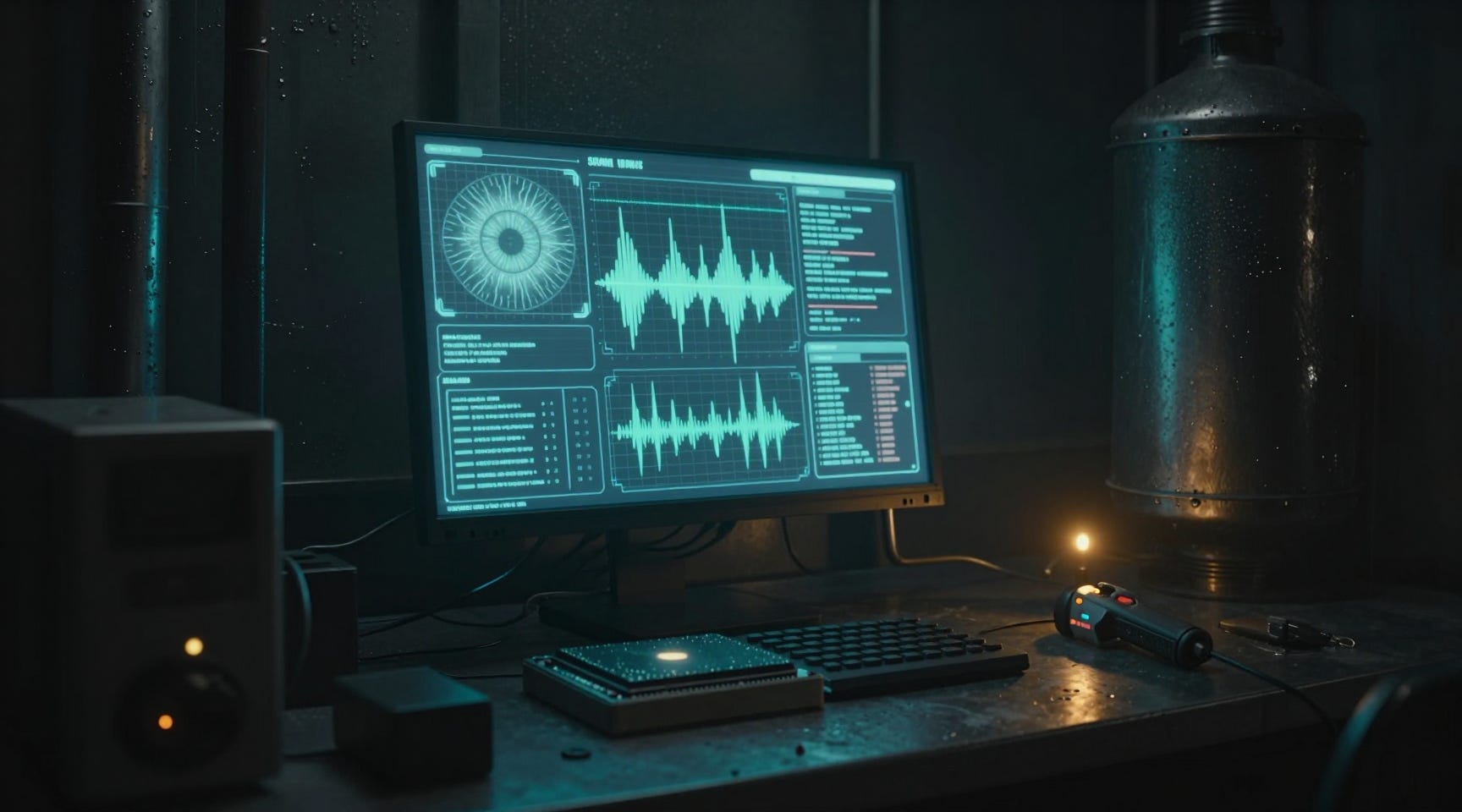
The biometric scanner hummed against Tatiana Ashworth’s fingertips, warm from three hours of continuous use. She held it over the girl’s left wrist, watching the display populate with vein-pattern data, capillary mapping, subdermal temperature gradients. Every human being carried a signature beneath their skin that no two people shared. Her job was to make one person’s signature look like another’s.
“Hold still.” Tatiana adjusted the scanner angle. The girl’s wrist was thin, malnourished-thin, the kind of thin that came from eighteen months on a cascade reactor maintenance crew where caloric intake matched output calculations rather than human need. “I need the radial artery mapping clean.”
Karla Guerrero sat on a metal stool in the back room of a water reclamation shop on Titan’s Meridian settlement. Sixteen years old, according to the intake contract the Copperline syndicate had filed with the settlement’s labor bureau. The contract listed her as a voluntary apprentice. The bruises on her forearms told a different story.
“How long does it take?” Karla’s voice was steady, which surprised Tatiana. Most clients couldn’t keep still. Their hands shook, their eyes tracked every sound from the corridor outside, their breath came in short pulls that disrupted the scanner’s thermal baseline.
“Twenty minutes for the scan. Another hour for the overlay build.” Tatiana pulled the scanner back and checked the capture. Clean. The vein-pattern data was dense enough to work with, despite the girl’s low body mass. “Then I burn the new profile onto a chip, and you walk into the UEN processing center on Level Four with a different name and a biometric record that matches someone who doesn’t exist.”
“Someone who doesn’t owe the Copperline anything.”
“Someone who never worked for them.”
Karla looked at her own wrist as if she could see what the scanner had captured. “The contract says I owe them four more years.”
“The contract says what they wrote on it.” Tatiana set the scanner on the workbench and opened her fabrication software. The display filled with biometric layers: vein geometry, iris topography, voiceprint frequencies, dermal electrical conductivity. Each layer needed modification. Each modification needed to pass the UEN’s civilian registration system without triggering pattern-match alerts.
The UEN system checked new registrations against a database of eleven million surviving humans. Every scan, every print, every voice sample filed since Year One. If Tatiana’s overlay matched an existing record too closely, the system flagged it. If the overlay strayed too far from human biological norms, the system flagged it. The margin she worked in was narrow enough to make her teeth ache.
She pulled a template from her archive. Stolen. Every template in the archive had been copied from UEN civilian databases through a maintenance access port that a sympathetic technician left unlocked for ninety seconds every third Thursday. Tatiana paid for those ninety seconds with thermal credits she earned from the same syndicate economy she was trying to help people escape. The irony lived in her chest like a low-grade fever, constant and impossible to treat.
Template 7719. Female, age range 14-18, biometric baseline within acceptable deviation of Karla’s natural readings. Tatiana began the overlay process, adjusting vein-pattern geometry point by point, threading the fabricated data between the template’s parameters and Karla’s actual biology. Too close to the template, the system would flag a duplicate. Too close to Karla’s real scan, and a Copperline enforcement officer running a search for missing contract workers would find her in minutes.
“My brother is still on the crew.” Karla said it without inflection, the way people stated atmospheric pressure readings or thermal credit balances. Fact. Condition. Not something that could be changed by the way you said it.
Tatiana’s fingers paused on the interface. “How old?”
“Thirteen.”
Thirteen. Cascade reactor maintenance involved radiation exposure, chemical handling, confined-space operations in thermal suits rated for adult body frames. The Copperline didn’t adjust equipment for smaller workers. They adjusted quotas.
“I can build two overlays.” The words left her mouth before the calculation finished in her head. Two overlays meant two stolen templates. Two templates meant she needed the maintenance port open for a hundred and eighty seconds instead of ninety. The technician who left the port unlocked charged by the second. Ninety seconds already cost Tatiana three weeks of thermal credit earnings. A hundred and eighty would cost six.
Six weeks. She ran the numbers the way she ran every number in this room: with the understanding that mathematics was the only honest language left in a settlement where everyone traded in lies.
“I can’t pay for two.” Karla’s voice didn’t waver, which made it worse.
“I know.”
Tatiana pulled up template 7720. Male, age range 11-15. The biometric baseline was rougher, captured from a registration entry with lower scanner resolution. She could work with it. The overlay would take longer, the margins would be tighter, the risk of a pattern-match flag would climb from three percent to something closer to eight.
Eight percent. One in twelve. Those were the odds that a thirteen-year-old boy would walk into the UEN processing center on Level Four and walk out as someone free, instead of triggering an alert that would bring Copperline enforcement to the reclamation shop within hours.
Tatiana saved the first overlay to a chip the size of a fingernail. She handed it to Karla. “Level Four. Registration desk. Give them this and your new name. Daria Voss. Say it.”
“Daria Voss.”
“Processing takes forty minutes. Don’t leave the desk. Don’t make eye contact with the security detail. When they hand you your new citizen card, walk to the transit hub on Level Two and take the first shuttle to Enceladus Station. The Copperline doesn’t operate past Saturn’s rings.”
Karla took the chip. Her fingers closed around it with the careful precision of someone who understood that small objects could hold enormous weight.
“Come back tomorrow at this time. Bring your brother. Don’t tell anyone where you’re going or why.”
The girl left through the back corridor, past stacked water reclamation filters and coiled piping that smelled of chemical treatment compound. Tatiana listened to her footsteps fade, then turned back to the fabrication display. Template 7720 glowed on the screen, waiting for modifications that would cost six weeks of earnings and carry an eight-percent chance of ending everything she had built in this back room.
She opened the overlay tools and began adjusting the first data point.
The math was terrible. She did it anyway.
Author’s Note: Biometric forgery operations emerged across Saturn’s moons by Year 14, driven by the expansion of syndicate labor contracts that bound workers, including minors, to multi-year terms with no legal exit mechanism. The UEN’s civilian registration system, designed during the chaos of the early Post-Invasion years, contained structural vulnerabilities that skilled forgers could exploit to create new identities for contract refugees. By Year 16, the Copperline syndicate’s Titan operations alone held an estimated three thousand active labor contracts, of which UEN oversight boards had reviewed fewer than two hundred.
If you enjoyed this story, you can follow the main story arc in The Exodus Rush, the first book in The Vethrak Requiem series.