


Wanjiku Bett held the inspection lamp across the weld until its shadow reached the plate beyond it.
Nothing opened. The narrow ridge remained straight. Article Four looked as whole as it had before the proof actuators put force through it.
She clipped the lamp to the scaffold and checked the access clearance again. Zero load confirmed. Actuators isolated. Mechanical capture engaged. The short barrel rested in Slip Two’s rock-anchored cradle, its open ends waiting to join pressure hulls elsewhere. Wanjiku needed no destination address to inspect the steel in front of her.
During proof, two groups of acoustic signals had crossed the pickups in the same order as the second-stage force came off. Strain had stayed within limits. Wanjiku had stopped the test before its planned maximum. The structural-test tag still hung from the fixture, and the release field remained empty.
The technician secured his boots beside hers. He held the ultrasonic probe in its captive sleeve, clear of the plate.
“Reference first,” she said.
He fastened the calibration block into the scaffold bracket. Known reflectors inside it returned echoes at known depths. Wanjiku checked those responses against the saved examination setup: range, sensitivity, probe identity, and the recorded surface correction.
The peaks occupied their expected positions.
“Gain unchanged,” he said.
She compared the stored value herself. Raising it could turn a small response into an alarming picture. Lowering it could give Cho a reassuring one. Neither would change the steel.
“Save this check beside the original.”
The block stayed clipped within reach. Behind them, the crane straps lay slack and secured away from the cradle. No load would move while they worked.
They photographed the acoustic pickups and cable paths before clearing only the attachments that obstructed the scan. Each removed sensor went into a retained sleeve with its position recorded. Wanjiku would need the sound map afterward, even if the probe found nothing.
The technician spread a measured film of coupling gel along the first examination path. It clung to the steel. He pressed the probe against it and advanced beside the weld, his other hand controlling the tethered lead.
A short echo rose on the display.
He stopped.
“Centerline?” Wanjiku asked.
“Past it. Plate side.”
She matched the probe position to the retained joint diagram. The response lay beyond the deposited weld metal, in the narrow band the joining heat had changed. A heat-affected zone. The surface under her lamp carried no corresponding line.
“Keep the whole pass. Return through it.”
The echo returned at the same position. A short cluster of responses followed along that band, separated by quiet steel.
Wanjiku left their interpretation field open.
A curved interface could send a harmless geometric reflection back to the probe. Poor coupling could make the picture unreliable. The sound had given them a reason to look here, and a reason to distrust how much they wanted an answer.
They repeated the pass after checking contact. The positions held.
At the second transition, another short group appeared beside the weld. The third gave them a similar response. Wanjiku traced each plate link back to the work package.
The indications occupied the same material side at all three joints.
Tuva Hawthorne reached the cleared access rail while they saved the third pass. Her torch remained locked away. She drew herself close enough to read the location diagram without touching the examination surface.
“Three?”
“Three locations with repeatable indications. We haven’t finished verifying them.”
Tuva’s hand tightened on the rail. “Mine were clean.”
“We kept those scans.”
Wanjiku brought the reference block back into the lamp’s reach.
The second qualified probe angle passed its reference check. They retained the new setup beside the first instead of replacing it.
At the first joint, the technician turned the sound path through the suspect band from a different direction. The echo changed in strength. Its reconstructed position stayed beside the weld.
Wanjiku entered that distinction before they moved.
They released their boot restraints and clipped along the inner access rail through the barrel’s open end. The probe case traveled on a shortened tether; nothing drifted into the cradle connections. From the inner face, the technician repeated the examination across the same plate region.
The indications remained.
Different approach. Different reflection path. The same small volumes of steel answering them.
They completed those checks at the other two transitions and repeated the reference afterward. Calibration remained within limits. The defect responses survived the changes of angle and face.
At the terminal bracket, Wanjiku opened the preserved post-weld scans. Their coverage crossed the positions she had now marked. Same registered locations, recorded settings, and adequate access. No gap in the old examination that conveniently explained the new picture.
The earlier traces were clean within their resolution.
She placed them beside today’s data without altering either scale.
Tuva stayed at the rail. “Did we miss them?”
“We couldn’t resolve these indications before proof. We can now.”
“They could have been smaller.”
“Yes. That stays in the record.”
Wanjiku saved the comparison. It established a measurable change after loading. It could not tell her whether an invisible precursor had existed when Tuva signed the weld execution, or why that material had changed.
The depth estimates occupied a shallow band near the surface, far short of the plate’s full thickness. Short planar reflectors, verified from different directions. Small cracks in metal that still looked intact.
She entered shallow microcracking in the heat-affected zones, with the measured extents and sizing limits attached. The weld centerlines remained outside those mapped indications.
The acoustic diagram supplied a separate comparison. The affected transitions matched the regions implicated by the repeatable arrival order. That agreement strengthened the case for examining every transition. It did not turn the order of sound into a crack running through the whole barrel.
She linked both records and left the cause unassigned.
Cho called while Wanjiku checked the last saved location against the plate.
“How deep?”
She gave him the bounded estimates.
“No through-wall crack?”
“None established by this examination. That doesn’t give us structural release.”
His screen showed the fixed outbound window beside her scan reservation. More examination would occupy the fixture and another crew block. A false alarm had a cost. A crack dismissed for its size would travel to people who could not ask the blank hull who had inspected it.
Cho rubbed the edge of his slate clip.
“What status can I carry?”
Wanjiku entered the disposition and read it aloud.
“Structural nonconformance under investigation. No further proof loading or transfer. Map every mixed-lot transition, full required coverage. Retain the baselines, today’s scans, and the acoustic record.”
He repeated the hold before attaching it to the schedule.
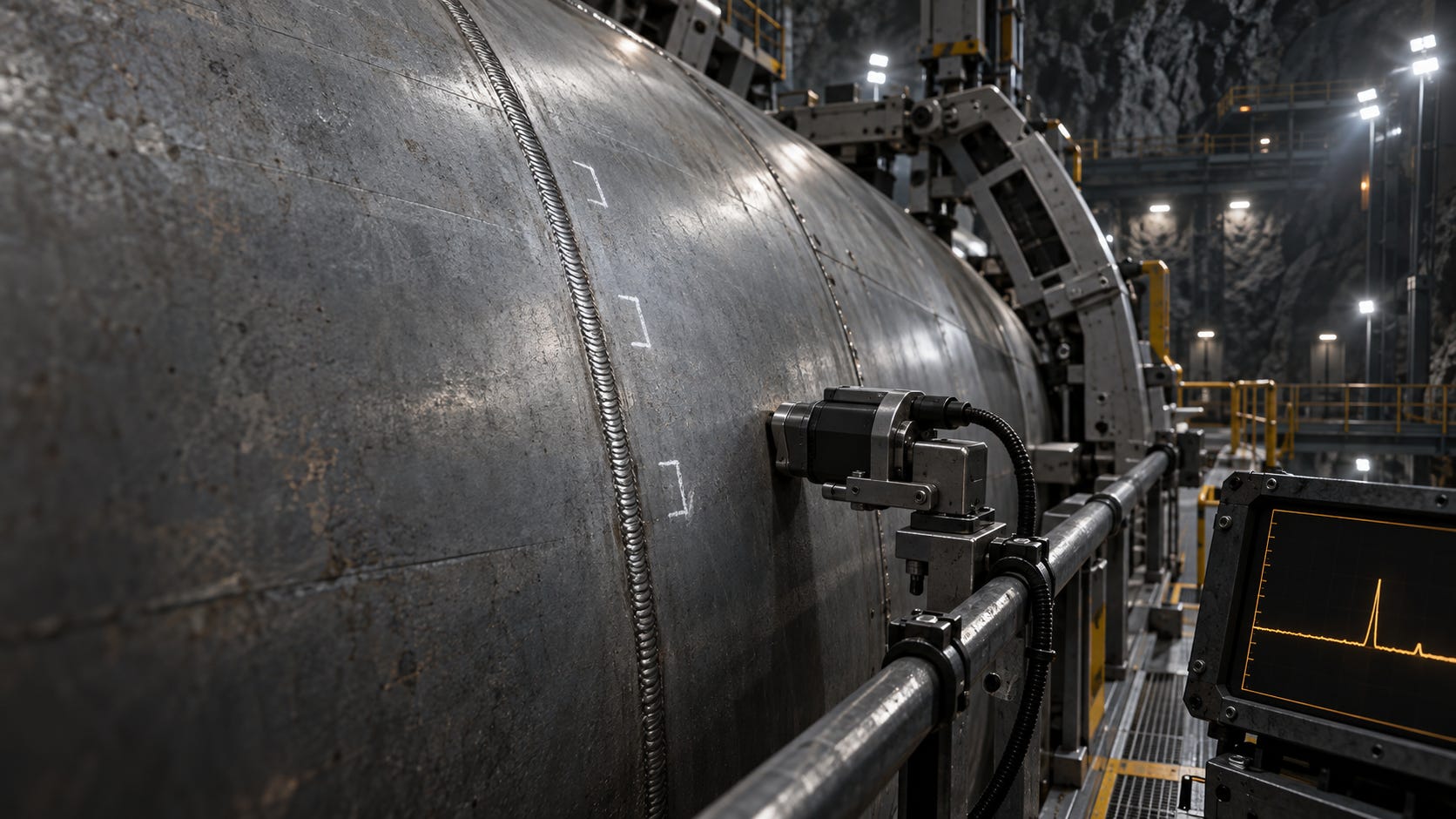
Tuva secured a chalk holder to the scaffold. Wanjiku clipped its tether to her harness before releasing it from the holder. She drew a short bracket beside the first verified indication, leaving the probe path clear. The technician matched the mark to the saved coordinates and photographed it with the joint reference.
The chalk was temporary. The finding would remain in the signed record after someone cleaned the plate.
She pulled along the rail to the next location and marked its limits. The lamp crossed each finished weld without catching an opening. White brackets accumulated on one side of the seams, small enough to pass beneath a glove.
Article Four had no name on its skin.
By the time she reached the third joint, it had places nobody was allowed to overlook.
Author’s note: This story continues the Site Anvil arc in late Year 3, after Article Four’s first proof test is halted. An anonymous hull still needs an inspection record that can distinguish what looked whole from what the instruments established.
New to The Vethrak Requiem? Start with The Exodus Rush, Book 1, where humanity fights for survival after an alien invasion using technology it barely understands. These short stories explore the wider universe; the novel begins the main story.