


The fragment turned end over end against a backdrop of nothing.
It was a chunk of Vethrak hull plating roughly the size of an orbital lifeboat, fracture-edged on three sides, and somewhere inside the warped lattice of its mid-section was a power cell. The cell’s thermal bloom pulsed in Anya Rask’s visor overlay, a slow steady amber that meant intact, charged, recoverable. She had a clean read on it. She could not reach it.
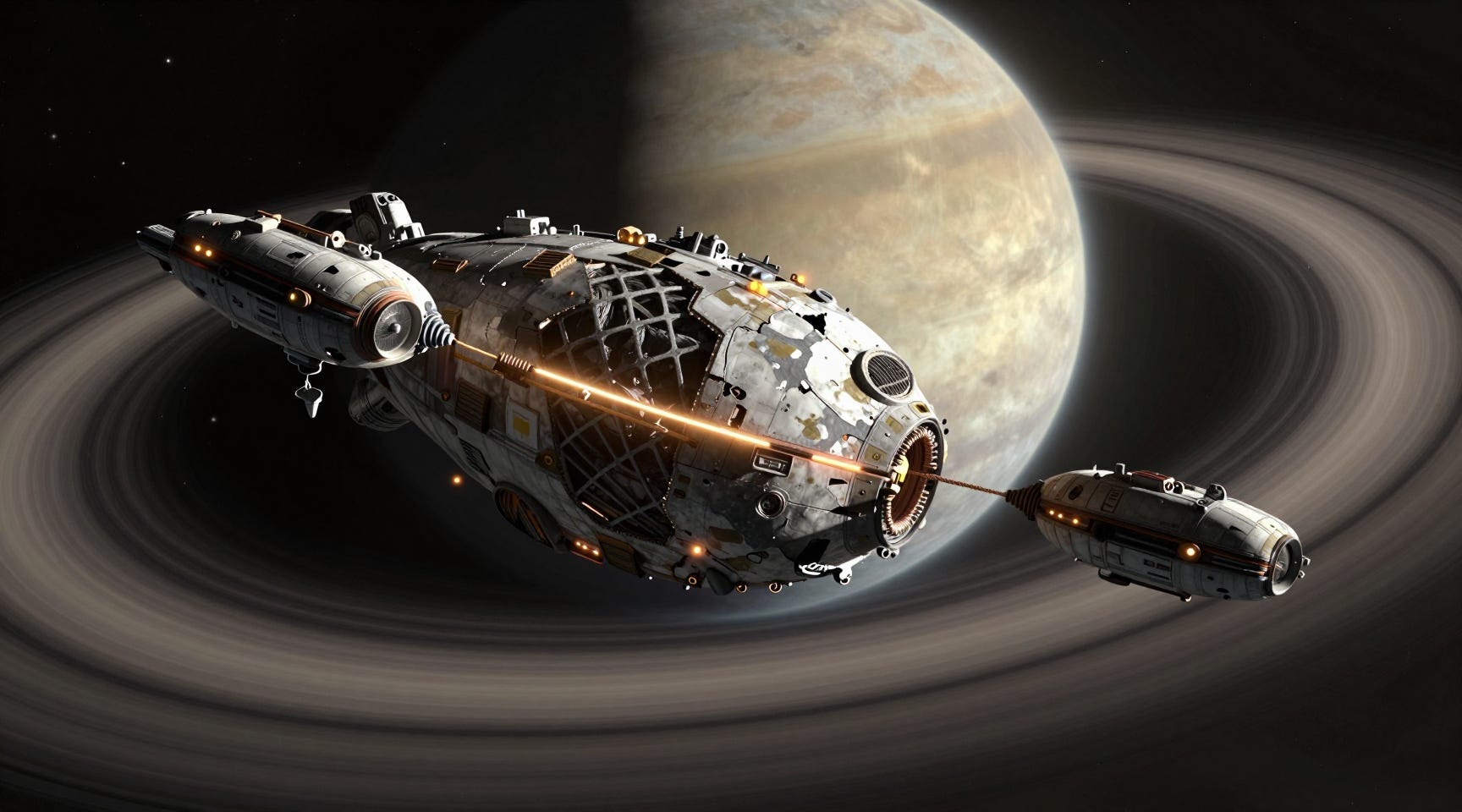
The Saltline drift was a thin debris field at the outer edge of Saturn’s E ring, low density, mostly slag and torn structural foam, the kind of place a salvager went when the high-yield zones were already claimed by larger crews. The cell was the only thing in twelve hours of sweep that was worth the suit time. The fragment was tumbling on three axes at once.
She had run the math twice. To stabilize the rotation enough to cut the cell free, she needed two anchor lines on opposing axes, applied in the same sixty-second window. The Underweight had one tow tether and one EVA worker. Her math came out the same both times.
The fragment turned past her again. The amber light in her overlay flickered as the cell swung out of line of sight. She set her boots against the skiff’s outer plate and watched the rotation cycle through. Twelve seconds per full tumble. Five of those rotations per minute. Three minutes left of suit margin before she had to cycle back inside for thermal recovery.
A comm hail came in on the open salvage channel.
“Skiff Underweight, this is skiff Halfwater. You working that piece or are you watching it?”
The voice was older than hers. Dry. The ring-belt vowels sat flat and unhurried, the kind of accent that came from spending more years in a habitat module than on any planet’s surface.
Anya keyed the channel. “Working it.”
“You’re alone.”
“Yes.”
“You’re going to lose it.”
The silence after was not rude. It was the silence of someone waiting to see if the truth was going to be argued with.
Anya watched the fragment turn. The cell’s thermal bloom rolled out of sight, came back, rolled out again.
“What are you offering,” she said.
“Forty-sixty in your favor. I bring my second tether and my second pair of hands.”
“Fifty-fifty, or I keep watching.”
Three seconds.
“Fifty-fifty,” the voice said. “Coming around your starboard.”
The other skiff resolved out of the drift on a clean approach vector. It was older than the Underweight by a decade, paint scoured down to bare hull on the leeward side, but the maneuver thrust was crisp. Whoever was flying had not been flying for fifteen minutes.
The pilot came up on a private channel. “Maren Holvaag.”
“Anya Rask.”
“Your overlay shows the cell.”
“Mid-section, port-aft pocket.”
“Confirmed. I’ll take the dorsal axis. You take ventral. On three, we kill the spin. You have ninety seconds to cut.”
“Acknowledged.”
They worked without further talk. Maren’s tether deployed first, a clean magnetic-grapple shot that took the fragment’s dorsal corner and held. Anya’s launched a half-second later from the opposing face, locked, drew taut. The two skiffs braced against the drag and the Underweight’s frame creaked through her boots.
The fragment slowed.
It did not stop. Two tethers on a piece of debris that size would not stop it. They bled the rotation down to a slow steady drift, one axis instead of three, and that was all they needed.
Anya kicked off the Underweight’s plate.
The crossing took eleven seconds. Her boots found purchase on the fragment’s pocked surface. The plasma lance came off her hip rig and she keyed it live and walked the cutting line along the seam she had already mapped from a hundred meters out.
Maren’s voice came through her suit comm, low. “You’ve got telemetry drift on your right tether. Three degrees and climbing.”
“Acknowledged. Cutting.”
The lance bit. The lattice peeled. The cell came out of its pocket in a slow drifting tumble of its own, intact, the thermal bloom no longer a guess but a hard line on her sensor. Anya caught it with a magnetic clamp and set it against her chest harness.
“Got it.”
“Releasing dorsal in five.”
“Releasing ventral on your mark.”
They unhooked. The fragment resumed its tumble and was once again somebody else’s problem, or nobody’s. Anya crossed back to the Underweight and cycled through her airlock with the cell still clamped to her harness. Maren’s skiff held station at fifty meters.
The cabin smelled of recycled coffee and old wiring insulation. Anya racked her helmet, unzipped the upper layer of her suit to her waist, and set the cell into the Underweight’s containment cradle. The cradle’s seal chimed green.
Maren cycled through twenty minutes later. She was a head shorter than Anya, ring-belt thin, her hair grey and cropped close. Her suit was older too, panels patched in three places with the kind of careful workshop weld that meant she had done it herself.
Anya poured two cups from the thermos. The coffee was its third pass through the recycler. It tasted of the recycler.
Maren took the cup with a nod.
They drank in the cabin chair quiet for a span of minutes. The cell’s containment hum sat under the thrum of the Underweight’s environmental loop. Outside the porthole, the drift turned slow against a backdrop of ring-shadow.
“You’ve worked this region long,” Anya said.
“Six months. Pre-invasion I was on Mars.”
“Mars.”
“Yes.”
Maren did not say more. Her hands sat around the cup in a way that did not invite the next question. Anya watched the thermal bloom on the containment cradle pulse its slow amber and did not ask.
After a while Maren said, “I had a daughter.”
Anya nodded.
“I had a husband too. They were both there.”
“I’m sorry.”
“You worked the Yard.”
“Nine years.”
“It shows.”
The silence after that one was longer. It did not feel like a silence with an end on it. The coffee went down. Maren set the empty cup on the cabin slab and stood.
“Fifty-fifty’s clean,” she said. “You sell yours, I sell mine. I’ll take my half raw.”
“Acceptable.”
Maren turned at the airlock.
“You comm me on the next find that needs two hands,” she said. “I’ll comm you on mine. No paperwork. The channel.”
“The channel.”
Maren held out a gloved hand. Anya took it. The grip was brief, dry, professional, the kind of handshake two people gave each other when neither of them had any room left for ceremony.
The airlock cycled. Maren cycled out. Her skiff peeled away from the Underweight’s flank ten minutes later on a clean burn back into the drift.
Anya stood at the porthole and watched the Halfwater shrink to a point of running light against the dim backwash of Saturn’s outer ring.
The cell hummed in its cradle. Half of its eventual sale was no longer hers. Half of the work to come, on whatever she found next, was already promised to someone she had spoken to for the first time ninety minutes ago.
Her wrist comm sat on the cabin slab where she had left it that morning.
The shadow-market message was still in the notification queue.
She did not open it.
She did not delete it either.
The ring-shadow turned slow across the porthole.
She sat down in the cabin chair with her boots still on and reached for the second cup.
Author’s note: Day Three of the Iron Wake Origins arc. Anya Rask cannot pull a Vethrak power cell from a tumbling fragment alone. Maren Holvaag, working her own skiff in the Saltline drift, calls over open channel and offers the assist. The negotiation runs a single round. The work runs ninety seconds. The handshake at the airlock is over an open channel, no paperwork, and it is the first piece of the cooperative the Iron Wake will eventually be built from. Maren lost her family on Mars. Anya does not ask the names. The compromise curve continues, but tonight it is a partnership, and that is its own small good thing.
If you enjoyed this story, you can follow the main story arc in The Exodus Rush, the first book in The Vethrak Requiem series.