


Henrique stamped his thumb on the shift terminal at 0558 and the refinery accepted him the way it always did, without comment, with the small green chime that meant another twelve hours of his life had begun.
The Titan corporate clock read local pre-dawn. Outside the pressure window of the supervisor’s cage, the refinery floor stretched away under sodium lights, an acre of cracking towers and distillation columns held inside the inflated hab dome like a clock inside a glass jar. Methane hung in the upper vault as a pale fog that the scrubbers never quite cleared. The smell of it was in his beard by the second hour of any shift. His wife had stopped commenting on it a year ago, which he took as a kindness rather than as the small surrender it probably was.
He pulled up the night supervisor’s handoff. The numbers were where he expected them. Official cracking yield for the overnight shift: 847,000 standard units of refined hydrocarbon distillate, 31,000 units of silicate-glass byproduct, two equipment incidents, no injuries reported. He signed the handoff. He logged his own shift open. He poured the day’s first cup of refinery tea from the thermos he carried from home. His mother-in-law’s blend. The one thing in the dome that did not taste like Titan.
Then he opened the second terminal.
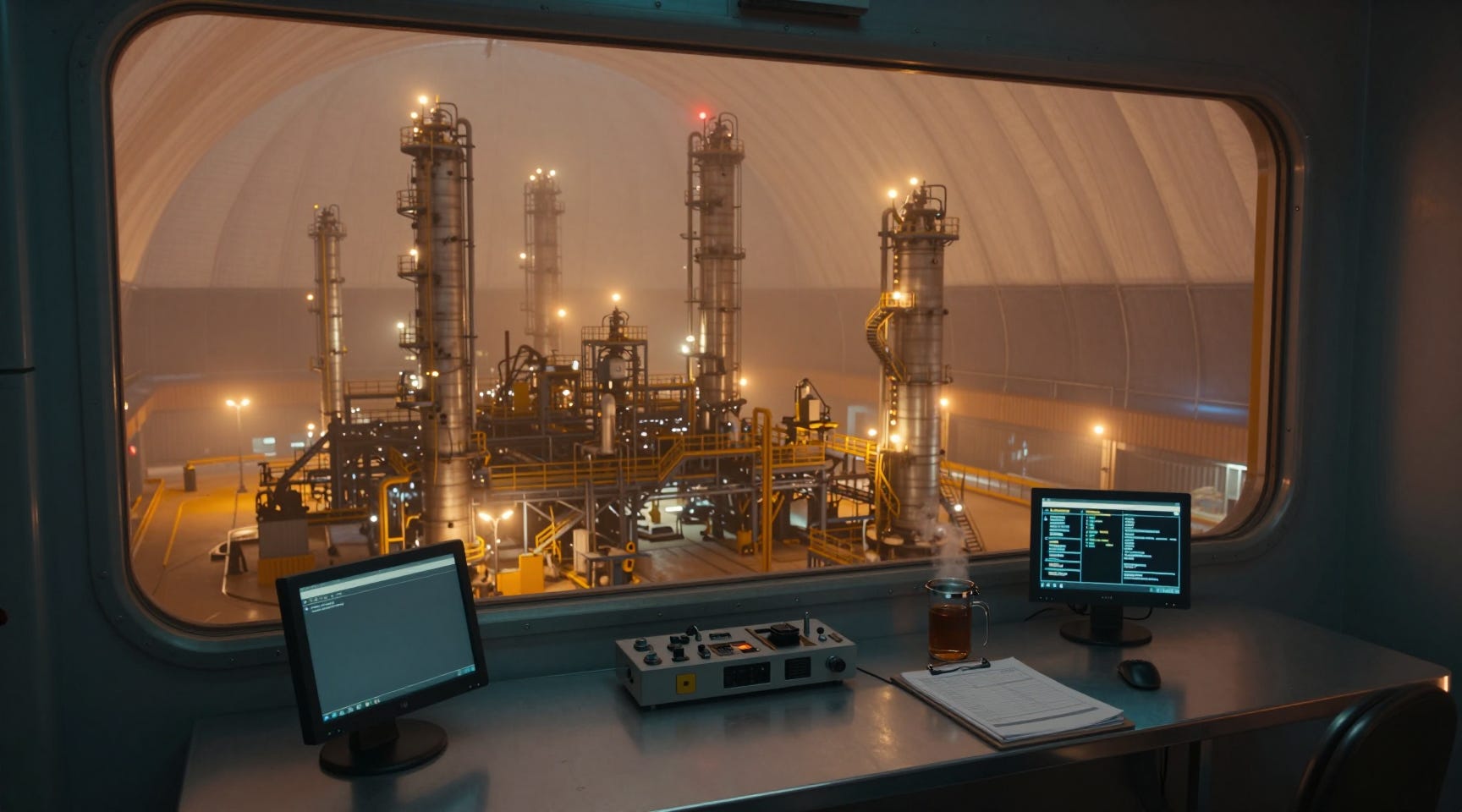
The second terminal was not corporate equipment. He had built it himself, in stages, over fourteen months. The casing was scavenged from a decommissioned scrubber controller. The processor was three generations behind the corporate model and that was the point. The second terminal did not network. The second terminal logged to a single physical chip in a slot Henrique could pull and pocket in under two seconds. Every shift supervisor on his rotation had one. Most of the floor leads had one. Some of the line workers had begun building their own.
The actual cracking yield for the overnight shift had been 891,000 units. The actual silicate-glass byproduct had been 38,500. The difference between actual and reported was the skim, and the skim was the reason eleven families on his deck still had heat.
He balanced the second ledger first. He always did. The corporate one could wait; the corporate one was the polite fiction. The real numbers were the ones that fed people.
His radio chirped. Floor lead Three, Inácio, calling in the early walk-down. “Henrique. Column Six is running two degrees hot. I’m going to walk the catalyst feed. Probably fine.”
“Probably fine” was Inácio’s way of saying he knew exactly what was wrong and did not want it on a recorded channel. Henrique acknowledged and made a note. Column Six’s catalyst feed had been intermittent for nine weeks. Corporate maintenance had a ticket open, scheduled for replacement next quarter. Inácio had been keeping it running on hand-cleaned spares and patience. The corporate ticket existed for the paperwork. The actual repair happened on the second ledger’s schedule.
At 0712 the courier came.
She was new. Henrique had not seen her before. Short, ring-belt frame, EVA-tight movements even on Titan’s heavier gravity, the kind of person who had clearly been born somewhere with less weight than this. She carried a transit clipboard with the bored expression of a freight broker logging a routine pickup. She did not introduce herself. She did not say where she was from. She handed him a manifest stamped for Pallas Station via Enceladus relay, addressed to a courier consortium he did not recognize and did not need to.
“Twelve hundred units of silicate distillate byproduct,” she said. “Standard freight.”
“That’s the manifest number.” He read it once, then signed it without comment.
She countersigned. She tucked the clipboard under her arm. She paused at the door of the cage and looked at him for the first time, a flat assessing glance, and then she nodded once and was gone before he had finished cataloging the look.
Twelve hundred units was the skim. The manifest said standard freight because, in the polite fiction the dome ran on, it was standard freight. The courier consortium was new to him but the routing was familiar. Three months ago the courier traffic had been mostly Ceres-direct. Now more and more of it ran through Enceladus. He did not know what had changed at the courier end. He did not need to. The buyers were buyers; the brokerage took its cut; the worker share came back as a heat allowance for the eleven families on Deck Twelve who had been one billing cycle from losing their habitat lease.
He sat with the second ledger open for a moment after the courier left, looking out at the cracking columns at their work.
His father had been a refinery hand on Earth, in the years before the invasion, in a country that did not exist anymore as a place where refinery hands lived. His father had believed in the legible economy. His father had believed that a man’s labor produced a recorded number and that the recorded number was paid honestly and that the payment fed his family and that the system held. His father had died on Earth with the rest of his city. Henrique had been on Titan, in the dome, the night the sky over São Paulo went white.
The legible economy had not survived his father. Some other thing had grown in its place. The thing had two ledgers. The thing fed people. The thing was not honest in the way his father would have recognized as honesty, and it was not dishonest in the way his father would have recognized as dishonesty either. It was a third thing, and the third thing was what Titan had given him in exchange for his father’s economy, and Henrique had made his peace with the trade.
He closed the second terminal. He pulled the chip. He pocketed it. He balanced the first ledger to match the manifest the courier had just countersigned. The corporate system accepted the numbers without comment, with the small green chime, the way it accepted his thumbprint.
At 1758 he stamped out and walked the long pressure corridor home.
His daughter was awake when he came through the door. She was six and she had no memory of Earth and she did not know any of this. She knew that the apartment was warm. She knew that there was rice on the stove. She knew that her father came home smelling of methane and that he carried her to the kitchen and that he held her for a long minute before he set her down.
He held her for a long minute.
He set her down.
He ate the rice his wife had made, and he did not think about the second ledger, and when he lay down to sleep that night the conscience he had rebuilt from scratch since the invasion was quiet and unaccusing, the way a conscience is when it has been hand-made in the dark by a man who knows exactly what it cost.
Author’s note: Day Twenty-Seven of the Iron Wake Origins arc. Year 3, Month 7. This is the fourth and final parallel-syndicate anthology break in the May arc. Anya Rask is not in this story. Henrique Monteiro is on Titan, running a single twelve-hour shift in a hydrocarbon refinery, and the courier who walks into his cage and signs for twelve hundred units of “standard freight” is Iron Wake on a routing chain that Anya negotiated at Enceladus five months ago. Neither party uses the syndicate’s name. Neither party needs to. The Saltglass Circuit, the worker collective that Year 12 canon shows already operating as a recognized Iron Wake supplier (see SS-070), founds itself in this shift, in the quiet way real institutions found themselves. Not in a ceremony, but in a balanced second ledger and a manifest signed without comment. The conscience Henrique rebuilt from scratch is the conscience the Iron Wake will be built on. The four syndicate origins seeded across this month, the Drift Covenant, Greyline Parish, Threadbank, and Saltglass Circuit, are now in place. The Iron Wake itself is one week from its naming.
If you enjoyed this story, you can follow the main story arc in The Exodus Rush, the first book in The Vethrak Requiem series.