


Agnieszka Nowak kept her gloves on until the end.
Powder clung to everything that came through Intake Three. The salvage crews called it glass snow. It looked like it belonged in a holiday dome, sparkling under the station lights. It tasted like metal and burnt insulation when it found its way past a mask seal.
A white bin waited on her desk, latches tagged red. BIO-SAFE. ACID RINSE COMPLETE. The sticker meant somebody else had already taken the risk. It did not mean the contents were clean.
Her terminal flashed the docket.
SP-LSA-2126-04419.
Category: Personal Effects.
Origin: Debris recovery, Earth orbit. Grid 3A.
Chain: intact.
Agnieszka tapped her badge to the reader. The desk accepted her and unlocked the bin with a soft click, like it had been holding its breath.
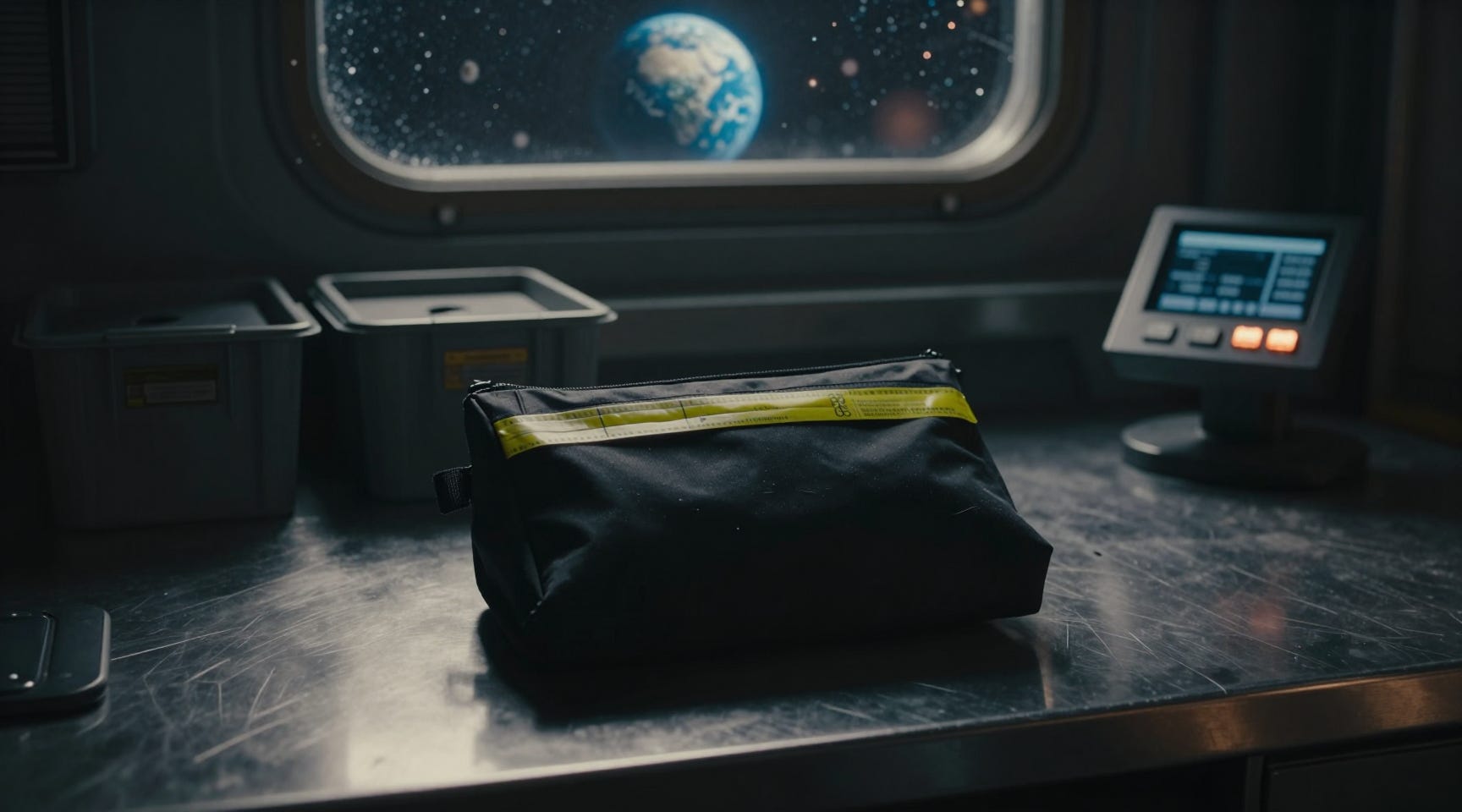
Inside sat a pouch made from black composite, edges sealed with a thermal weld. The seam had melted unevenly, warped by heat. A salvage crew had done the best they could with a field cutter and a prayer.
A second sticker covered the clasp.
RETURN ONLY. NO AUCTION.
Her throat tightened.
She logged the pouch, then slid it into the inspection cradle. The cradle rotated it under a ring of sensors that mapped residue profiles and radiation. Numbers climbed and settled. Most readings landed in the green. The last one hovered, then dropped.
Safe enough.
The station was quiet at this hour. No meetings, no briefings, no loud arguments in the hallway outside Effects. Luna Station Alpha ran twenty-four hours a day, like a heart that refused to stop. The night shift had its own rhythm: soft footfalls, muted radios, the distant cough of pumps.
Agnieszka broke the seal.
The pouch opened with a reluctant tear, adhesive stretching before giving up. She kept her movements slow. Protocol loved slow. Protocol loved labels, checkboxes, and hands that never trembled.
A folded cloth came out first. It had been white once. Now it carried a faint gray stain, as if smoke had settled into the fibers and decided to stay.
A second item followed, heavier. A metal tube, thumb-length, capped at both ends. A memory canister.
Agnieszka set it down and stared at it until the ache behind her eyes sharpened.
No messages. No recordings. No last words.
The instruction sat in every training module, every printed placard in Effects. The same line appeared on the salvage tags that arrived from Earth orbit, from ruined stations, from burned-out corridors in cities with names people whispered.
Somebody always tried to hide a goodbye.
The system could not afford a flood of them.
Her terminal prompted: OPEN CONTENTS. VERIFY OWNER. PACKAGE FOR RETURN.
The owner record loaded with a delay. The station data link to Earth ran through a relay chain that had been rebuilt twice since the invasion. Bandwidth was rationed like oxygen.
The name field populated.
Kamil Z.
No surname.
No citizenship.
Status: Missing.
Agnieszka’s mouth went dry.
The invasion had given humanity numbers too big to hold. Warsaw had given her faces.
Kamil.
The canister sat in front of her like a dare.
Her glove hovered over it. The terminals in Effects did not have audio output. They had no speakers, no easy way to play a voice. The station had been designed that way on purpose.
Agnieszka pulled up the return guidelines. The document scrolled past, crisp and cold.
Personal effects recovered from salvage operations will be returned to verified next-of-kin when possible.
Unauthorized media will be destroyed.
Everything about the line sounded reasonable until it reached her desk.
She slid the canister into the reader.
The terminal did not play anything. It only displayed a file header.
AUDIO. 00:26.
Agnieszka’s pulse kicked.
Twenty-six seconds.
Not a speech. Not a confession. A pocket-sized human thing.
She could flag it as unauthorized and watch it disappear into a shred queue that ran straight into the station’s incinerator. Nobody would question her. Protocol would thank her.
The terminal asked for disposition.
DESTROY.
RETURN.
HOLD FOR INVESTIGATION.
Her tongue pressed against her teeth. The taste of metal lingered. The air recycler near the ceiling clicked, then settled back into its steady whisper.
Agnieszka opened the cloth again, unfolding it over the desk.
A child’s shirt.
The fabric carried a stitched patch near the hem: a cartoon rocket with a crooked flame. Somebody had sewn it by hand. The stitches wandered, then found their way. The patch was faded from too many wash cycles, the kind people did in buckets when machines stopped working.
Agnieszka’s hands went still.
The station lights did not flicker here. Effects had its own circuit, isolated from the rest of the deck. People in this wing did not get to blame ghosts in the power grid.
Her mind offered a memory anyway.
A boy in line at Warsaw. Dark hair matted with sweat. A plastic toy rocket in his fist. The toy’s tip had been chewed to a blunt nub.
Kamil.
Her throat tightened until swallowing hurt.
Agnieszka clicked into the owner record again. The database returned a note in the comments field.
Refugee processing, Warsaw Corridor 17. Guardian: Ewa Z.
Agnieszka leaned back in her chair. The metal legs of it complained.
Ewa.
She had given Ewa a ration card once. The card had been printed on cheap polymer and stamped with a seal that meant nothing outside the city. Ewa had held it like it was gold.
The boy had been asleep against her shoulder, head tucked into the hollow of her neck.
Agnieszka had envied her.
Not the hunger, not the fear. The simple weight of a small body trusting somebody enough to sleep.
The terminal pinged again, impatient.
Disposition.
Her glove reached for the DESTROY option, stopped, then drifted away.
Agnieszka opened a new form: RETURN PACKAGE CONTENTS.
Item one: textile, child’s shirt, white, patch present.
Item two: unknown media canister.
She hesitated, then typed a third line.
Item three: transcript.
The cursor blinked at her.
No transcript existed.
Not yet.
Agnieszka pulled a thin slate from the drawer under her desk. The slate was old, corners chipped, screen scuffed. It had no network connection, no upload path. The station issued them for offline paperwork and nothing else.
She loaded the audio file into an air-gapped decoder.
The slate warned her.
UNAUTHORIZED MEDIA.
Agnieszka accepted.
The decoder produced text. Imperfect. Enough.
The slate filled with words.
Ewa. Mama.
The decoder struggled with the next line, then corrected itself.
I found your ring.
Agnieszka’s chest tightened.
I kept it safe.
A pause, marked by a blank line.
Tell Kuba I did not forget his joke.
Another pause.
I am sorry.
The last line arrived like a drop of water on hot metal.
I love you.
Twenty-six seconds, turned into six short sentences.
Agnieszka stared at them until the letters blurred.
The station did not allow her to print without logging a reason code. The return packages had to be sealed under camera, stamped, and scanned. Every gram that left Luna Station Alpha carried a story of theft, fraud, or grief.
Her fingers hovered over the slate.
Protocol would not let her send a message.
Protocol would let her send paper.
Agnieszka copied the transcript into the return form. She changed the label.
Item three: documentation.
She attached a compliance code, the kind used for medical inserts and hazard warnings. Nobody checked those too closely. Nobody wanted to.
Her heart hammered in her ribs as she finalized the package. The desk camera watched. The terminal recorded. The station accepted her signature.
Agnieszka slid the child’s shirt back into the pouch. The fabric folded small, like it wanted to vanish. She placed the transcript behind it, then pressed the pouch shut.
A sealing strip waited in the bin.
RETURN SEAL.
The strip carried the station’s emblem: a circle, a line, a small star. It meant Luna Station Alpha had done its part. It meant the package would be routed through whatever remained of the Earth logistics net and delivered if somebody could find Ewa Z.
Agnieszka smoothed the strip over the seam.
The adhesive gripped.
The terminal flashed CONFIRMED.
Agnieszka sat back and held her hands above the desk, palms down, as if keeping them from shaking.
The package sat in front of her, sealed and silent.
The station’s pumps kept breathing.
Somewhere below, somebody worked on Fold Drive components recovered from the same debris field. Engineers chased the future with tools that still smelled of war.
Agnieszka touched the pouch one last time.
The return seal felt warm under her glove.
Nobody would call it heroism.
The story would not make a report. It would not make a headline.
Agnieszka logged the bin as ready for outbound and pushed it onto the conveyor.
The belt carried it away, smooth and steady.
The terminal cleared her desk for the next docket.
SP-LSA-2126-04420.
Category: Personal Effects.
Agnieszka kept her gloves on.
Author’s Note: Luna Station Alpha becomes a quiet crossroads in the early recovery years, when humanity starts turning wreckage into tools and grief into procedure. This story lives in that small gap between salvage and survival.