


Kavita Nair opened the return petition with two hundred eleven signatures and set about removing the ones that could not stand.
The chapter office held a single desk, four wall rails, and a workforce roster she could pull apart line by line. She hooked one boot under the restraint bar and ran the verification filter at its strictest setting. Three names carried duplicate credentials. Two more belonged to memberships that had lapsed before the collapse. One rigger had signed twice, once under a shift alias and once under his legal name, the second-income field still active beside both entries.
Each removal weakened the thing she was required to respect.
Names she knew moved past under the filter. A loader from the family supply queue. A woman who had stood the recovery rotation with Lena and come out of 3-Bravo carrying effects bags. A welder whose partner worked the same clinic that had received the dead. None of them had signed out of weakness. They had signed because the arithmetic in their households ran ahead of the arithmetic on the spine.
“You can send the whole sheet back,” the recording steward said. He anchored himself to the rail beside the desk, his slate already open to the rules of order. “Three duplicates. Nobody on this station would fault the challenge.”
“The duplicates come out. The petition stays.”
“It reopens the tunnels.”
“It reopens inspected tunnels. Those are different sentences.” She flagged the rigger’s double entry and left his legal signature in place. “Strike the invalid names. Count the rest.”
The filter returned two hundred four. The forum threshold was one hundred ninety.
She had wanted a fault large enough to spare her the next two days. The petition had not given her one. A challenge over three duplicates would have made her the same office she had spent nine days refusing to become, the desk that settles a question by controlling who is allowed to ask it. The strike fund held eight more daily allocations if the promised transfers cleared, five if they did not. Every signer on the cleaned sheet could read those numbers as well as she could.
She scheduled the forum for the next shift change and published the notice on both channels.
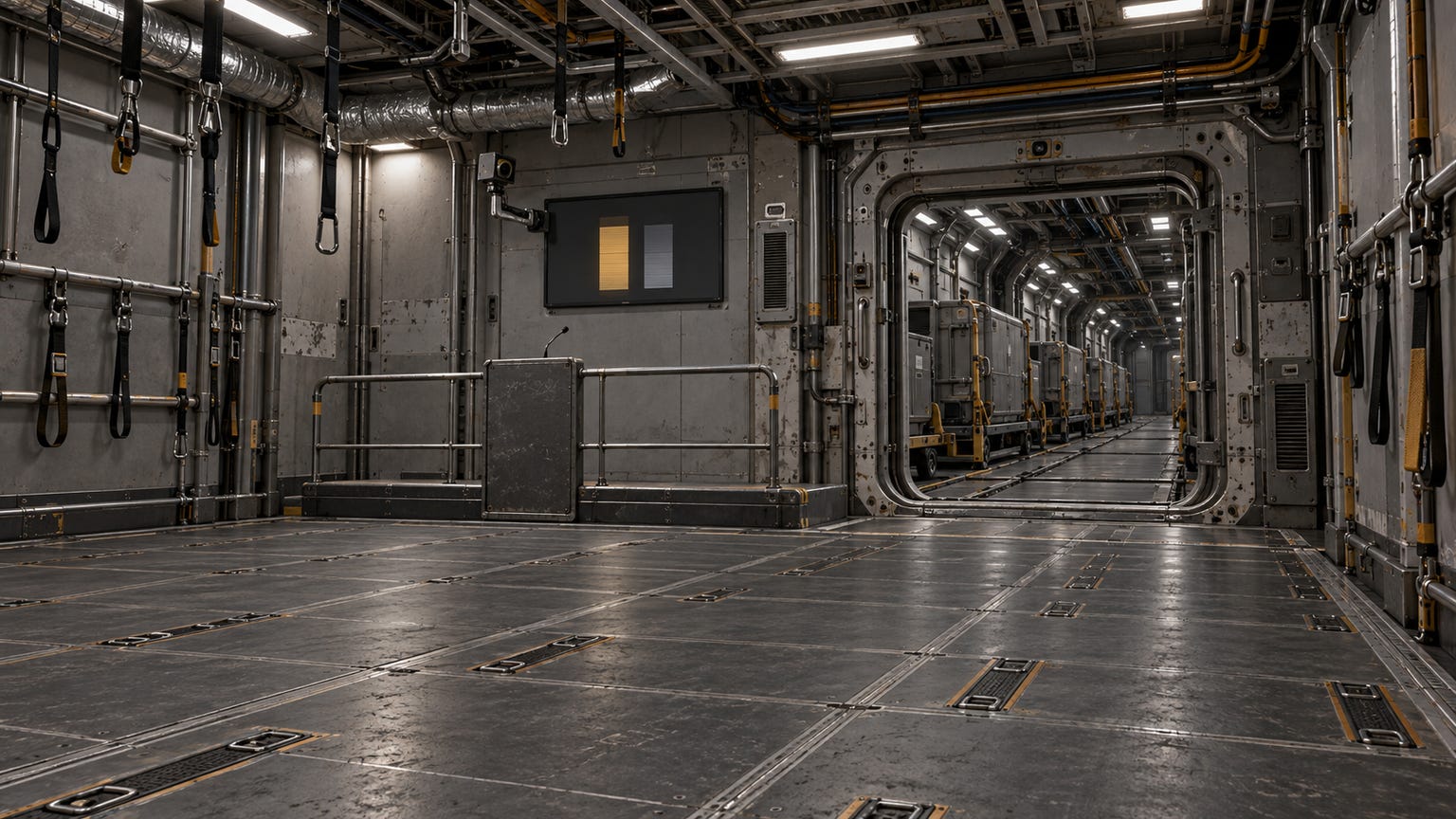
The forum bay took the shape the strike vote had taken. Hundreds of boots locked to the floor grid. Others clipped to wall rails and overhead straps, tethers crossing in the orderly lattice that low gravity demanded of any crowd. A camera arm held its station above the speaking rail. Kavita had authorized the record herself. A closed count could be denied later. An open one could be read by anyone, including the people who wanted the chapter to look like a seam about to split.
She took that risk with her eyes open.
The steward who had filed the petition spoke first. She kept her argument to the calendar. Inspected tunnels reopened under joint watch. 3-Bravo sealed. Talks continued with the line intact underground instead of stalled on the spine. Wages returning to households before the fund emptied. She named no villain and asked for no surrender. She asked for time the strike did not seem able to buy.
Then the father, anchored near the front, a household slate clipped to his belt.
“I signed the six demands,” he said. “I signed them again when Kavita read them in this bay. I believe every word of them still.” He turned the slate toward the nearest rows, then thought better of the gesture and held it against his chest. “My housing grace ends in six days. My partner’s hours went with the mill schedule. I am not asking anyone to be brave for me. I am asking whether we can hold a thing we cannot win.”
Nobody answered him with a slogan. Kavita had asked for that much before the doors sealed, and the bay honored it. A rigger two rows back said she would give up her own grace period before she reopened a face on a summary. She said it without heat, and the man did not argue. Two true things could stand in the same room without one of them being cowardice.
The room carried the strain in its quiet. Nine days of held wages sat in it, alongside the two injured miners still in Ayanda Molefe’s ward and the inner shift that had come out under recovery procedure instead of on their own boots. The petition had not invented that pressure. It had given it a ballot.
A voice from the rail lattice put the question to Lena.
“You read rock better than anyone here. Tell us plainly. Can any tunnel be made safe?”
Lena Vasquez unclipped from her strap and brought herself to the rail with two controlled pulls. Dust still marked the seams of her coveralls.
“No,” she said. “Mining is risk. The rock moves whether we approve of it or not.” She let the words settle. “Risk is not the same as permission to hide risk. A tunnel is safe enough when the people inside it can stop the work and be believed. We do not have that. An inspection run by the chain that recoded the hold will tell you the tunnel passed. It will not tell you who decided what passing means.”
Kavita brought the proposal onto the shared display and read it to the room the way she read a manifest, clause by clause. Reopening criteria. Joint-watch composition. The sealed status of 3-Bravo. Then the section on records.
The proposal asked for inspection summaries delivered to the chapter after each reopened shift.
It did not ask for the unedited logs.
A control light on the record feed changed state. Ji-woo Han had taken one of the remote seats the safety engineers were owed, a name and an open channel with no camera behind it. Kavita reached the records clause, spoke the word summaries, and the light went dark. Ji-woo had closed the connection.
Kavita did not name her. A summary was the recoded hold in cleaner language. Anyone who had held the original knew how much a summary could leave out, and how quietly.
She called the vote by anchored show and open credential, both counted against the record.
Two hundred four petitioners had brought the question. The chapter answered it with more than eleven hundred credentials logged across the bay and the remote seats. Conditional return failed. The count held it under by seventy-one.
The strike vote nine days earlier had carried by more than four times that gap. Seventy-one was not a mandate for anyone. It was the width of a chapter under load, measured in the open where load could be seen.
Kavita published the result before she left the rail. Total for. Total against. Abstentions. The seventy-one sat in the record where any reader could find it, Helios counsel and Fleet Construction and whoever else measured a chapter by the width of its seams.
“The petition does not pass,” she said. “The signers acted inside their rights, and the chapter thanks them for asking in the open. The six demands stand. The line stands.”
She spoke the motto once, because seventy-one people needed to know the count had not read them out of it.
“In vacuum, we stand together.”
Outside, the line reformed along the access spine. Boots found the floor strips. Tethers clipped to the rail posts in the pattern nine days had worn into muscle. The chain held its shape.
It held its shape with gaps in it. A space where the father had gone back to a household slate. A space where a rigger had gone to think. Seventy-one people standing somewhere other than the spine tonight, some of whom would return by the next shift and some of whom she had no promise from at all.
Kavita clipped her tether to the nearest post and took a place in one of the gaps. The empty cars waited beyond the checkpoint. The air moved past the line the way it had every day since the first step out.
She left the count published behind her. A chapter that could be read could be divided by anyone patient enough to study it. Standing at the rail, she had decided the alternative was worse. A line that hid its own seams would break at them in the dark, and no one would see the break coming.
If you enjoyed this story, you can follow the main story arc in The Exodus Rush, the first book in The Vethrak Requiem series.